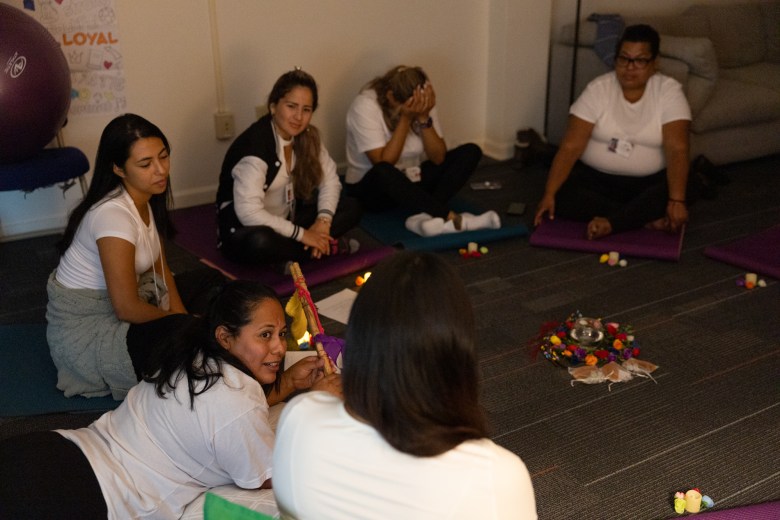
On a Friday morning in early September, a group of women sit cross-legged facing small candles and flowers in a softly-lit birth training room in Hartford. Six of the women form a circle around a pregnant woman, who is just a month away from giving birth.
The group is there for a ceremony meant to transmit feelings of peace and safety to the mother-to-be. Zaza Robles, a 35-year-old Hartford resident who is originally from Peru, leads the meditation. She asks the other participants to take deep, slow breaths and repeat affirmations for the guest of honor.
Robles, who was an obstetrician in Peru for eight years, and the other five women forming the circle are doulas-in-training at the community doula program, run by the Hispanic Health Council, or HHC, and funded by the Connecticut Health Foundation and Hartford HealthCare.
The training is conducted entirely in Spanish, and aims to address a major maternal health gap in a city where over half of residents who give birth are Hispanic, according to the latest report from the state Department of Public Health.

A doula’s work consists of educating, informing and guiding the person who is or will get pregnant. They do not provide medical services. As a doula, one can specialize in prenatal care, labor and postpartum care, or all three.
“The doulas coming out of this program can be the ones advocating for the Spanish-speaking pregnant women, connecting them with resources and in the hospital. Imagine waiting nine months to give birth and you end up being ignored, and not being told things because, ‘Oh, she won’t understand.’ Discrimination is evident at the moment of care,” Robles said.
During the ceremony, the doulas warned the future mother not to be surprised if her nipples darken, as this happens so the baby, born with blurred vision, can find them and feed himself. They also taught her what types of massages her partner can perform to ease the pain of contractions, and they practiced breathing exercises together to prepare for when it’s time to push during a natural birth.
The event marked the end of two months of theory classes, which covered topics ranging from pregnancy physiology, nutrition, breastfeeding, and racism in the health care system for women of color.
Next, the doulas will complete in-person practices at Hartford Hospital. After getting certified, the women will be able to start their own businesses and provide services to the Hispanic community.
Bianca Noroñas, director of the maternal and child health center at HHC, runs the training and teaches the theory classes. She said the program aims to train people from the community to fill the gaps in maternal health needs.
“We’re creating this workforce of people from our community so they can pursue additional careers, if they’re already professionals, or begin pursuing one if they haven’t had any education. We’re also building a workforce that allows them to learn about and explore public health,” Noroñas said. She herself has worked as a doula — first in Puerto Rico, where she grew up, and then in Connecticut.
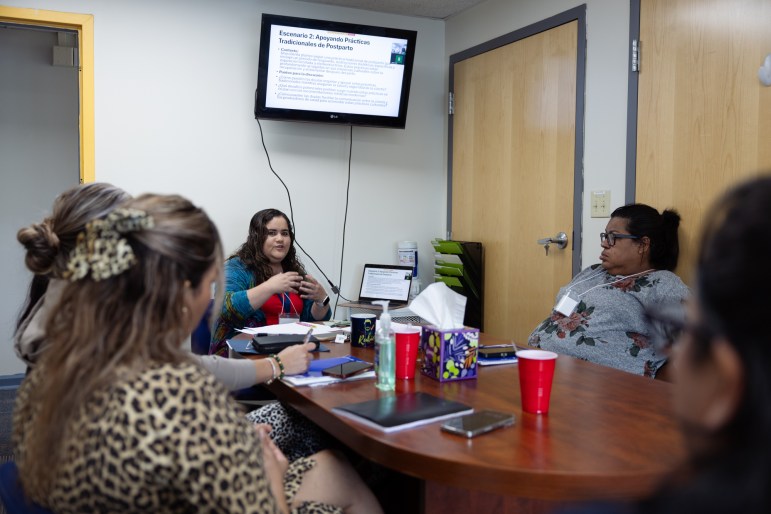
The women in the program represent different parts of Latin America. Robles, Ximena Chavez, Gloria Gavidia, and Angela Rivadeneyra are from Peru, while Yisenia Martinez is from Puerto Rico and Deicin Garcia is from Mexico. All of them are mothers themselves. Some have been in Connecticut for many years, others just migrated two years ago. They are united by the opportunity to accompany Hispanic women in Hartford to have a dignified birth.
In the United States, there are studies and research that explore and quantify the benefits of having a doula during pregnancy. One of the most recent, which analyzed data from women with Medicaid doula services between 2014 and 2023, showed that these women had a 47% lower risk of cesarean delivery, a 29% lower risk of premature birth and 46% attended postpartum checkups.
Over the course of these two months of classes, the doulas formed a clear sorority bond among themselves, along with Noroñas. Being mothers, there were days when they would bring their daughters or sons to class and take care of them together. While one sat the other’s child on her lap and whispered a song, another opened cookie wrappers for the child to eat.
Several of the women applied to the doula program because they find that work necessary in Spanish for Hispanic women in Connecticut. Also, during their own pregnancies, there was no one to guide them through giving birth in a foreign country with a different health care system.
There aren’t many studies on pregnancy and childbirth experiences of non-English speaking women in the U.S. One of the few is the September 2018 Listening to Mothers in California survey, which found that of some 2,500 mothers interviewed, 10% of those who spoke Spanish as their first language reported experiencing unfair treatment because of their language.
“I know many pregnant women who were not treated well, they didn’t give them proper explanations, they left with many doubts, and unpleasant experiences,” Robles said.

When Robles moved to Connecticut in 2022, she had a daughter and was pregnant with her second child. She worried about the costs of giving birth, as she was unfamiliar with Medicaid, known as HUSKY in Connecticut. Now, in addition to participating in the community doula program, she works with the Comadrona program of the HHC, which provides support services to pregnant women, and three years ago helped her secure health insurance and find a place to give birth.
“I would have loved to have a doula, because I practically gave birth alone. My husband was there for the C-section, but had to go to work right after,” Robles recalls. “My sister-in-law was caring for my baby and had to take time off from work to stay with my little one.”
Noroñas said it has been quite complex to educate the Hispanic community in Hartford about what a doula is and how they support new mothers. Sometimes, doula work is confused with the emotional care that people in a traditional family — such as a grandmother, sister, or aunt — provide without pay. But when these women immigrate to the U.S., they are often single or with a partner and lose the family unit that usually supports them during pregnancy in their countries.
“Many mothers here are alone in the postpartum period, during labor and even during prenatal care,” Noroñas said. “A doula could be the support that the mother needs during such an important time.”
Gavidia, who is part of Noroñas’ program, gave birth with a doula in the U.S. Many of the doulas-in-training like her come from families where women were involved in reproductive health in their countries. Her grandmother was a midwife and clandestinely distributed condoms in Peru to mothers who no longer wanted to have more children.
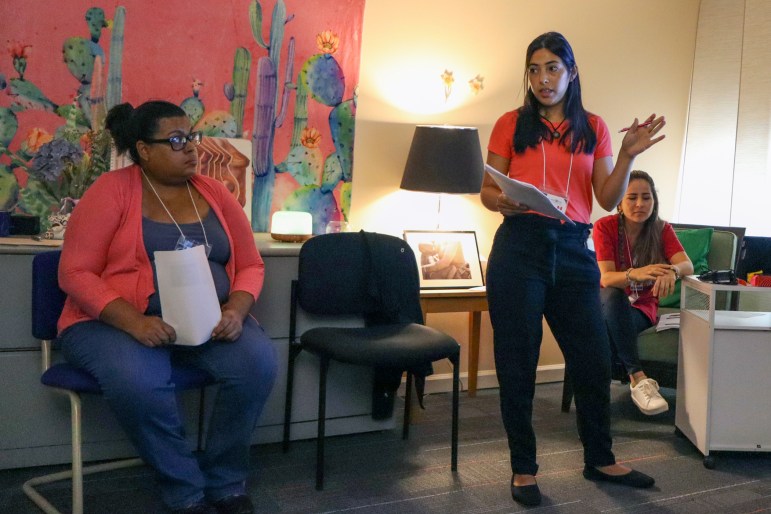
When Gavidia learned she was pregnant, she started researching and decided to find a doula due to the lack of a support network she had. Now a nursing student, Gavidia saw the doula program as an opportunity to offer support to women and complement both her clinical and emotional expertise.
“I’m going to be a doula because I know that many women in my community aren’t properly informed. They aren’t told about the power of doulas and the control they can have during birth, in hospitals, and even during medical appointments,” Gavidia said. “I also want to include fathers so they can be more present throughout the entire process.”
The next cohort of the doula program at HHC is expected to begin in October. Anyone with a high school diploma and over the age of 18 can apply. Those interested in applying can email Noroñas at biancan@hispanichealthcouncil.org.