


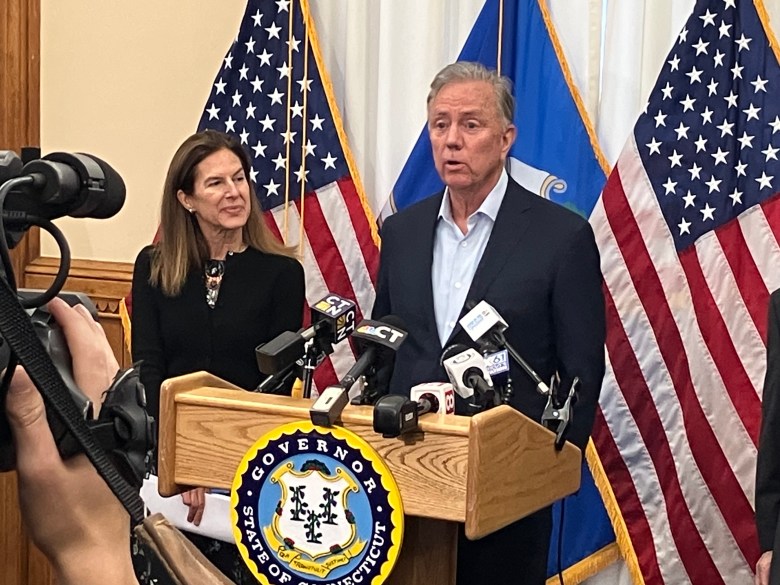
Gov. Ned Lamont outlined plans Monday to reserve $500 million in state funds for imperiled federal human service programs while reaffirming his pledge to preserve November SNAP benefits.
But it remained unclear how far Connecticut will spread that fund, equal to one-fifth of last fiscal year’s historic $2.5 billion surplus.
Will it only safeguard services jeopardized by the federal government shutdown, which could be ending soon? Or will it also offset permanent cuts imposed last July by Congress and President Donald Trump?
Among those cuts are new SNAP working requirements that could leave about 36,000 Connecticut residents without aid between Dec. 1 and March 31.
“We’re here to announce a Federal Emergency Relief Fund,” Lamont said during a late morning press conference, noting the $500 million would be used to bolster the Supplemental Nutrition Assistance Program, other food aid, heating and energy assistance grants and other human service initiatives. “I’m really pleased that we’re able to come to this position and give citizens of Connecticut some confidence and comfort. We’re there. We’ve got your back.”
House Speaker Matt Ritter, D-Hartford, one of several legislative leaders who joined Lamont at the announcement, predicted the fund would enjoy strong bipartisan support when the state legislature comes into special session on Wednesday and Thursday. He particularly praised House Minority Leader Vincent J. Candelora, R-North Branford, for publicly urging the use of state funds to roughly 360,000 Connecticut residents who would continue to receive SNAP benefits.
“In Connecticut,” Ritter added, “you have a culture where people of all parties said, ‘Enough is enough.’”
Legislators are expected to vote Wednesday and Thursday to create a short list of federally funded social programs — involving nutrition, health care, energy assistance and more — that Lamont could add to, drawing from this $500 million response fund.
Most of the rest of that $2.5 billion surplus will be used to pay down state pension debt, though portions already have been assigned to increase the rainy day fund and to boost a long-term effort to increase child care statewide.
Under the legislation expected to be adopted in the special session, only the governor could recommend specific appropriations from that response fund, legislative leaders said, but a panel of the six highest-ranking state lawmakers — including four Democrats and two Republicans — could block any expenditure with a simple majority vote.
The fund would expire when the regular 2026 General Assembly session starts Feb. 4, and any unused dollars would also be used to pay down pension debt.
CT officials hopeful that shutdown ends soon, but nothing’s certain
State officials said they assume the federal government shutdown that began Oct. 1 will be over well before early February but conceded little about that saga is easy to predict.
An end appeared in sight around 1 p.m. Friday, when the Trump administration announced federal funding for food assistance would resume immediately — even though the president still was fighting states’ efforts in federal court to secure funding.
But later that day, the U.S. Supreme Court ordered the federal government to pause any further payments. In addition, the Trump administration ordered states on Saturday not to provide full SNAP benefits for November.
Connecticut did not follow the directive, and Lamont said the state will cover the entire cost of SNAP benefits for November, about $72 million, if necessary, using this new fund lawmakers will create this week.
Meanwhile, the shutdown appeared to be nearing an end Sunday when eight Democratic U.S. senators broke ranks and agreed to support a temporary federal funding resolution. Congressional leaders said votes could happen early this week, The New York Times reported.
Democrats, who are in the minority on Capitol Hill, had been united against adopting a new federal budget unless Republicans restore health insurance subsidies set to vanish Jan. 1.
That subsidy cutback represents an estimated $340 million annual hit to Connecticut residents who buy insurance on the state’s health exchange.
“I’m very hopeful that the feds are going to come up with a solution that doesn’t penalize our people,” Lamont said. But he added, “I can’t make any predictions about the federal government.”
Will Lamont use CT dollars only to temper pain of fall shutdown?
If the shutdown ends soon, the lion’s share of the $500 million emergency reserve fund would still be intact.
Even if the Trump administration is allowed to penalize Connecticut for using state funds to support SNAP, the $72 million in monthly program costs represents just one-seventh of the fund.
The state is advancing smaller sums of money to replace stalled federal funds in the Special Supplemental Nutrition Program for Women, Infants and Children — commonly known as WIC — and in a key winter energy assistance program. But Washington already has indicated it will reimburse states for any funds they advance to keep both initiatives afloat during the shutdown.
But the General Assembly, where Lamont’s fellow Democrats are in the majority, began planning a state emergency response fund to offset federal cutbacks last June — almost four months before the federal shutdown.
State legislators had anticipated problems not only from a federal budget standoff but from a major package of federal program cuts that were debated by the GOP-led Congress in early June and passed on July 1.
Those cuts directly affect about 36,000 immigrants, young adults, veterans and people experiencing homelessness who no longer meet new, stricter work requirements for SNAP benefits. They are expected to lose coverage between Dec. 1 and March 31.
And that won’t be changed by the federal shutdown ending.
“As of right now, Connecticut is well-positioned to make sure that these hardships are just going to be dealt with,” said Senate President Pro Tem Martin M. Looney, D-New Haven.
Lamont, who committed state funds Friday to restore SNAP benefits that Washington had stalled seven days earlier, drew criticism from legislative leaders from both parties who wanted him to act sooner.
Would the governor use the state response fund to help groups harmed by last July’s federal program cuts, such as this portion of the SNAP population?
“I think it’s something we’re looking at,” he said, adding that he also would explore options to work with federally qualified health centers to assist households losing health insurance premium subsidies.
GOP leader cautions Lamont not to exceed his authority
But even if he appeases his fellow Democrats in the General Assembly and does more to backfill vanishing federal funds for human service programs with state dollars, he could annoy Connecticut Republicans in the process.
GOP leaders here support using the state surplus to ease temporary pain caused by the federal government shutdown. But when Washington cuts social programs permanently, the Connecticut GOP says, state government should be wary about stepping in.
And if Connecticut wants to spend more to pick up services Washington is dropping, Lamont and the General Assembly should find offsetting spending cuts elsewhere in the state budget, they say.
“Obviously there’s a leap of faith here,” said House Minority Leader Vincent J. Candelora, R-North Branford, who also attended Monday’s press conference. “We are putting $500 million into the hands of the governor to mitigate this crisis, and we need to make sure that he is doing just that.”
Candelora already was rankled Friday when the governor committed state funds to support SNAP after legislative leaders from both parties had spoken in favor of the concept but before lawmakers formally had voted to create the response fund.
“Unless the governor thinks he’s filed paperwork to run for king of Connecticut, that’s not possible,” Candelora said Friday.
Lamont countered Monday that “timing is important,” and action was needed Friday.
“Look at how desperate people were last week,” he said. “Look at the lines. They’re like bread lines from the Great Depression. People were scared. I wanted to do everything I can to give them confidence.”
Candelora added he remains supportive of a response fund to address human service programs harmed by the shutdown but warned that if Washington resolves that issue before Wednesday’s special General Assembly session begins, more Republicans may vote against it.
“I helped craft this plan, and so I support it,” he said. “But I will just say, if the federal government reopens, I certainly can understand why Republicans will say this fund is no longer necessary.”