



When the legislative session ended in June, we celebrated several advancements for the state’s K-12 students. This included a recommitment to high-dosage tutoring, with increased funding for this Covid-recovery response.
The state also invested in more professional development for educators to implement best practice literacy plans in all districts, so that every student becomes a lifelong reader. Under the clear-eyed leadership of the Education Committee, the General Assembly crossed some important things off their to-do list. But key pieces addressing educational equity were left for another day.

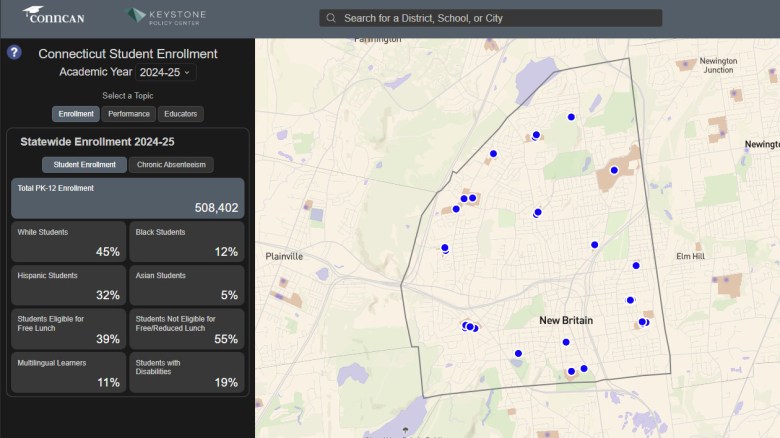
At ConnCAN, we recently launched a new, interactive map as a tool to help families, educators, policymakers, and state leaders visualize the current state of educational opportunity in Connecticut.
Our geographical borders tell a stark story of inequitable access to learning, despite our ongoing efforts to build a more just learning landscape. For example, in Bridgeport, where 27% of students are Black and 61% are Hispanic, only 16% of students are on track according to the statewide assessment in Math. Right next door, in Fairfield, which is primarily white, 72% of students meet that benchmark. That’s just one of myriad examples of educational inequity. As our map makes clear: we have unfinished business in public education.
This week, legislators reconvene for a special session which should include several bills and promises made to students last year. These items built broad consensus, promised real impact and nearly crossed the finish line earlier in the year.
Of those items left behind, legislators should pass measures to increase language access for families navigating their children’s academic journeys. They should also open pathways for prospective educators in Connecticut, so all kids can have a qualified teacher to meet their needs.
In 2023, advocates helped pass a Multilingual Learner Bill of Rights in Connecticut, ensuring that the rights of students and parents are protected and are shared in a families’ dominant language. Two bills that would have increased access and transparency for the families of multilingual learners stalled this year.H.B. 6477 would have required the state to make plans to translate government forms and applications into common non-English languages in Connecticut. Relatedly, H.B. 7009 would have expanded Connecticut’s public school information system to include data on the academic progress of students in bilingual education programs.
Connecticut prides itself on welcoming linguistic and cultural diversity, so families shouldn’t have to wait for these expanded protections and opportunities. Advancing these proactive measures in a special session would acknowledge the strengths that multilingual residents bring to Connecticut.
We all feel the impact of teacher shortages. S.B. 1513 would have addressed them by creating incentives for aspiring educators, making them eligible for existing teacher recruitment scholarship funds, teacher residency programs, recruitment grants, and loan reimbursements. It would have specifically expanded incentives for teacher candidates in shortage areas, or candidates who fall into underrepresented populations. Our failure to broaden eligibility keeps too many prospective Connecticut educators without a clear path to the classroom. We can fix this in a special session.
These aren’t abstract ideas. Language access helps families understand available services and opportunities, and to advocate effectively for their children. Stronger pipelines mean qualified teachers in front of students who need them most. Together with the state’s investments in high-dosage tutoring and literacy professional learning, they form a coherent approach: identify needs early, communicate clearly, support teachers, and deliver effective interventions.
While we understand that a special session is a limited opportunity to find consensus and pass legislation, we know that Connecticut students, families, and educators should not be moved off the agenda once again. Let’s use this special session to finish what we started: pass language-access and transparency for multilingual families; strengthen the teacher pipeline; and keep building a public-education system in which every student, no matter their address, has a fair shot at success.
Steven Hernández is the Executive Director of the Connecticut Coalition for Achievement Now (ConnCAN). He formerly served as the executive director of the Connecticut General Assembly’s Commission on Women, Children, Seniors, Equity & Opportunity.