


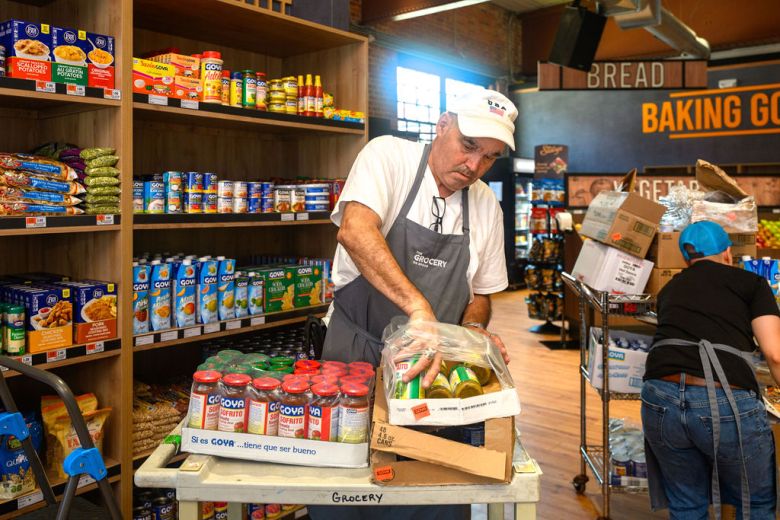
For the past year and a half, the Grocery on Broad has helped fill a gap for residents of Hartford’s Frog Hollow neighborhood.
In an area known as a “food swamp,” where food can be purchased but quality and healthy items are limited, the nonprofit grocery store has become a key source for fresh produce, meat and pantry staples, enabling families to buy foods they once needed to travel out of Hartford to get.
But the first week of November saw a change: Fewer shoppers came in to make purchases at the beginning of the month, usually the busiest time for the small grocer.
“There are definitely people who would normally be shopping who simply cannot,” said Ben Dubow, the executive director of Forge City Works, the nonprofit that operates the Grocery on Broad and Fire by Forge, a popular Hartford restaurant.
The change in traffic was the result of the 42-day-long federal shutdown, the longest in U.S. history. As congressional lawmakers grapple with funding the government, the pause in funding is having significant effects on the national economy, with thousands of federal workers furloughed or working without pay, flights grounded due to staffing shortages, and consumer spending slowing down as discretionary money dries up. Estimates from the Congressional Budget Office found that the shutdown could cost the US economy as much as $14 billion.
For Dubow, some of the biggest difficulties have come from changes to the Supplemental Nutrition Assistance Program, or SNAP. Once known as food stamps, the federal nutrition program supports some 42 million Americans — including 360,000 Connecticut residents — who cannot afford food, by supplementing the grocery budgets of low-income workers or in some cases, covering food costs entirely.
Federal funding for the program lapsed for the first time ever on Nov. 1, as the Trump administration argued that, with the shutdown in effect, it could not spend emergency funds to extend benefits into November.
With more than half of their shoppers reliant on SNAP, the lapse immediately raised concerns for Dubow and the staff of the Grocery on Broad.
In the short term, Dubow said he’s worried about what lower shopping activity could mean for both consumers unable to pay for much-needed groceries and for the store’s inventory, especially the fresh items that have spent a little more time sitting on the shelf instead of being used in fresh meals.
In the long term, he’s worried about what the lapse could mean for the economy, particularly the larger supply chain the store fits into.
“The food ecosystem is really complex and has a huge economic impact,” he said. “It helps create jobs and sustain jobs within an industry that actually can provide good jobs to people.”
That concern over SNAP funding has transformed into a sense of uncertainty in recent days, as federal courts have weighed in on the Trump administration’s argument that it could not fund SNAP in November. That argument has been found lacking as courts have called for the program to be fully funded, even as the administration continues to push back on doing so.
Connecticut officials, meanwhile, recently ended their debate over the best way to plug the funding hole, with Gov. Ned Lamont announcing last week that the state would immediately restore funds for SNAP recipients, enabling them to fully use their benefits in November. That money has already been disbursed even as the Trump administration tries to pressure states into pulling the funding back.
Nationally, the matter could end soon: In the past 48 hours, a Senate majority has moved to end the shutdown, with the House expected to vote this week.
Ending the shutdown would remove some of the worries that have weighed on Dubow recently. But, more broadly, the community he’s working to serve still faces longstanding issues around food security and affordability, issues that have been amplified as inflation and tariffs continue to eat into consumer spending and as SNAP faces federally-mandated changes that could push millions of Americans off of the rolls in the coming months.
The shutdown, he fears, could be a preview of issues likely to crop up in the future.
“We’re asking people to sometimes make life-and-death type decisions about where they’re spending their very limited dollars in a world where everything’s getting more expensive,” he said.
The SNAP lapse has had ripple effects on broader economy — including on those who aren’t in the program
In recent weeks economists have highlighted that SNAP affects more than those directly enrolled.
That’s largely for two reasons. First, SNAP contributes a significant amount of the money spent at grocery stores nationwide — roughly $8 billion a month according to some estimates. Second, SNAP money is well-known to have something economists refer to as a multiplier effect: for every $1 of SNAP money spent, it produces somewhere between $1.50 and $1.80 in economic impact.
Grocery stores are just one beneficiary of that impact. According to federal data from the U.S. Department of Agriculture, in 2023, SNAP benefits produced some $124 billion in sales at 262,000 retailers. Roughly half of that spending was at major retailers like Walmart, Kroger and Costco. An additional quarter was at supermarkets.
SNAP has an even bigger impact on small independent grocery stores in rural or food insecure areas, which often have a limited customer base and narrow profit margins. The consistent spending of SNAP recipients at these stores can be the difference between them staying open or shutting down entirely.
The National Grocers Association, which represents independent community grocers, acknowledged as much in a statement released last month. “With SNAP fueling over 389,000 American jobs and generating $1.54 in economic activity for every dollar invested in the program, grocers’ staffing and inventory are planned around benefit cycles,” said NGA President Greg Ferrara. “A lapse in funding could lead to reduced employee hours, perishable food losses and declining sales.”
In a region like New England, where roughly $364 million dollars of SNAP funding circulates through the economy each month, that loss could be expensive as families tighten their budgets even further to pay for groceries.
Even with restored SNAP benefits, headwinds remain
Restoring SNAP benefits won’t completely erase the issue.
Food prices have risen considerably, roughly 3.2% from August 2024 to August 2025, according to federal data. That inflation, along with the continued impact of tariffs on imported goods, means that people are spending more to keep their pantries stocked.
At the Grocery on Broad, prices are kept in check through a sliding scale discount system where shoppers self-report their income and are then given a corresponding discount on items purchased at the store. Dubow notes that in recent months, more people are coming into the store to take advantage of the discounts, a sign he says of a growing difficulty affording things.
And with the increased strain, Dubow said he is worried about the SNAP program. The program is slated for a number of changes as a result of the One Big Beautiful Bill Act signed into law in July; New work requirements and a looming shift of some administrative costs from the federal government onto states could force millions of people out of the program.
The pain is expected to be pronounced in Connecticut, with families in the state projected to lose an average of $200 a month in benefits under the changes — one of the hardest hits in the country.
A recent analysis from The Hamilton Project, an economic policy initiative at the Brookings Institution, found that the structural changes to SNAP will likely blunt the program’s ability to help the nation respond to recessions, as people will struggle to access benefits that could help them weather an economic downturn.
If that happens, the economic effects could be felt by a larger group than SNAP recipients alone — like the small businesses that serve many people who use SNAP to pay for food.
For now, Dubow is focused on supporting his store’s patrons and encouraging people across Hartford to take advantage of the Grocery on Broad. And he said he’s been encouraged by how the state government and a network of nonprofits and community organizations have addressed the funding lapse, working quickly to maintain access to food for vulnerable people in the state.
But he said he hopes that as the immediate SNAP crisis nears its end, more people begin to see how valuable the program is.
“This has targeted economic impact,” he said of SNAP. “When it goes away, the negative impact it has is not just on individuals who can’t eat and kids who can’t eat. It really impacts small businesses and farmers and the whole system.”
