



This story has been updated.
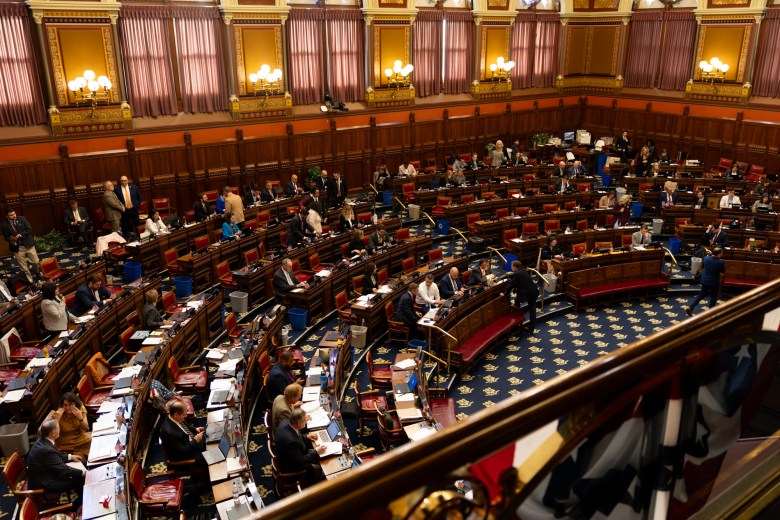
The state House of Representatives overwhelmingly approved a $500 million emergency fund late Wednesday to bolster social service programs threatened by the longest federal government shutdown in national history.
The House voted 126-20 to approve the bill following more than two hours of debate, with 28 of 48 Republicans siding with all 98 Democrats to back the measure. Because creating the emergency fund potentially could push Connecticut over its budgetary spending cap, the measure had to pass with at least a 60% majority, which meant at least 90 supportive votes in the House.
Given that the 43-day shutdown is nearing its end, the House debate was more a prelude of a larger discussion expected to continue for years: Should Connecticut tap its wealth to temper the deep, longer-lasting cuts to federal human service programs ordered last July by President Trump and Congress?
While many cutbacks to Medicaid don’t start for two more years, vanishing federal subsidies and stricter benefits rules threaten health care and nutrition aid for thousands of Connecticut households now.
“This bill is really about our job to protect our families, particularly in the wake of Washington’s failure to act,” said Rep. Maria Horn, D-Salisbury, co-chair of the Finance, Revenue and Bonding Committee, who added the shutdown “has wreaked havoc on households across our state.”
Rep. Joe Polletta of Watertown, ranking House Republican on the finance committee, who voted for the bill, said, “Our politicians in D.C., on both sides of the aisle, ought to be ashamed of themselves.”
But as Congress late Wednesday approved a temporary federal funding measure — allowing the shutdown to end in the coming days — Polletta added that, “I don’t think there’s going to be a need for this fund.”
“This government shutdown has ended,” said Rep. Gale Mastrofrancesco, R-Wolcott. “At the end of the day, this bill is not necessary at all.”
The measure the Democratic-controlled state House approved would set aside one-fifth of last fiscal year’s historic $2.5 billion state budget surplus to aid those harmed by the shutdown — or by any other federal budget cuts — between now and the start of the 2026 General Assembly session on Feb. 4.
The state Senate, where Democrats also hold a majority, will debate the emergency fund Thursday.
Gov. Ned Lamont, who already has announced his support for the measure, could tap this $500 million pool to bolster the Supplemental Nutrition Assistance Program, or SNAP, and six other human service programs. These include: a second nutrition assistance program that serves women, infants and children; school meals; winter heating and energy assistance; Medicaid; and federal child care and housing assistance grants.
Any of the $500 million that remains unspent by July 1 of next year would be used to retire Connecticut’s hefty pension debt, which exceeded $35 billion entering last fiscal year, according to Lamont’s budget office.
Is CT response fund needed with federal shutdown ending?
But just as Polletta and Mastrofrancesco questioned the need for any state intervention once the federal government shutdown has ended, others said Connecticut needs to do more for years to come — unless Washington reverses a dangerous trend of cutting back aid to states.
“The fact is that so many working people throughout this state struggled — prior to the federal shutdown, prior to the federal budget cuts,” said Rep. Brandon Chafee, D-Middletown.
“I know people in my community that are going hungry,” said Rep. Anthony Nolan, a Democrat from New London, one of the state’s poorest communities. “I know people in my community that are watering down milk to make milk last longer.”
“For people to say that there are no emergencies,” Nolan added, “that is ridiculous.”
The Trump administration since last spring has used a host of legal maneuvers to block health care, education, nutrition and other federal aid to Connecticut.
Majority Democrats in the General Assembly also began talking — months before any federal government shutdown — about tapping Connecticut’s coffers to offset the big cuts in federal assistance pursued by President Donald Trump and the GOP-led Congress.
The One Big Beautiful Bill Act, which Trump signed on July 4, ordered more than $1 trillion in spending cuts over the next decade to help finance roughly $4.5 trillion in tax relief — breaks aimed chiefly at high-earning households.
The bulk of those spending cuts involved Medicaid, an omnibus program that supports medical and behavioral health services, substance abuse treatment, and nursing home and in-home care. It also supports hospitals and federally qualified health centers that treat uninsured and underinsured patients.
Congress and Trump also imposed stricter work requirements that could remove about 36,000 immigrants, young adults, veterans and people experiencing homelessness from SNAP eligibility in Connecticut between Dec. 1 and March 31.
And starting Jan. 1, Washington will cancel subsidies that help people afford health coverage through through state-based insurance exchanges like Access Health CT. The cost to consumers here is projected at almost $300 million per year.
“Do we want to start thinking about hiring more people to make sure we can deal with Medicaid changes?” House Speaker Matt Ritter, D-Hartford, asked during a Wednesday morning press conference. “Do we want to put more money to Medicaid, potentially? How do you want to deal with SNAP benefits and the reductions that we’ve seen there?”
State Senate President Pro Tem Martin M. Looney, D-New Haven, said last week Connecticut should immediately explore options to help families cope with a huge, impending jump in health insurance costs.
But tempering ongoing federal cuts to Medicaid, SNAP and health insurance subsidies likely would require state appropriations of hundreds of millions of dollars year after year — not just diverting dollars from a temporary, $500 million emergency fund.
Many Democrats in the General Assembly have said Connecticut easily could afford to help. The state has used aggressive budget caps and savings rules in place since 2017 to force annual surpluses averaging more than $1.8 billion over the past eight years. That’s a total currently represents more than 8% of the General Fund.
Those surpluses, created by drawing dollars from health care, education, municipal aid and other core programs, have been used to retire state pension debt faster than Connecticut has in the past. But analysts say, even at this aggressive pace, that debt won’t be eliminated until well into the 2040s.
“It’s time that we re-examined how we do our budget in this state,” Chafee said, adding that asking one generation to solve a debt problem created by three is unfair. “We’re asking the current generation of taxpayers to pay off the whole bill. It’s ridiculous while people are struggling.”
Leaders of the General Assembly’s Republican minority said last week that Connecticut should tap its reserves to assist the state’s roughly 360,000 SNAP recipients who lost benefits when the shutdown entered its second month on Nov. 1. Lamont, who originally was reluctant to commit state dollars to fund those benefits, agreed to do so last Friday, and payments to households resumed Saturday.
Now, with the federal shutdown expected to end, not all Republicans in the state House said Connecticut can afford to drop its guard.
State House Minority Leader Vincent J. Candelora, R-North Branford pledged to support the $500 million response fund during a press conference prior to the House debate.
“What we are doing today points to a failure at the federal level,” Candelora said. “And we cannot have government holding individuals hostage to try to get what they want — either party — and it’s something in Connecticut we don’t do.”
Will Lamont tap CT’s coffers to protect social services, health care?
But Lamont will play a huge role in whether Connecticut taps it coffers — for even a few months, let alone for years to come — to replace vanishing federal aid for social services.
According to the legislation the state House passed, Lamont has sole authority to propose expenditures from that pool. But a 6-member panel of state legislative leaders — which includes the House and Senate majority and minority leaders along with the House speaker and Senate president pro tem — can block any spending with a simple majority vote.
The governor already has been using small amounts of funds from the state’s basic pool of operating cash, to replace stalled federal funding for nutrition assistance for women, infants and children and also for heating assistance. Connecticut had commitments from the Trump administration that Washington would reimburse any state dollars advanced in these areas after the shutdown.
In other words, that won’t cost the state anything.
Lamont did pledge last Friday to commit as much as $72 million in state funds, if necessary, to cover November SNAP benefits stalled by the shutdown. But he did so only after hundreds of thousands of SNAP recipients here already had gone one week with no benefits — and amid public appeals from legislative leaders from both parties.
The Trump administration announced Wednesday it would cover the November SNAP benefits costs promptly after the shutdown ends, Politico reported.
A fiscally moderate Democrat, Lamont has traditionally been wary of using state funds to supplement programs normally funded by the federal government.
When asked last week whether he would support a state-funded SNAP benefit to protect the 36,000 recipients affected by new work requirements, the governor said only that officials would consider it.
Will SNAP crisis boost support for universal free school meals?
Also Wednesday, advocates for Connecticut funding free school breakfast and lunch for all students said they hoped to use the recent SNAP crisis to build support for their cause.
Representatives of End Hunger CT and the American Heart Association appealed to state legislators to consider funding the service when the 2026 session resumes in slightly less than three months.
“The crisis over SNAP funding has highlighted the very real problem of food insecurity here in Connecticut,” said Amari Brantley, policy coordinator for End Hunger CT. “The restoration of federal funding is welcome, but Connecticut cannot ignore the working families who will continue to fall through the cracks.
Connecticut had offered free meals during the 2023-24 academic year but pulled back due to state budget constraints.
Advocates for universal free meals have said Connecticut could offset most or all costs of the program by establishing a sales tax surcharge on sweetened beverages.
“We know that one of the most effective solutions to food insecurity is feeding all the kids at school and we are encouraging lawmakers to support funding in the 2026 session,” Brantley added.
