This story has been updated.
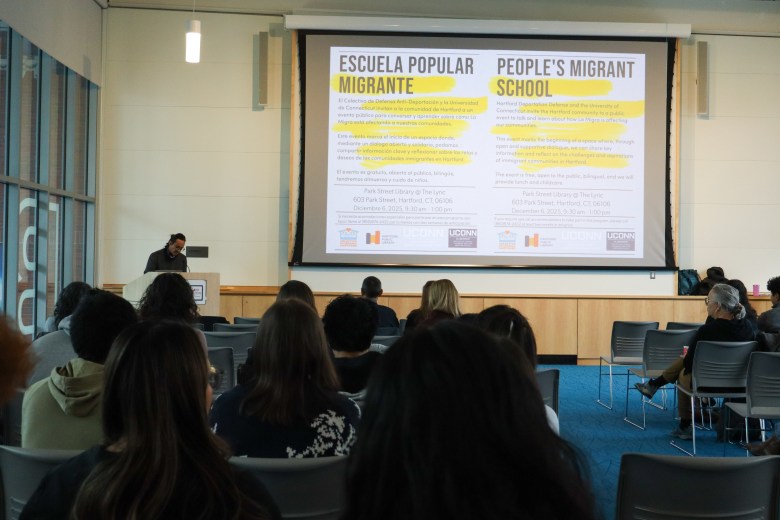
The University of Connecticut, along with the Hartford Deportation Defense, launched the first session of the new ‘People’s Migrant School’ in Hartford on Saturday, aiming to build bridges of collaboration between the university and the city’s immigrant communities.
“The idea is to have a political and social component in the creation of knowledge at the university,” said Camilo Ruiz, assistant professor of anthropology at the University of Connecticut.
On the second floor of the Park Street Public Library, Ruiz’s students presented their final projects in English to community members in Hartford, with simultaneous Spanish translation provided by Constanza Segovia, organizing director and cofounder of Hartford Deportation Defense and Connecticut For All.
The People’s Migrant School is an effort by Ruiz, with the support and collaboration of the Human Rights Institute and the Center for Latin American Studies at the University of Connecticut, to bring the classroom to the people. And also to focus the research generated by students in the ‘Latinx communities in the United States’ class, on creating tangible and useful information for neighborhoods in Hartford.

More than 150,000 people in the greater Hartford metro area are considered immigrants, according to the national census. This group is composed primarily of people who migrated from the Caribbean, South America and Central America. Two-thirds of them have resided in the U.S. since 2009 or earlier.
Ruiz said classes traditionally do not extend beyond the four walls of a university classroom, but this year he wanted to do things differently, given the multiple detentions of immigrants around the city.
“Since many of my students have migratory connections to the United States, I proposed to them changing the class format to something relevant that connects the university with the immigrant population,” Ruiz said.
Segovia advised Ruiz to have the students focus their projects on Connecticut and, if possible, on Hartford. This led to the creation of seven different projects with one-page printed infographics in English and Spanish, which were distributed at the event.
Saturday’s presentations covered topics such as the history, recruitment and infrastructure of national immigration agencies, the Trust Act, and a short film that offered a mother’s perspective on immigration raids.
Two presentations were about ‘Know Your Health Rights’, where students outlined strategies to mitigate risks, like having photocopies of medical prescriptions, a list of their medical providers and medical records.
For some students, like Nicole Samaniego, the project was more than just a class assignment.
“I don’t have the luxury of separating this project from my personal life. My family is immigrant, and this information we presented is so important to me,” said Samaniego.
Student Beatriz Torres explained that this project is an attempt to connect with communities and what happens in their daily lives outside of the university campus.
“If you walk around the university campus, people act like nothing is happening, and that’s a privilege,” Torres said.
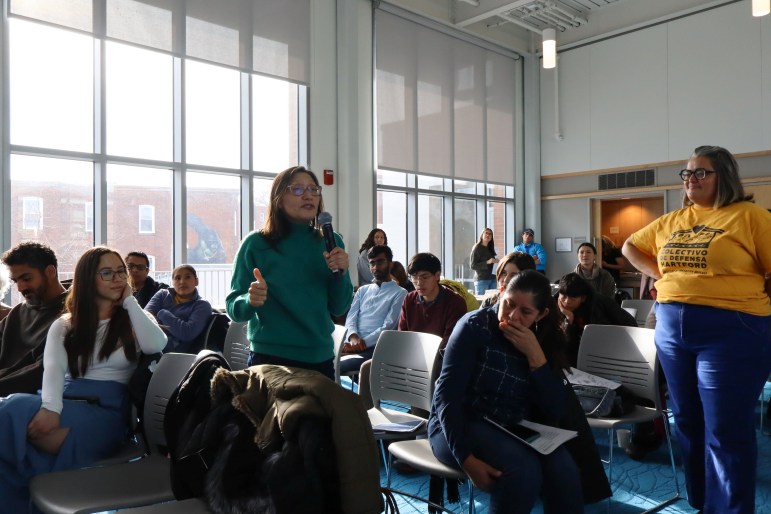
After the presentations, there was a time for dialogue and reflection with the audience, which included Hartford residents, professors and community activists from the immigrant community, such as Ruth Valera, a member of the Hartford Deportation Defense.
Valera asked the audience if those who had gone to the Capitol to support them when they testified in favor of HUSKY for Immigrants, the Trust Act or for more protections for immigrants could raise their hands. Less than 10 people in a room of more than 80 did.
“It wasn’t easy speaking in English to politicians in suits, who are mostly white, right?” said Valera, looking at the people who had testified with her at the legislature. “It’s not easy to be heard; it’s intimidating sometimes, but we’re going to keep doing it, and we need you to join us.”
Ruiz plans for the community school to be a recurring community classroom each semester. For now, this was the first of what he hopes are many.
Clarification: A previous version of this story said there were more than 40 people in the room at the event. There were more than 80 people in the room.
Correction: A previous version of this story incorrectly reported that 150,000 immigrants resided in Hartford. The number represents the population of immigrants in the greater Hartford metro area.