


Facing strong headwinds in the midterms, the Connecticut Republican Party opened a digital advertising campaign Monday with a 1-minute video portraying Gov. Ned Lamont, a wealthy Democrat seeking a third term in 2026, as indifferent to the high cost of living in Connecticut.
The piece offers a mocking twist on the Lamont administration’s light-hearted marketing campaign declaring “Connecticut home of the pizza capital of the United States,” a boast on social media and on some highway signs at the Connecticut border with New York.
“You know, Ned Lamont is, we think, channeling his inner Marie Antoinette and [saying] ‘Let Connecticut eat pizza!’” said Ben Proto, the chair of the Republican Party.
Proto said the campaign, at least initially, would be “mostly organic, our social media.” The state GOP has not been a reliably effective player on social media, unable or unwilling to engage in posts with the potential to go viral, fueled either by humor or outrage.
The piece was shown to reporters at 1 p.m., copies provided on thumb drives — not online. The video was not posted on the party’s Facebook or Instagram pages for nearly four hours. It did not appear on the party’s rarely updated X account.
It can be seen here. on the GOP’s Facebook page.

Proto said the party was ramping up with the start of 2026, when the governor, the other statewide constitutional officers, the General Assembly and the U.S. House delegation will be on the ballot. He said the party was quick to defend the Trump administration’s arrest of Venezuelan President Nicolas Maduro against criticism from Connecticut’s Democratic senators and one of its congressmen.
“We’re doing far better on social media,” he said.
Proto was elected in June 2021 as state party chair, an increasingly ill-defined job in an era when political power and influence has migrated to Super PACs — even more so in Connecticut, where the GOP controls no levers of government and has been unable to win a congressional race for 20 years.
“What I’ve really learned over the last four and a half years is what my job is and what the job of this party is,” Proto said. “And the job of this party, ultimately, is not to define the issues. That’s up to the candidates. Our job is to help our candidates amplify their message. And we know the message on our side is that the Democrats have made this unaffordable.”
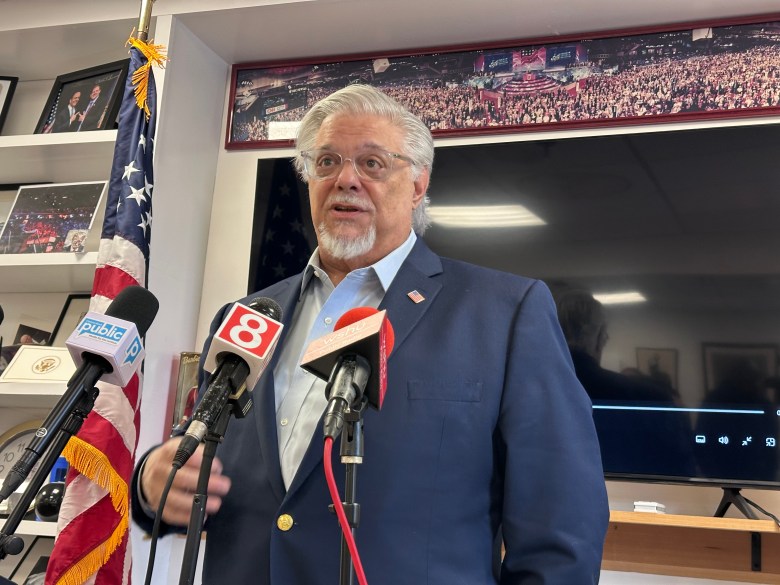
The press conference at the party’s headquarters in Middletown was a rarity.
“The election cycle has officially begun,” Proto said. “Some will say it started the day after the November elections, and that’s true, because that’s the day Ned Lamont found the word ‘affordability’ in his vocabulary. Prior to that, it didn’t exist. And we all know that the issue here in Connecticut is affordability, as it is across the country.”
Acting as a surrogate for the Lamont campaign, state Sen. Matt Lesser, D-Middletown, waited outside the GOP headquarters to insist that emphasizing the cost of living is not without risk for Republicans who mostly have remained silent over the trade war that President Donald Trump is waging against economic rivals and allies alike, his suspension of job-producing off-shore wind projects, and his support for the expiration of tax credits that will produce an increase in health costs under the Affordable Care Act.
“I just thought it was a stunning display, incredibly out of touch at a time when the country is reeling from tariffs from Donald Trump and Republicans in Washington, the same week that health insurance prices for tens of thousands of Connecticut residents just tripled because of Donald Trump and Republicans in Washington,” Lesser said.
Each of Trump’s presidential victories have been followed by Republican losses in Connecticut.
When Trump first took office in January 2017, Republicans were on the rise at the General Assembly. They still were a minority but strong enough to influence fiscal policies, including the adoption of stronger spending caps as part of a bipartisan budget deal in 2017.
The GOP held 18 of the 36 seats in the Senate and were only five short of the 76 seats necessary for a majority in the 151-member House. Democrats made huge gains in 2018, and they now outnumber Republicans by at least 2-1 margins in each chamber of the General Assembly.
As was the case after Trump’s first election, Democrats flipped control of municipal governments in 28 communities in November, the first general election since his return to the White House. Proto said his goal for 2026 was progress, not a legislative majority.
“I do not expect that we are going to have 19 senators and 76 members of the House come January of 2027,” Proto said. “It’s an incremental change. And how do we bring about incremental change? You bring about incremental change by changing a couple of districts.”
A first step would be shrinking the Democratic majority to less than two-thirds, robbing the party of the super majority status it now enjoys.