


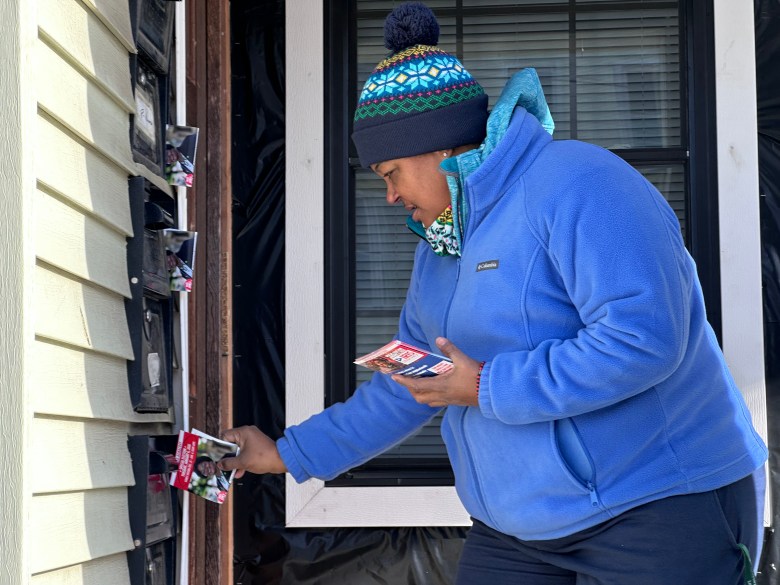
Iris Sanchez stuffed two battery-powered hand warmers in the pockets of her fleece jacket, grabbed her phone and campaign flyers and began her rounds on a frigid Saturday, reminding voters in a Puerto Rican neighborhood of New Britain that Tuesday is not only Three Kings Day.
It is an election day.
Sanchez, a Democratic member of the city’s Common Council, and Republican Jamie Vaughan are on the ballot in a special election for the 25th House District.
They have competed with the weather, darkness that falls before 5 o’clock, and the distractions of holidays as much as they have against each other.
The off-cycle early-winter election is one of two this month for vacant seats in the state House of Representatives, each in districts that favor Democrats —overwhelmingly so in the 25th. The best showing by a Republican in the district over the past decade was 29.9% of the vote in 2024.
On the other side of Connecticut, voters go to the polls Jan. 13 in the 139th House District of Ledyard, Montville and Norwich. Republicans have been more competitive there, winning 47% of the vote in the midterm elections of 2018 and 2022.
Campaigns for special elections are sprints, condensing what typically occurs over the better part of a year into no more than 56 days. State law requires the governor to issue a writ of special election within 10 days of a vacancy, with the election to follow exactly 46 days later.
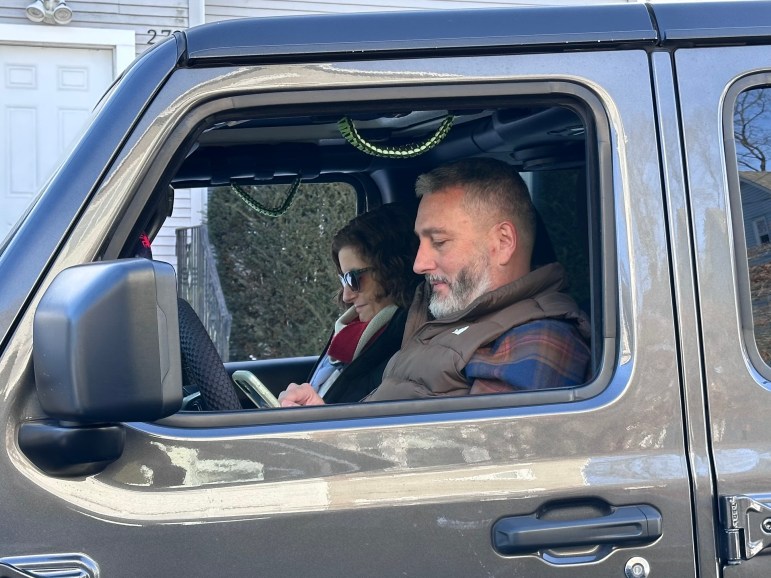
“I’ve got eight weeks to hammer out 10 months” of campaigning, said Vaughan, the Republican nominee in 2024.
The tools employed in a special election are those found in any local or state election: door-to-door campaigning, direct mail, text messages, digital ads and social media. Vaughan also has spent $2,669 for billboards, his name and face looming over Route 9.
“It’s everything you would do normally — except on a condensed time frame,” said Mike Farina, a Democratic campaign consultant.
Sanchez and Vaughan each opened campaigns right before Thanksgiving after Bobby Sanchez, also a Democrat, resigned from the General Assembly to begin a two-year term as New Britain’s new mayor. He, too, first won the legislative seat in a special election in January 2011.
There have been no debates.
In the 139th, Democrat Larry Pemberton and Republican Brandon Sabbag are competing for the vacancy left by the death of Rep. Kevin Ryan, D-Montville, on Nov. 23. A third candidate, Mark Adams of Norwich, is suing to get on the ballot as an Independent Party nominee.
Vaughan and Sanchez are evenly matched on finances: Both are relying on public financing that provided grants of slightly more than $27,000. But Democrats outnumber Republican by more than a 3-1 margin in New Britain, and Vaughan said split is closer to 5-1 in the 25th.
Sanchez, 50, who moved to New Britain from Puerto Rico in 1994, has other advantages. The 25th House District is 56% Latino, and she had been elected five times to the council, most recently in November.
On Saturday afternoon, she campaigned door to door near Willow Park, where a housing project stood when she first came to the city. She encountered two men on the sidewalk, reminding them in Spanish of the election. Both promised to vote. She said her pitch at the doors is simple.
“I just won election as a councilwoman, my fifth, And I’m introducing myself again, saying that I’m running for state rep,” Sanchez said. “And I always tell people, anyone that needs a ride to let to let me know.”
Early voting was light: 72 Democrats, 26 Republicans, 20 unaffiliated voters and three registered Independents had cast in-person, early-voting ballots. Another 22 Democrats, six Republicans and seven unaffiliated had cast absentee ballots.
Turnouts in special elections tend to be low, drawing mainly the voters who also turn out for municipal elections.
Vaughan, 51, a graphic artist who has lived in New Britain his entire life, other than a stint in the Marines, said he greeted volunteers Saturday morning with donuts, coffee and door-knocking assignments in a borrowed conference room.
The volunteers included Rep. Joe Polletta, R-Watertown, and Rep. Nicole Klarides-Ditria, R-Seymour. He was grateful for the help from the lawmakers and state party, but he wished the GOP was able to do more.
Republicans were not lining up to run after Bobby Sanchez won the open mayoral office, succeeding Republican Erin Stewart, one of the two declared Republican candidates for governor.
“I was like, ‘Yeah, you know what? Let me jump back in.’ We didn’t have anybody to really run in the district,” Vaughan said. “We need a voice.”
On Saturday, rather than go door-to-door, Vaughan drove to the homes of Republican voters who have turned out in part elections.
At one stop, he ducked beneath the branches of the overgrown evergreens on either side of an unshoveled sidewalk leading to the home of an 81-year-old widow, a Republican who contributed $50 to his campaign in 2024.
There was no answer. He tucked a flyer into the door.