

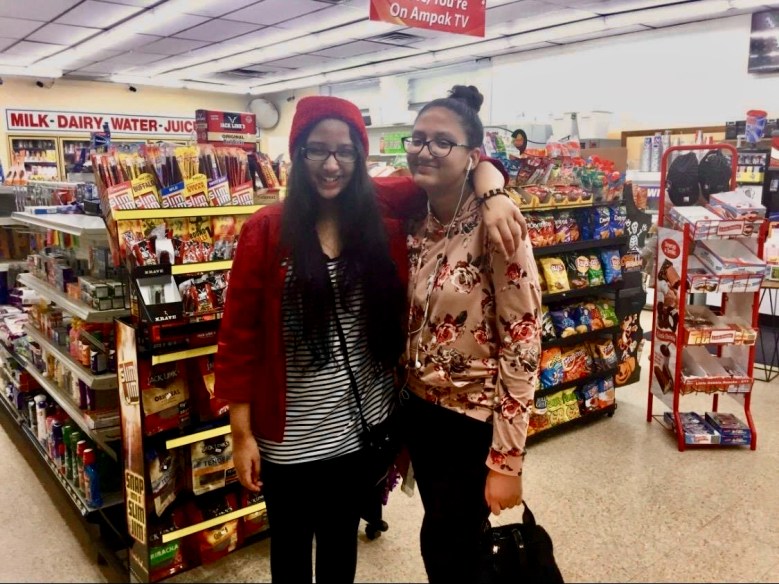
Half of all small businesses go under within five years, but my family’s store, Ampak Foodmart in Middletown, was swimming steadily at nine years. That was until a Dollar General opened a stone’s throw away. Within months, we sank.
Middletown is known for its plethora of small businesses. With more and more towns growing indistinguishable from each other, all littered with a combination of the same regional and national chains, small businesses are becoming a rare asset.
Everyone who has ever gone to the same mom-and-pop shop over any length of time knows that they are more than a place to buy milk, snacks, and lotto tickets. It feels almost impossible to see the same faces behind the counter and not somehow learn about their family vacation next month, or the storm coming on the weekend, or about a car robbery that happened to their neighbor – who lives near you, so you better be careful!

I grew up sitting behind the counter while my dad chatted with seemingly every single person who came up to him. Whether they were wealthy widows who liked to treat themselves to chocolate and cigars now and again or a group of boys coming in from Xavier down the street, my dad knew them all. As a teen who was constantly on her phone, being at the store was one of my most cherished points of connection with my real-life community. I think at a time when everything we need can be delivered almost magically to our doors, these casual, nothing conversations can mean more to us than we thought possible. I’d only noticed once they were gone.
My family’s story is not unique. In fact, one out of every 20 independent grocery stores will go out of business within a few years of a dollar store arriving in their area. With the booming rate at which dollar stores have been expanding, many small businesses are facing the repercussions multiple times over. The opening of big box stores has always been challenging for small businesses, but the rapid growth and unpredictability of dollar stores pose another threat entirely.

Due to competition within different dollar store chains (ie, Family Dollar, which owns Dollar Tree, versus Dollar General), it is hard to know when a Family Dollar will open and sink a Dollar General; ergo, it is hard to know whether a small business should ride out the storm or jump ship. Recently, 1,000 Dollar Tree-owned stores have been set to close; meanwhile, Dollar General forecasts net sales to grow between 3.7% and 4.7% by the end of January 2026. One thing is certain, though, families like mine are having their livelihoods washed away by these mega-chain corporations.
Some places have legislation against dollar stores. In 2020, the city of Manvel, Texas, adopted an ordinance that prohibits the building of new dollar stores within two miles of another dollar store, convenience store, or gas station. Furthermore, in 2019, the city of Stonecrest, Georgia, adopted a total ban on new dollar stores. These are concrete examples of municipal governments putting their people before their profits. Similar ordinances have been adopted in Connecticut as well. East Hartford adopted an ordinance prohibiting a new dollar store from opening within 2,000 feet of another dollar store. In my research, I have found 28 cities that have adopted similar ordinances on dollar stores. The progress is limited, but real.
Despite this, both Dollar Tree and Dollar General have forecasted an increase in profits, and with that will come expansions into more typically lower-income areas, like where I live, stealing money from the community, because that is what they are doing. Dollar General failed more than 4,300 government price-accuracy inspections in 23 states since January 2022, while Family Dollar failed 2,100 price inspections in 20 states. At the counter, instead of telling you about a sister getting married in the spring, they are charging you a price that wasn’t on the shelf and pretending not to notice.
Now, I completely understand that a stranger telling you to bypass your cheapest, most widespread convenience store option may sound out of touch and too demanding. As a low-income person myself, I understand the benefits of dollar stores. I only ask you to think twice before you patronize one.
As for legislators, I continue to advocate for laws that will keep small businesses afloat. An ordinance limiting chain dollar stores would preserve the charms many CT towns are known for, my hometown of Middletown especially, as well as protect their residents. Supporting small businesses is key to creating strong community bonds, and that may be worth more than the convenience of a dollar store.
Aida Sherwani is a junior at Connecticut College. She is studying Government with the goal of working in legislation and public policy.