


This story has been updated.
Lawmakers said they’re concerned about findings in a recent audit report showing failures by state prison staff to distribute medications on time, inform individuals who were released about money left in their accounts, and provide proper training for employees.
An audit report released in July, which reviewed the years 2022 and 2023, found the Connecticut Department of Correction had administered medications to incarcerated individuals late — or, in some cases, not administered them at all. A review of medications given out to 10 people showed delays roughly 10% of the time.
“This could really put inmates and correction officers in danger for folks not receiving their medication,” Rep. Lucy Dathan, D-New Canaan, said during a forum at the Capitol on Friday.
Dathan is co-chair of the legislature’s Government Oversight Committee, which convened the forum, along with the Judiciary Committee to discuss the audit. Lawmakers at the forum also raised concerns with the functioning of the state’s correctional health care system as a whole.
Rep. Steve Stafstrom, D-Bridgeport, who co-chairs the Judiciary Committee, said the legislature has heard for years about problems with medical care for incarcerated men and women. He said he wanted to see data from the department showing improvement.
“Frankly, I don’t know what else we can do to track that we’re getting better. I don’t see that we’re getting better. And maybe we are. But I would like the data to back that up,” said Stafstrom.
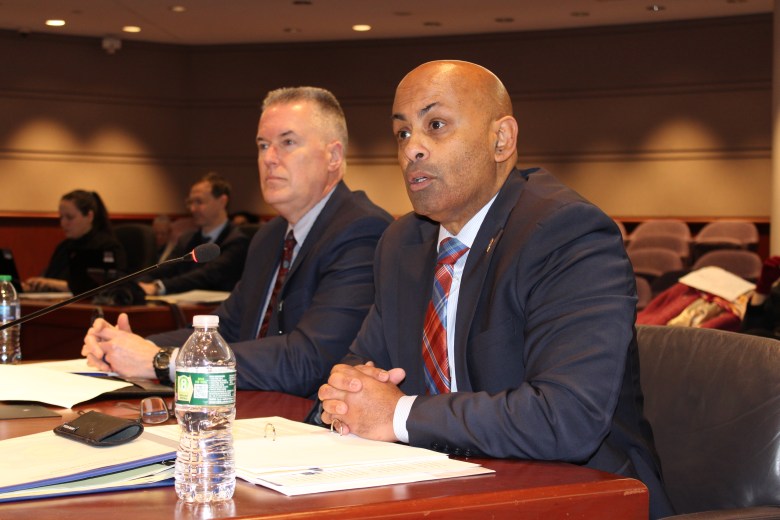
DOC Commissioner Angel Quiros told lawmakers Friday that the department has struggled to fill positions for nurses and prescribers. That was the case in 2022 and 2023, and it’s still the case, he said. Quiros said the state’s nursing ranks declined during the pandemic and DOC is competing with other health care facilities — like hospitals, which offer better pay — for a limited number of providers.
That may have resulted in there not being enough nurses to distribute medication, Quiros said.
Robert Richeson, chief operating officer for DOC’s health services, said the department changed its policies to allow for a larger window of time when medication could be distributed. He said nurses were coached on the importance of documenting any delays. The electronic health records system now allows for exceptions for “exigent circumstances” that might cause delays in medication distribution, such as a facility lockdown.
Stafstrom said he wanted to receive a direct report monthly on the doses of medicine delivered and the percentage of compliance, so he could track whether compliance was increasing or decreasing over time.
Sen. Sujata Gadkar-Wilcox, D-Bridgeport, said she felt there needed to be a way to prioritize individuals with serious conditions for whom delays in medication could lead to significant health risks.
“ There could be certain medications, [that] when they’re missed even by an hour, could be critical for a patient,” she said.
In a press conference in advance of the hearing, advocates called for heightened scrutiny on medical care for inmates, particularly in light of the deaths of Tyler Cole and Ronald Johnson, who died from an overdose of methadone and other prescribed medications while incarcerated at Garner Correctional Institution.
“We will never know how many deaths in custody actually resulted from misdiagnosis and overdosing clients without adequate professional oversight,” said Barbara Fair, executive director of Stop Solitary CT. “Incarceration was not meant to be a death sentence, and yet countless people have died in just the last five years.”
State auditors are in the process of completing a performance audit with a specific focus on medical care for incarcerated men and women.
Other findings
According to the audit, DOC continued to hold money that had belonged to individuals who had been released from prison. As of August 2024, there were 7,813 inactive accounts that held a total of about $483,000, according to the report.
Several lawmakers pointed out that the money, which had been held in commissary accounts while the person was incarcerated, could be critical for someone who was newly released from prison.
“Most of the inmates are going to be released at some point in time, and we want them to be good upright, law-abiding tax paying citizens,” said Sen. John Kissel, R-Enfield, ranking member on the Judiciary Committee. “In this day and age, any dollars in your pocket are going to be helpful, and there’s just no real reason why someone should not be alerted as they’re walking out the door, ‘Hey, you’ve got $500 coming to you.’”
The audit also found lapses in training for DOC employees. Auditors said 19 of the 20 employees’ training they reviewed did not meet requirements. Employees must have 16 hours of training per year if they don’t have direct contact with incarcerated individuals, and 40 hours per year if they do work directly with the incarcerated population.
Quiros said he had raised the requirement for in-person training from 8 to 24 hours and reduced the amount of training on computers at individual facilities. He said training numbers had improved in recent years, but were not at the levels he would like to see. He estimated that at each facility, between 88% and 100% of staff who work directly with the population had completed required training.
Costly leaves of absence and overtime
A series of extended administrative leaves of absence among DOC employees also drew the attention of lawmakers. Several expressed concerned about the amount of money being paid to employees under investigation for misconduct or awaiting criminal charges.
The report found that, while paid leave is capped at two months, nine employees remained on administrative leave for over a year. In at least one case, it lasted for over three and a half years.
Together, the department paid these nine employees more than $800,000 during the time they spent on administrative leave beyond the permitted 60 days.
According to the Department of Correction, most of the employees who are on administrative leave are either under investigation for use of force, under investigation for “undue familiarity” — usually for bringing contraband into a facility — or have been arrested for a felony outside of work.
The department attributed the lengthy periods of paid leave to delays in investigations.
Dathan questioned why someone with pending charges could not be brought back and placed on an administrative desk duty rather than being paid while not doing any work.
Quiros told lawmakers that there were 26 individuals currently on administrative leave, a decrease from 61 in August. He said he had been bringing people back to work who were awaiting trial proceedings for felony charges. In some cases, he said, the delays were caused by lengthy court procedures.
Quiros said that of the people who were on administrative leave, he estimated that about half would return to the department and half would be dismissed, depending on the severity of the charges.
Lawmakers also took issue with overtime pay. According to the audit, DOC spent $96.6 million on overtime hours in 2022 and $103.4 million in 2023. The audit found that a number of employees who were ineligible for overtime were paid a total of $81,500 in those two years.
State Auditor John Geragosian said understaffing puts both the correction officers and incarcerated men and women at risk, which can lead to more people being injured and receiving workers’ compensation.
According to Quiros, about 300 people completed training for correction officers at the academy in 2025, and the department was preparing to hire 100 people. But Quiros also noted that during that time, 287 people had left the department for various reasons. He said the department plans to bring on 300 more correction officers, filling between 92% and 93% of the open positions for officers.
But Quiros noted that even with every position filled, there are situations where overtime was necessary. He said the number of people on leave for workers’ compensation has been rising. In December, the department had about 200 people on workers’ compensation leave for more than a month and another 230 out on short-term leave.
“ Just throwing more resources into getting more correctional officers may decrease the amount of overtime. [It] will definitely decrease the facility emergency lockdowns that we have for lack of staff,” said Quiros. “But we’re still going to have the problem that, anytime a correctional officer is off on accrued time, it generates overtime.”
State Auditor Craig Miner noted that there had been a wave of retirements within state government shortly before the audited time period. He said there was likely a high number of new employees at the department in those years, and that the findings of the audits might be more concerning if they were to continue in the future.
But lawmakers expressed frustration over what they saw as persistent problems.
Rep. Renee LaMark Muir, D-Deep River, questioned whether the addition of more correction officers would really solve the problems. She said the department had the same number of officers as it had in 2010, despite having closed multiple facilities and decreased the number of people incarcerated.
“It’s not just simply throwing more staff at the problem, it’s stepping back and fixing the management problems,” said LaMark Muir. LaMark Muir said she wanted to see a staffing analysis done.
Quiros said he was open to the idea. Currently, he said, the department has nearly 500 vacancies.
Sen. Gary Winfield, D-New Haven, urged Quiros to ask the legislature this year for funding to create a better system.
“ I need an ask that is visionary. I need an ask that has a vision for a prison system that works for everyone in the prison system,” said Winfield.
Correction:
An earlier version of this story misspelled Robert Richeson’s name.