


This story has been updated.
Connecticut state lawmakers said Monday that they will propose a bill allowing state residents to sue federal law enforcement agents for violations of their constitutional rights.
The bill’s proposal is in response to the shooting of Alex Pretti by a U.S. Border Patrol officer in Minneapolis on Saturday. Pretti is the second protester killed by federal immigration authorities in Minnesota this month, after Renee Good was shot and killed by Immigration and Customs Enforcement officer Jonathan Ross on Jan. 7.
“I’ve heard from many of my constituents who are concerned that this could happen here and who are looking to the state and our state leaders and to provide some assurance that Connecticut is doing what we can to protect our residents,” said Sen. Matt Lesser, D-Middletown, during a press conference on Monday.
Connecticut would join several other states that have enacted similar laws, including California, Massachusetts, Maine and, most recently, Illinois.
“This is a well-established thing that we can do to make sure that if constitutional rights are violated, that the residents of the state can do something about it and can bring a lawsuit and can achieve justice,” said Lesser.
In 1871, a federal statute known as 42 U.S.C. 1983 was enacted, primarily to allow the courts to remedy violations of constitutional rights performed by the Ku Klux Klan. The statute allows for lawsuits against local and state officials in the case of a violation of constitutional rights. But there is no equivalent law allowing people to sue federal officials. In response, states began to create what are called “converse 1983 laws,” allowing for lawsuits against federal agents.
The 1971 Supreme Court case Bivens v. Six Unknown Named Agents of the Federal Bureau of Narcotics found that individuals do have a right to sue federal officials for damages relating to violations of people’s constitutional rights. But the court has not allowed a lawsuit under Bivens to proceed in more than 30 years, and a 2017 Supreme Court decision tightened its use even further.
Sen. Gary Winfield, D-New Haven, noted that the Westfall Act, a 1988 law that protects federal employees from personal lawsuits for their conduct while carrying out their professional duties, further limits individuals’ recourse.
“I think it’s important for folks to be able to rest assured that the Constitution of the United States means something. If that doesn’t mean something, I don’t know who we are, what this country is,” said Winfield.
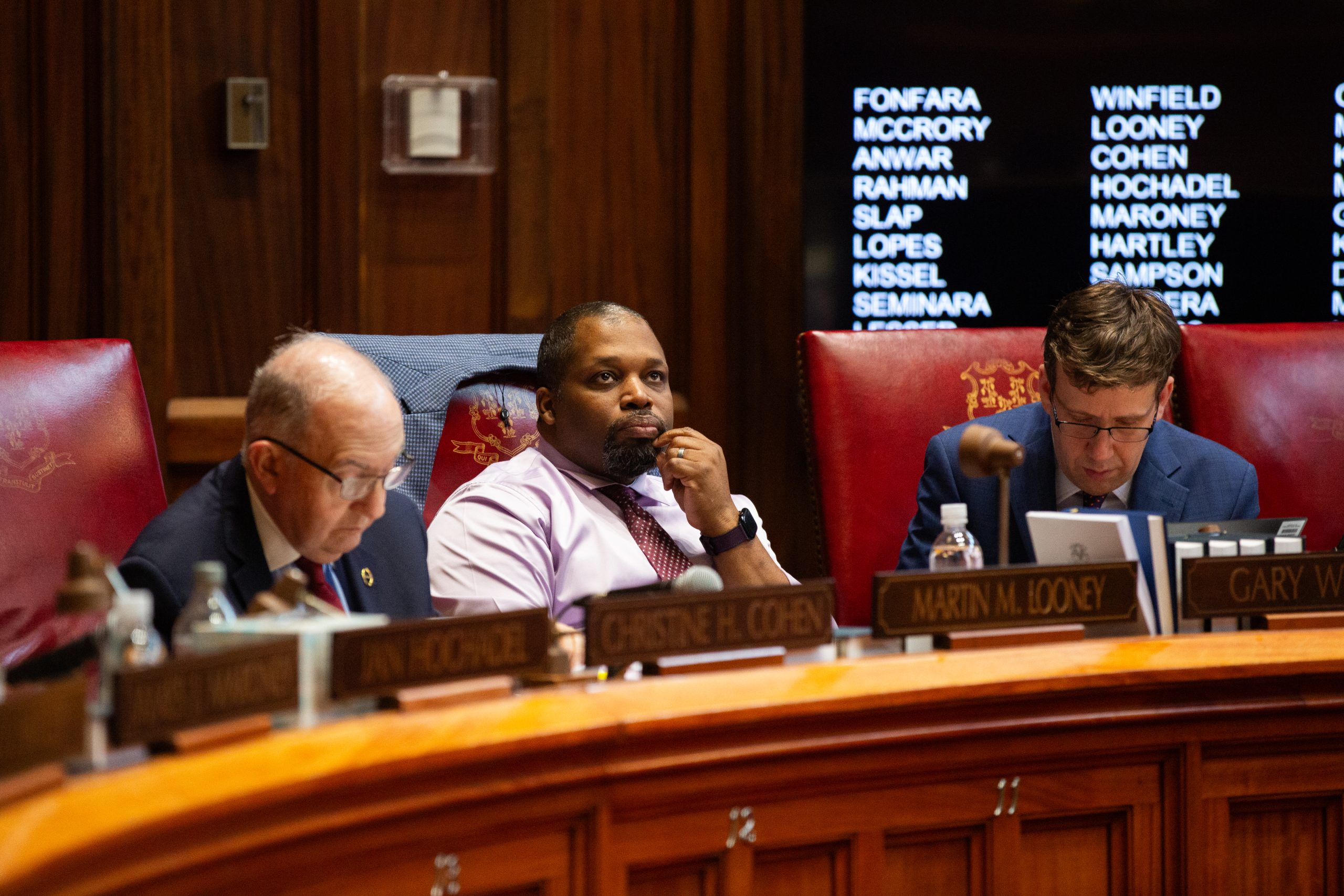
Sen. President Pro Tem Martin Looney, D-New Haven, said it was possible the law could be challenged by the federal government. The federal government sued the state of Illinois last month, claiming that a law allowing people to sue federal immigration agents went against the Supremacy Clause of the Constitution, which says that federal law overrides state law.
But Looney disagreed that the proposed Connecticut law was at odds with the U.S. Constitution.
“These actions actually further the ultimate supremacy of the federal constitution by helping people vindicate their fundamental federal constitutional rights,” said Looney.
Senate Minority Leader Stephen Harding, R-Brookfield, welcomed debate on the proposed law in a statement he issued Monday.
“Anyone who breaks state or federal laws should be held accountable for their actions. In the meantime, the amped up rhetoric and the violence must end. Anyone who doesn’t like how the law is enforced is free to advocate for different laws, and to protest peacefully,” said Harding.
Democratic lawmakers said they had been working with the Connecticut chapter of the American Civil Liberties Union to draft the legislation.
There have been constitutional violations in Connecticut as ICE increased its presence here, said Chelsea Infinity-Gonzalez, ACLU-CT’s director of public policy and advocacy.
“ There’s operations ramping up all around us, in New York and Massachusetts, most recently in Maine. And so it truly is only a matter of time,” said Gonzalez.
Gonzalez said the ACLU was also working on legislation that would regulate the use of license plate readers so that the data collected was not used to assist federal law enforcement.
At the federal level, Connecticut politicians have widely criticized the shootings in Minnesota, and several have called for an independent investigation into the shooting. State investigators were not allowed access to evidence in the shooting of Good, and Drew Evans, superintendent of Minnesota’s Bureau of Criminal Apprehension, which investigates police shootings, told reporters Saturday that federal officers had blocked his agency from the scene of Pretti’s shooting even after it obtained a signed judicial warrant.
U.S. Attorney General Pam Bondi sent a letter to Minnesota Gov. Tim Walz on Saturday, calling on him to share records on the state’s Supplemental Nutrition Assistance Program, or SNAP, to repeal “sanctuary policies” and allow detention centers to cooperate with ICE, and to provide the federal government with access to the state’s voter rolls.
Connecticut, along with 22 other states, has been sued in federal court by the Trump Administration for its voting records. The state in July joined 20 other states in a lawsuit pushing back against a directive from the federal government to provide data on people enrolled in SNAP.
In response to a question from CT Mirror, spokesperson for the Attorney General’s office Elizabeth Benton said the state “has not received such a letter” from Bondi and referred to earlier comments in which she said that any statements about hypothetical requests for data from the federal government would be “premature” and depend on the exact data requested.
Senate Majority Leader Bob Duff, D-Norwalk, said during the press conference that the federal government was targeting Democratic-led states, and that Connecticut would “resist feverishly.”
“The federal government does not run elections, and we’re not going to give them data in order to try to make a mockery of our residents, our voters, and anyone else for their cruel and dangerous policies,” he said.
Connecticut’s congressional delegation last week voted against a bill that would fund the federal Department of Homeland Security. The bill passed the House of Representatives and is now headed to the Senate.
An Associated Press report is included in this story.
Correction: A previous version of this story incorrectly described the federal law allowing for lawsuits against state and local officials. The statute was enacted in 1871, not 1983. 1983 was the number of the statute.