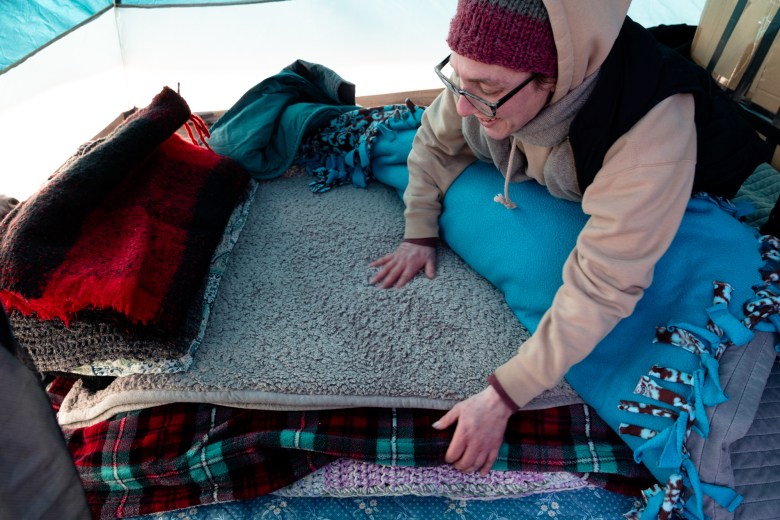
Ganina Mancini peeled back layers of blankets in the tent she shares with her partner Teddy DeLorenzo: a knit blanket, a new blue comforter, a plush throw.
The two have lived in a tent in Milford for months, and as temperatures plummeted Friday ahead of a storm that dropped a foot of snow on the town, they packed to go to a motel for the weekend. But questions remained. What would they do with their tent? Would the place that had been home for months withstand the whipping winds? If they packed everything up, would they be able to find a dry spot, get the stakes back into frozen ground?
They were just a couple of the dozens of people experiencing homelessness in Milford — and among many more around the state — who had to scramble to find a place to stay through the weekend’s winter storm.
“It’s just not a normal thing,” DeLorenzo said. “You’ve got to stay bundled up, whether you’re under the covers or not. It’s cold.”
“And then sometimes you have three layers of clothes, you’re not comfortable. Sometimes sleeping like that is a pain,” Mancini added. “But we get through it.”
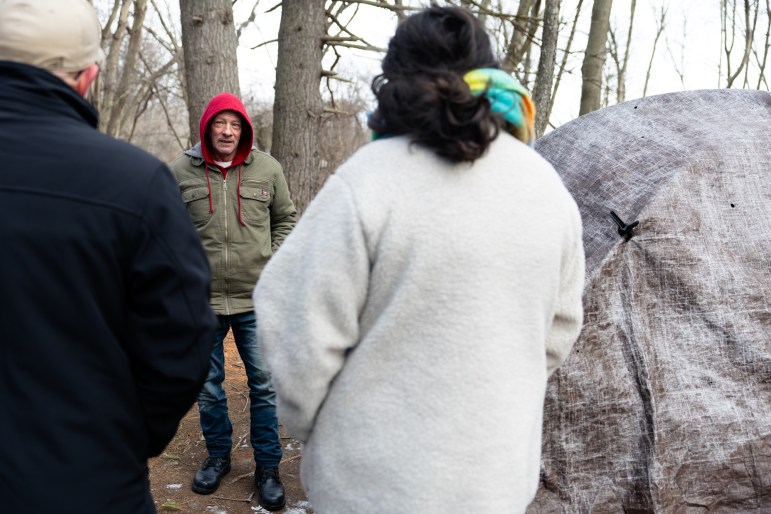
Beth-El Center, a Milford nonprofit, planned to put about 20 people living outside or in their cars up in motels for the weekend and early part of the week. Another 40 would sleep on cots at the shelter, and 20 more would stay in overflow spots at local churches, said Hannah Smith, the organization’s director of shelter services.
Homelessness — particularly unsheltered homelessness — has been increasing in Connecticut in recent years. The population of people living outside, in their cars or in other places not meant for human habitation rose by 45% from 2024 to 2025. An annual count, which takes place in January each year, showed that 800 people were unsheltered on that night last year.
Connecticut homeless service providers for years have said they need more resources to meet the need of the unhoused population. This need becomes particularly acute, they say, in instances of extreme weather. Across the country, at least 12 people died because of the cold weather over the weekend, according to national news media.
Key lawmakers have said they want to focus on addressing homelessness in the legislative session that begins next month. Last session, a bipartisan group of legislators formed the new Homelessness Caucus to advocate for more solutions and aid for the unhoused population.
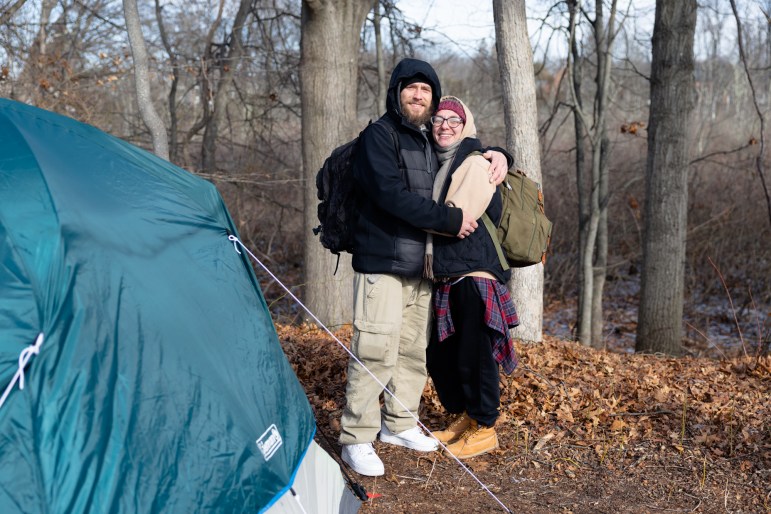
Mancini and DeLorenzo became homeless for the first time after an eviction in 2020. They’ve since rented rooms in other people’s houses, but always ran into problems with roommates who didn’t pay the rent or utility bills.
They met in middle school and interact with the ease of a longtime couple. He helps her put on her backpack as they leave their tent and head over to the Beth-El shelter. She is almost always smiling and helps him keep his spirits up, he said.
Their site is clean, devoid of trash. They’re diligent about cleaning up and keeping the elements outside their tent. The storm posed problems.
Jason Blakeman, an outreach worker, tried to convince them to pack up their tent and all their belongings but DeLorenzo resisted, worried that they wouldn’t be able to put the tent back up in their old spot. They like their spot. It’s quiet.
During the last storm, DeLorenzo said, they had to hold the tent up to keep it from collapsing in the wind. He planned to come out every couple of hours to sweep snow off the top.
The two hope to move into an apartment soon. Just a few days ago, Mancini got approved for the Housing Empowering Recovery from Opioids (HERO) program through the Connecticut Department of Mental Health and Addiction Services. The program aims to help people achieve sobriety through stabilizing their housing. Mancini has been in her current sobriety program for nearly a year.
They’re excited for regular date nights, for time to focus on romance rather than survival. “I’m excited to get our old life back,” DeLorenzo said.
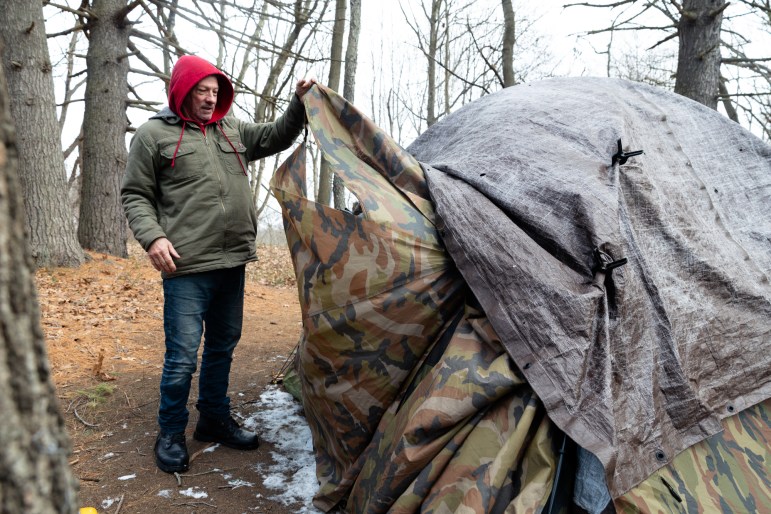
For Brian Liberatore, who lives in a wooded area of Milford, “survival is a full-time job.” He has a campsite complete with a tent, tools covered with a tarp and a cook stove. He’s in culinary school at Gateway Community College and likes to practice on the propane stove.
His tent is coming apart at the seams after a December snowstorm ripped through the fabric. In preparation for this weekend’s storm, he’d clamped the edges together and tied the tent to nearby trees. He, like DeLorenzo, planned to hike through the storm from his motel room every couple of hours to sweep snow off his home.
Liberatore is familiar with the unsheltered community and has an extra tent he’s let people stay in before, notably a man who was recovering after heart surgery and had been discharged from the hospital back into homelessness.
“These are people that have had lives,” he said. “They’ve had families, children, and they deserve the respect and basic humanity, and compassion.”
Liberatore keeps a guitar at his campsite where he said he likes to play all kinds of music. He got a guitar for his now-12-year-old grandson a few years ago. He prefers the freedom of living outside to a shelter, but wishes he had a place to stay.
“I would rather not live in a shelter because I have freedom, no neighbors, no rules. But the weather has just gotten a little too much,” Liberatore said. “You’re good until you’re not good.”
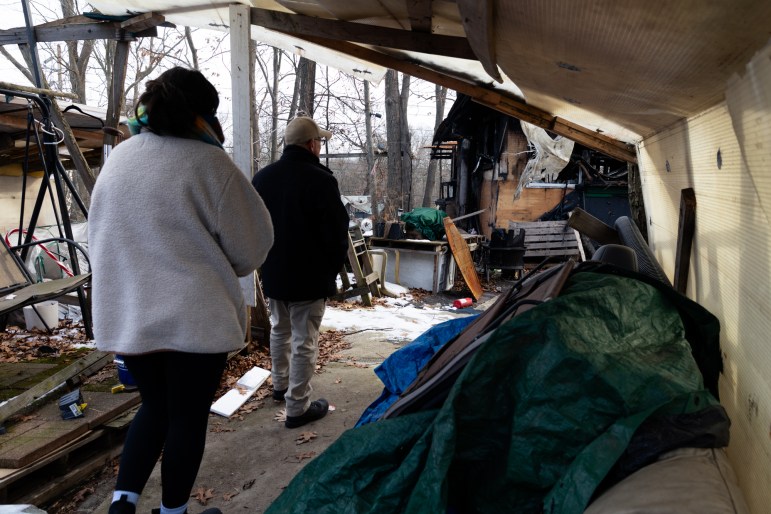
Extreme weather is just one of the circumstances that can reveal the fragility of unsheltered homelessness. Blakeman and Smith on Friday visited an old campsite where a group of people had built tiny homes in the woods, complete with running water, a garden and an outdoor bar. They’d listen to music at night and established rules and chores for everyone living there.
A fire broke out in August, displacing everyone who lived there and killing one man, Joseph Kane. Now, rosaries hang on the remains of Kane’s home. Blakeman said he waited while first responders retrieved Kane’s body from the wreckage.
“I wanted him to have someone here who cared about him,” Blakeman said, through tears.
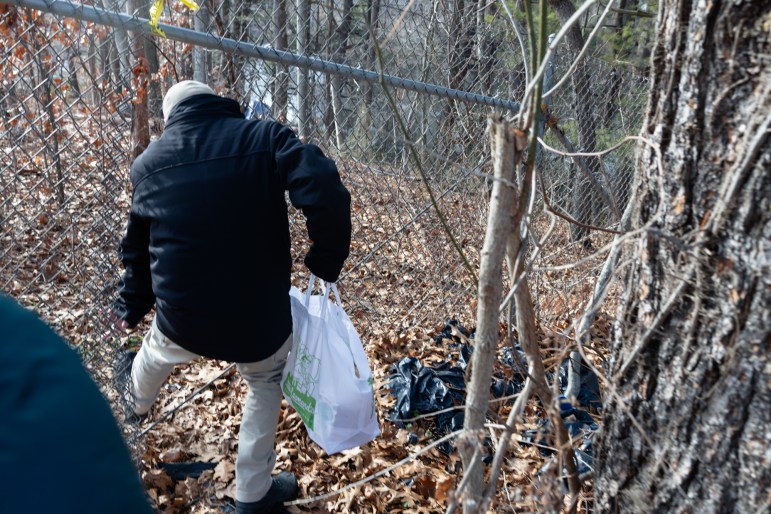
He and Smith spent much of the day Friday visiting people who lived outside and ensuring they knew where to go and when. They arranged Ubers to take individuals, ensured they had enough space to pack up their belongings and even to transport pets. They got people gift cards to buy enough food to wait out the storm.
For Bonnie Rossignol, who has seen someone’s tent flattened because it was too close to the path of a snow plow, the news that she’d be able to stay in a motel paid for by the provider didn’t arrive until late Friday afternoon. Rossignol said she’d set up an awning in the front of her tent to try to keep the snow away from the front door.
“When the snow comes down, it just pushes down on that awning,” she said. “But if that awning collapses, there goes the whole front of my tent and everything inside of it is, boom.” She smashed her hands together.
Blakeman had an extra tarp for her. He and Smith arranged an Uber to pick her up at 4:45 p.m. She promised to be at the meeting spot and packed by then.
But, for them, the work was just beginning. The snowstorm dropped more than a foot of snow across the state and temperatures are expected to stay below freezing for days.