


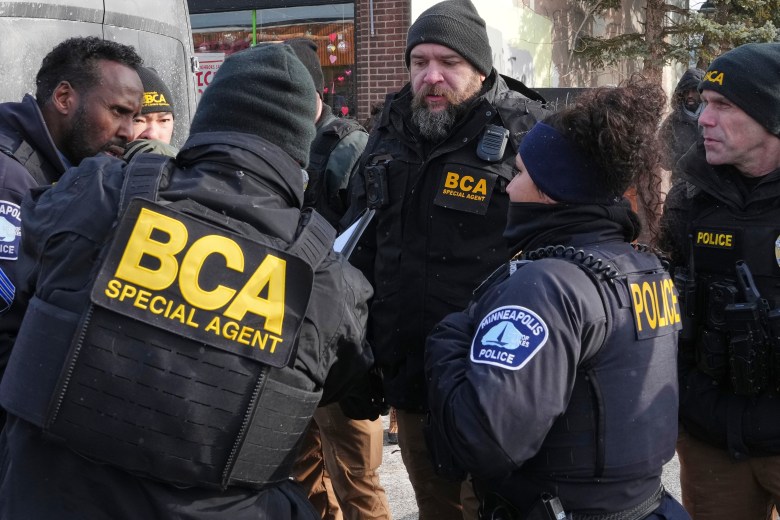
The Connecticut police accountability law that creates a legal obligation for police to intervene when witnessing abuse by other law enforcement officers applies to federal immigration agents, two senior police officials said Friday.
“I would expect that if a Connecticut police officer saw any law enforcement anywhere that was abusing or violating the rights or using excessive force, that they would step in and intervene,” said Ronnell Higgins, the commissioner of emergency services and public protection.
Thomas Wydra, a former municipal police chief who oversees training standards for state and local police as the executive director of the Connecticut Police Academy, said the duty to intervene, established in law after the police killing of George Floyd, is clear.
“It doesn’t matter what patch they’re wearing,” Wydra said. “You have to recognize when your colleague is getting elevated in terms of their emotion. You have to pull them aside, whether verbally or physically. You’re helping them, you’re saving them from doing something potentially tragic. So that’s a good statute.”
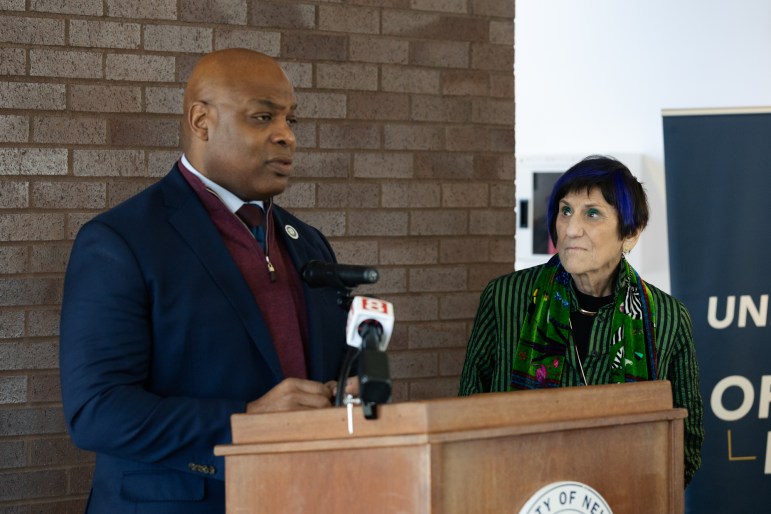
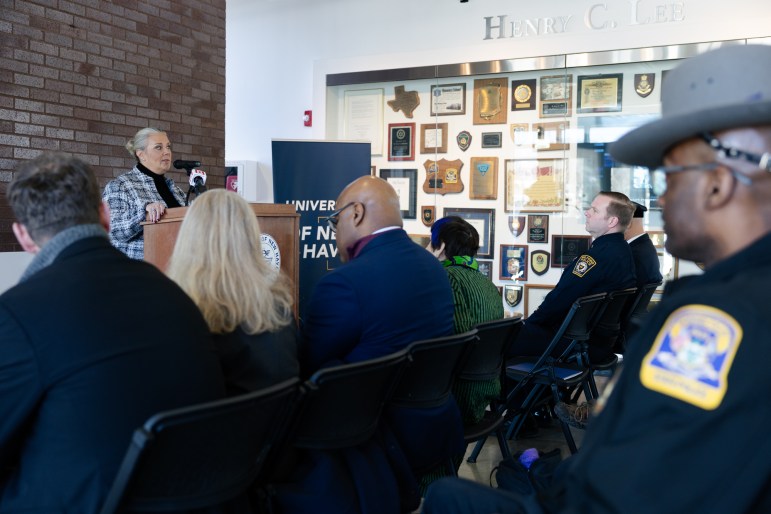
Higgins and Wydra made their comments during and after an event publicizing U.S. Rep. Rosa L. DeLauro, D-3rd District, delivering a $1.5 million federal earmark to continue funding a multistate de-escalation training program that the University of New Haven offers along the length of the eastern seaboard.
The U.S. Immigration and Customs Enforcement agency had no immediate comment.
Higgins, whose agency includes the State Police and police academy, said state and local police officers are troubled by what they’ve witnessed in videos of federal immigration conflicts with protesters in Minneapolis, where two unarmed civilians were fatally shot and federal agents failed to coordinate with local police and demonstrated no training on crowd control or de-escalation.
“No one could have predicted the timing of the event,” DeLauro said.
Lisa Dadio, a former New Haven police lieutenant on the criminal justice faculty at the university, oversees one of the four regional de-escalation training centers. She said the data is clear: Departments that use the program experience a reduction in injuries to officers and the public.
The program trains officers to recognize certain personality types and provides techniques for de-escalation without physical conflict. Dadio said her center has trained 2,200 people and certified 245 trainers who bring the techniques to their departments.
Higgins began his comments acknowledging the violence in Minneapolis, echoing comments increasingly being heard by state and municipal police officials.
“Most of the people I’ve talked to locally and around the country about this very matter are very concerned,” Higgins said. “Here in Connecticut, we wear names on our uniforms. We don’t wear masks. We have a statewide policy on crowd control. Again, you heard me talk about de-escalation, and that being woven into the tapestry.”

The mass protests staged in Connecticut after George Floyd’s murder in 2020, including one that shut down I-84 for a time, ended without injuries and few if any arrests. Gov. Ned Lamont has repeatedly noted the I-84 incident as a textbook case of peaceful civil disobedience and police restraint.
Higgins said those results come from training, planning and intention.
“There are operational plans that are drawn up in advance for planned protests and demonstrations, and we oftentimes identify a point of contact, a liaison between the police and those who would be protesting,” Higgins said. “What I’m seeing is nothing shorter than the exact opposite of what we’ve been working on for the last five years.”
One difference today is that protests often are designed to disrupt federal crackdowns on undocumented immigration, not merely register disapproval.
Wydra said that harassment inevitably leads to frustration by the federal agents. He offered no opinion of the federal shooting, saying they should be subjected to investigation before comments. But he said he was alarmed by what he saw as either the inability or unwillingness to de-escalate, even if provoked.
“You look at both those incidents, clearly there was an escalation, and the escalation involved the law enforcement officials,” Wydra said. “That’s what we don’t want to see here. In both situations, one can argue that the agents themselves, had they just engaged in some basic de-escalation strategies, would make this conversation moot.”
The Connecticut police accountability law, passed in 2020, creates the office of an inspector general to investigate complaints of police misconduct, requires police and correctional officers to intervene when witnessing brutality, mandates body and dash cameras, bans chokeholds in most circumstances and clarifies that deadly force can be used only when police exhaust all reasonable alternatives.