


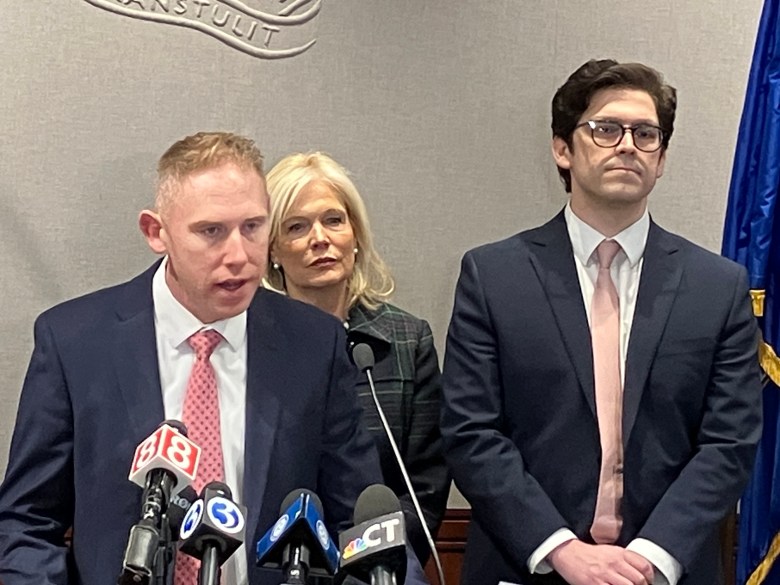
Senate Republicans unveiled a $1.5 billion tax relief plan Tuesday, arguing the state’s flush coffers can afford far more than the one-time $500 million rebate Gov. Ned Lamont pitched last week.
The caucus’ affordability plan also features several initiatives to reduce consumers’ electric bills, including the removal of the public benefits charge.
The overall plan marks a huge departure from the caucus’ support for aggressive savings policies that have revitalized depleted budget reserves and cash-starved pension funds since 2017.
And based on the latest projections from state analysts, it would eliminate nearly all surplus funds in future years, jeopardizing a new program that relies on unspent budget dollars to expand affordable child care.
The Senate GOP would deliver most of its relief through cuts to the state income tax, reducing rates and dramatically expanding an existing credit that offsets a portion of municipal property tax bills. A third element would cut the payroll tax that supports the Paid Family and Medical Leave program by 20%.
And while Lamont’s $200-per-person rebate would be a one-time boost offered this October — just before the November state elections — Republican senators said their relief, worth hundreds to some low- and middle-income households and thousands to others, would happen year after year.
“The governor’s $200 table scraps a couple of weeks before the election are not affordability,” Sen. Jason Perillo, R-Shelton, said during an early afternoon press conference in the Legislative Office Building.
“What we’re saying as a caucus is that’s not enough,” Minority Leader Stephen Harding, R-Brookfield, said of Lamont’s rebate. “The people on Main Street, the people in our districts, the men and women of the working class and middle class of the people of the state, no longer should be looked away from.”
Restructuring the CT income tax
The linchpin of the Senate Republican plan would be Connecticut’s second income tax rate cut ordered in the past three years.
The state income tax has seven different rates, taxing various portions of household income between 2% to 6.99%. Most middle-class income is taxed between 4.5% and 6%.
Senate Republicans would eliminate the 2% rate entirely, meaning the first $10,000 earned by singles and first $20,000 earned by couples now would have no tax applied to it.
And the 4.5% rate would be reduced to 3%.
Caucus officials estimate the rate changes would save taxpayers roughly $975 million per year.
A second key element is tied to the property taxes that municipalities levy on non-commercial cars and other vehicles.
Local taxpayers still would pay those bills up front, ensuring cities and towns wouldn’t lose the roughly $900 million they generate annually from vehicle taxes. But individuals earning less than $100,000 per year and couples below $200,000 would receive a state income tax credit reimbursing them for their full vehicle tax bill. That credit also would be “refundable,” meaning Connecticut’s poorest working families, which owe no income taxes, still could have the full value of the credit added to their refund.
An existing income tax credit that offsets up to $300 of middle-class households’ property tax bills would remain in effect under the Senate Republican plan. But it would apply only to taxes levied on land, buildings and other non-vehicular properties.
This second provision of the Senate GOP plan would cost the state less than $600 million per year, according to caucus officials.
An a third component would reduce the state payroll tax that supports the paid Family and Medical Leave Program from 0.5% to 0.4%, saving workers a collective $90 million per year.
Scaling back savings efforts dramatically
The proposal marks a huge departure for the Senate Republican Caucus, which has staunchly supported aggressive budget caps that have forced massive surpluses since their enactment in 2017.
The surpluses have averaged more than $1.8 billion, about 8% to 9% of the General Fund, since then. But they ended a string of deficits and tax hikes that dominated state finances between 2009 and 2017 and enabled Connecticut to amass a record-setting $4.3 billion rainy day fund while pumping another $10 billion from surpluses into a pension system analysts say was badly under-funded for 70 years prior to 2011.
The chief cap driving those surpluses, which captures a portion of state income and business tax receipts, has grabbed more than $1.4 billion alone, on average, since 2017.
But even though Connecticut still owes more than $33 billion in unfunded pension obligations, a per-capita debt that exceeds most other states’, Senate Republicans say they’re ready to redirect those budget cap savings into tax relief.
The GOP hasn’t abandoned its belief in these savings efforts, Harding said. Rather, the governor and his fellow Democrats in the General Assembly’s majority already have signaled their intent to gut this system.
“What we’re saying here today is, if you’re going to modify that [budget] cap once again, return it back to the taxpayer,” Harding added.
Analysts estimate the cap, which bars lawmakers from spending all income and business tax receipts, will force $1.81 billion in savings this fiscal year. That, combined with an $86 million estimated operating surplus in the General Fund, would leave Connecticut with almost $1.9 billion unspent when the fiscal year ends June 30.
Lamont wants to take $500 million of that to provide a $200 October rebate to individuals who earn less than $200,000 per year and a $400 rebate to couples making less than $400 per year.
The governor also wants to send another $140 million from what’s left to support the special child care expansion endowment he and lawmakers created last June. That still would leave more than $1.25 billion to pay down pension debt and expand reserves.
But analysts say the budget cap that saves a portion of income and business taxes will capture $1.2 billion in 2026-27, and $855 million the year after that. In other words, it wouldn’t be enough to cover $1.5 billion in tax cuts either year.
Lamont spokesman Rob Blanchard said the Senate Republicans, the only caucus that declined to propose a complete state budget last spring, now is dangling relief without a plan to pay for it.
“Unfortunately, the Republican plan repeats the failed mistakes of the past by relying on volatile revenue to fund ongoing costs, a path that led to painful cuts and tax hikes,” Blanchard said. Connecticut hasn’t closed its books in the red since 2017, when it finished with a modest $22.7 million deficit. It never has wrapped a year since then with less than $569 million left over.
“The governor remains focused on building on real fiscal progress, including the largest income tax cut in state history, a stronger Earned Income Tax Credit for working families, and protecting Connecticut families from extreme health care cuts pushed by the White House and Republicans in Congress,” Blanchard added.
But Sen. Ryan Fazio of Greenwich, ranking GOP senator on the Finance, Revenue and Bonding Committee and a contender for the Republican gubernatorial nomination, said his caucus believes any budget-balancing issues in future years could be settled easily by stemming growth in new programs. Republicans in recent years have said Connecticut could save money in future years by forcing public universities to spend down large reserves, trimming Medicaid benefits for undocumented residents and scaling back state employee raises that have stood at 4.5% for most workers since 2021.
Driving down electric costs
The Republicans’ plan for saving people money on their electric bills recycles a proposal that has been floated several times by the GOP in recent years: getting rid of the public benefits charge.
The charge, which appears as a portion of customers’ electric bills, represents the cost of dozens of state and federally mandated initiatives such as energy efficiency programs, power purchase agreements and assistance for low-income customers. Taken together, the cost of all those programs is roughly $1 billion a year.
“There is so much pork stuck in our public benefits tax that it would boggle the mind,” said Fazio, who also is ranking Senate Republican on the Energy and Technology Committee. “Over the next several years, we could eliminate some of those programs, cut others and fund the most necessary ones through the normal budget process in order to provide relief for our residents.”
The plan put forward by Republicans did not specify which of the programs currently paid for under the public benefits charge they would elect to keep, but Fazio said that he estimated an amount in “the low hundreds of millions of dollars” would have to be shifted onto the state budget.
That shift could be accomplished in about four years, or one gubernatorial term, added Fazio, who is running in the Republican primary for governor.
But despite widespread voter frustration over the cost of electricity bills, Democrats such as Lamont have dismissed calls to eliminate the public benefits charge as little more than a shell game that shifts the burden of the charge onto taxpayers. Others have questioned the wisdom of cutting things such as energy efficiency programs, which can help customers reduce the size of their bills.
“Ratepayers and taxpayers are the same people,” Lamont told the Connecticut Mirror in an interview late last year. “What you’ve really got to do is generate more electricity that will reduce the great spikes … that’s what really drives the cost.”
During last year’s legislative session, Lamont did work with lawmakers to approve legislation allowing the state to borrow money to pay off a portion of the public benefits charge. That borrowing helped to shave $5 to $10 off of bills late last year — an amount that was quickly offset by higher electric rates in the winter.
Proposals to end the public benefits charge are also complicated by the fact that contracts to purchase power from clean energy resources — such as the Millstone Nuclear Power Station — can at times appear in the charge as a credit that helps to lower bills. Lamont’s commissioner of the Department of Energy and Environmental Protection, Katie Dykes, said last month that those contracts are expected to return $100 million to electric customers later this year due to their increasing competitiveness with natural gas.
Fazio did not dispute those predictions following Tuesday’s press conference and said the state should maintain its ability to enter into long-term contracts with power generators. However, he said, those contracts should be capped at two-and-a-half times the market rate for power.
Claire Coleman, who heads the state’s Office of Consumer Counsel, released a statement Tuesday cautioning that any effort to cut funding from public benefit programs could have unintended consequences.
“While it is appropriate for state leaders to focus on energy affordability, reactive proposals to disinvest in the reliability of our electric grid, cost-effective energy resources or important affordability initiatives risk not being in the best interest of ratepayers,” Coleman said. “We’ll be monitoring legislative discussions closely and will advocate for any program changes to be evidence-based and done with a scalpel, not a sledgehammer.”