


On a late-night shift in November, state Trooper Wilfred J. “Billy” Blanchette IV chased an erratic driver on highways through Montville and Norwich, his speed reaching 120 mph. As midnight approached, the 31-year-old trooper radioed a request to his supervisor, Sgt. Gordon L. Leslie.
“Sarge, can I ram this thing, please?”
Seven seconds passed before the sergeant answered.
“Yeah, try it.”
Blanchette accelerated towards the target, a Honda Accord carrying two men west through a construction zone on Route 2 in Norwich. Suspecting the driver was drunk or on drugs, Blanchette had pursued the speeding car from Route 2A in Montville onto I-395 and, now, Route 2. His only other information was that the license plate on the silver Honda was bogus, registered to a black BMW.
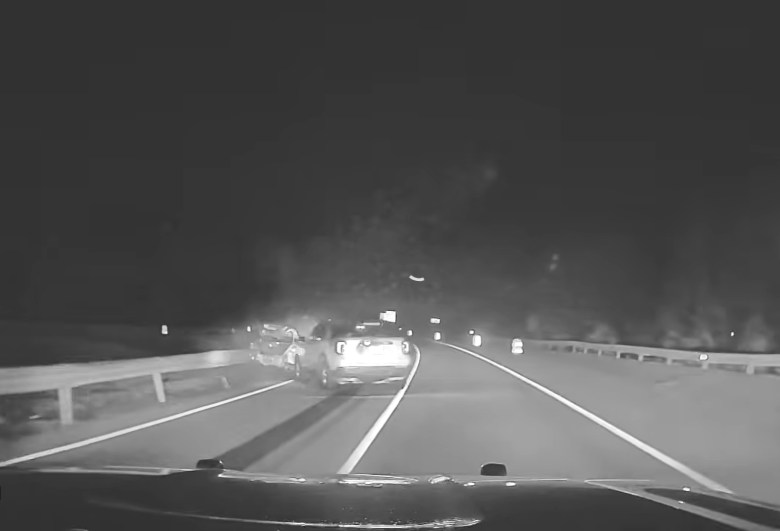
Close behind him in another cruiser was his younger brother, Trooper Noah Blanchette. The Blanchettes are third-generation state cops, grandsons of a retired major and sons of a former detective sergeant, now a police chief in Montville. Noah’s dashboard camera would record what happened next.
Blanchette drove into the rear quarter of the Honda, putting it into a spin. The Honda crashed head-on into the guardrail separating the west and east lanes, then bounced back into the path of the trooper’s cruiser.
Investigators would calculate that Blanchette was going 75 mph when he aimed his cruiser at the Honda a second time, putting it into another spin; then a third time, when Blanchette pushed it into the guardrail. The Honda’s trunk flew open, the front crumpled. The chase was over, ended without injuries — but not without legal and political complications now unfolding.
The trooper and sergeant were placed on paid administrative leave Friday, their police powers suspended. Acting on a belated referral from the police in late January, the Office of Inspector General announced the same day that it had opened an investigation into what the office called Blanchette’s “use of deadly force,” a legal term of art that applies to the level of force, not the outcome.
With the investigation comes the bright light of transparency absent for the two months after the incident on Nov. 24, including the release of audio and video recordings captured by body-worn and dashboard cameras. It raises questions about the inner workings of the State Police and renews complaints by Republicans that policies and statutes regulating police pursuits are too restrictive.
The IG investigation prompted an outcry from three House Republicans, including their leader, Rep. Vincent J. Candelora of North Branford. Like nearly all Republicans, they had voted in 2020 against the police accountability law creating the Office of Inspector General. They called the latest investigation “an overreach.”
The investigation is the first public test of the second man to hold the post of IG: a retired jurist, Eliot D. Prescott, who assumed the post in July. He was appointed in April by the Criminal Justice Commission, whose members warned it was a “difficult and thankless job,” subject to constant second-guessing of being too lenient or too tough on police.
His predecessor, Robert Devlin, had filed criminal charges against Brian North, a state trooper who fatally shot a carjacker armed with a knife as the man sat in a locked car at the end of a high-speed chase on I-95. The trooper was acquitted at trial and returned to duty after an internal affairs investigation.
Prescott, a trial and appellate judge for two decades, shrugged off the concerns. He told the commission, “I’ve made unpopular decisions on the bench.”
This week, Prescott declined to comment on the investigation or the Republican complaints of overreach, other than to say that once the State Police referred the case, the legality of reviewing the use of force was “not a close call.”
In a statement announcing the investigation, Prescott characterized Blanchette’s deliberate collision as a “PIT maneuver,” a controversial law enforcement technique used to end pursuits by striking the rear quarter of a vehicle, forcing it into a spin.
“The use of a PIT maneuver under many circumstances, and particularly at high speeds, constitutes the use of deadly physical force in light of the risk of harm it creates to the operator of the vehicle, its occupants, if any, and/or any bystanders,” Prescott said.
The technique is banned by statute in at least one state and prohibited or restricted to low-speeds by some police agencies. The Los Angeles Police Department, for example, bans the maneuver at speeds exceeding 35 mph. A report issued by the Department of Justice cautioned against its use without training.
The Connecticut State Police says it has not instructed troopers in the technique in the last six years, meaning Blanchette would have not been practiced in its use.
The Police Officer Standards and Training Council, a state agency that sets standards for policing, issued a directive in 2019 stating that “forced stop procedures,” including a PIT maneuver or other intentional collisions, “may be considered to stop a fleeing vehicle.”
But that permission came with a significant proviso: “Forced stop procedures may be considered when the necessity for an immediate apprehension outweighs the dangers presented to all parties involved and innocent persons.”
The non-binding DOJ guidance further advises police should weigh several factors before a PIT maneuver.
“Officers should communicate the current situation, including speeds, vehicles, and environment; articulate the need for using the PIT maneuver; and advise the supervisor where and how they plan to execute it. The seriousness of the crime for which the suspect is wanted is highly relevant in this determination and must be included in communication to the supervisor.”
None of that occurred in the recording made public by the IG.
In a statement to the Connecticut Mirror, the State Police declined to say whether Blanchette and Leslie had a more detailed conversation about the appropriateness of a deliberate collision.
“This investigation remains pending, and the radio transmissions between Trooper Blanchette and SGT Leslie are being examined by Internal Affairs investigators,” the department said.
Andrew Matthews, the executive director of the Connecticut State Police Union, said the union would make no statement other than the comments in a newsletter distributed to its members and first reported by Inside Investigator. It seemed directed at the IG and policymakers:
“If our Troopers are not treated fairly, or you conduct a politically motivated or biased investigation, or you mislead the public and damage the reputations of our Troopers – There will be consequences! We will never forget how the previous Inspector General treated Trooper North and falsely implied his actions were racially motivated.”
Rep. Tammy Nuccio of Tolland, one of the three House Republicans critical of the referral to the IG, said Blanchette’s actions were reasonable, given the time of day, the light traffic and what she said was the greater danger posed by the fleeing driver.
She noted that Blanchette had acted only after obtaining permission from a supervisor, and the previous deployment of a tire-deflating stop stick had failed to end the chase.
“The cops did their job, and now we’re going after the trooper and the sergeant,” said Nuccio, the mother of a state trooper not involved in the incident. “This is very frustrating to us.”
Rep. Greg Howard of Stonington, a police officer and the third Republican who signed onto the criticism statement with Nuccio and Candelora, offered no opinion on the actions of the trooper or sergeant.
“If the Connecticut State Police had done their own investigation” and faulted Blanchette or Leslie, “you would not have heard from me one way or another,” Howard said.
His objection lies in the IG’s characterization of a PIT maneuver as “deadly force” on its face, which he sees as going beyond the statute.
Ken Barone, a certified police trainer who oversees the collection of racial profiling and use-of-force data in Connecticut as a project manager at the Institute for Regional and Municipal Policy at UConn’s School of Public Policy, said the IG’s review of the incident is evidence the accountability law is working.
“Nobody would have heard about this case” had the police not referred it for review by the IG, and that is a form of accountability, Barone said. “Let’s not make hay about an agency that did the right thing.”
If the right thing, there still are questions about why details of the incident took two months to reach the highest echelons of state law enforcement — or become public. If police are accurately reporting use of force, as required by a 2019 state law, Blanchette’s deliberate collision of the Honda was the first by a state trooper since passage, Barone said.
The State Police and the agency of which it is part, the Department of Emergency Services and Public Protection, have not made officials available for interviews. But they responded in writing to questions posed by the Connecticut Mirror.
The police said via an unsigned email that the incident wasn’t reported to Col. Daniel Loughman, commander of the State Police, or his boss, Ronnell Higgins, commissioner of emergency services and public protection, until Jan. 22.
The next day, the State Police notified the Office of the Inspector General of the incident. The department gave the office relevant reports and records.
So, what accounted for the two-month delay informing Loughman, Higgins and Prescott?
“The incident was flagged for further review at the District level, and after detailed analysis of the incident at each level of the chain of command, it was ultimately identified through that standard review process as eligible for reporting to the Office of the Inspector General,” police said in the statement.
The agency has not specified if the suspension of the police powers of Blanchette and Leslie are due to violations of its policies regarding pursuits and forcibly ending them.
“The Internal Affairs investigation into this case remains pending,” the department said. “After thoroughly analyzing the pursuit and supporting documentation, if issues of non-compliance with CSP policy arise those issues will be identified.”