


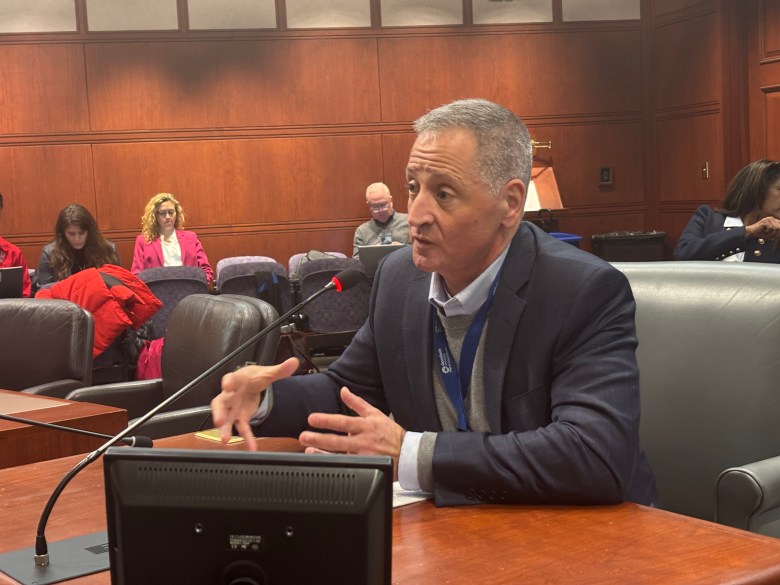
Officials from Connecticut’s regional magnet schools testified before the legislature’s Education Committee Friday on two proposed bills that they said pose a serious threat to their ability to operate.
Under Gov. Ned Lamont’s proposed budget legislation for fiscal year 2027, Regional Education Service Centers would see a $12 million cut to the magnet schools they operate. Under separate legislation, raised by the committee, the magnet schools would have to start paying for what are known as 504 plans — required accommodations for students with disabilities — shifting costs onto magnet operators and away from individual districts, which currently cover the 504 plans of students enrolled in regional schools.
The problem with the proposals, advocates said, is that regional magnet schools can’t raise enough revenue to offset the losses or cover new costs. Unlike local districts, they can’t raise property taxes. They do charge tuition, and local districts pay 58% of it, but tuition rates have been capped for years by the state and can’t be raised.
Ryan Donlon, associate executive director of the Regional Education Service Center LEARN, warned of extreme consequences if the proposed changes become law.
Those include “reducing programming for children and beginning contingency plans, and — I can’t believe I’m saying this, but … the loss of at least some of our nationally recognized and highly demanded magnet schools,” Donlon said.
Under the governor’s budget, magnet operators would be allowed to raise tuition again, but only in line with inflation as determined by the U.S. Bureau of Labor Statistics. That wouldn’t make up for the entire $12 million lost.
Eric Protulis, executive director of the Regional Education Service Center EASTCONN, said he likes the idea of tying tuition to inflation but the governor’s approach — as proposed — wouldn’t work.
“It simply locks in years of underfunding,” Protulis said.
Instead, Protulis said, lawmakers should set “a realistic base tuition rate that reflects the actual cost of education in 2026,” then adjust that for inflation moving forward. And he urged the legislature to reject changes in the two bills, H.B. 5033 and S.B. 138, which he said an inflationary adjustment could not offset.
Another problem with the 504 plan change, according to Protulis: Regional magnet schools have as many as three and a half times the proportion of students with 504 plans, compared to local districts.
Goodwin University Magnet Schools Superintendent Sal Menzo assured committee members that schools would not start turning away students with 504 plans as a result of S.B. 138, but he said, “We’ll have to make other reductions to cover the services they need.”
CREC Deputy Superintendent Sarah Vocca described the change to 504 plans as “an unfunded mandate” and said the costs for such plans can shift “wildly and unpredictably.”
“Shifting unlimited fiscal responsibility to magnet operators without additional funding places a significant strain on already very tight budgets,” she told the committee. She estimated it would cost CREC as much as $2 million more annually.
Robin Cecere, director of school choice for the Connecticut State Department of Education, said the $12 million had been “a one-time initiative to provide some financial relief.” The changes in H.B. 5033, which cut back that funding and tie tuition increases to inflation, reflect a shift to a “sustainability” model for regional magnet schools, she said.
The inflation adjustments would occur once every two years and be based on the Consumer Price Index calculated by BLS.
“So it creates a basis for ongoing support and financial relief,” Cecere said.
Cecere also said the plan “mitigates against adding burden onto districts” because local districts would continue receiving baseline per-pupil funding for students enrolled in regional schools. In effect, they would use that per-pupil funding to pay the rising cost of tuition.
However, local districts have already complained that their baseline funding remains flat in the governor’s budget. Advocates for those districts have also chafed at the proposal to allow magnet school tuition to rise.
Rep. Tina Courpas, R-Greenwich, asked who will ultimately pay the $12 million Lamont removed from the state budget.
“Is that falling on the district or on the parents going forward?” Courpas asked.
“Ultimately, that $12 million goes elsewhere, and is borne, honestly, by the [magnet school] operator now,” Cecere said. She said tuition would now increase each year, tied to inflation.
Education Committee co-Chair Rep. Jennifer Leeper, D-Fairfield, seemed unconvinced.
“The $12 million is not even — if we were following the legislative formula — where they should have been two years ago. They’ve been flat-funded for a very long time, and they are struggling,” Leeper said. “To then again reduce $12 million for this fiscal year ‘27, and then start the inflation from a reduced point — do we have an estimate of how many years it would take for them to even regain that 12 million?”
“I didn’t do that analysis, but when I looked at it, it would take a few cycles to compare to,” Cecere said.