


This year, Putnam Public Schools Superintendent Steven Rioux will ask the town of Putnam to give its school district an additional $1.6 million — a 7.23% increase from last year.
“When I built my budget this year, I asked the principals to tell me what you need, and the need was about $2.5 million, or an 11% increase,” Rioux said. “That’s not going to happen, right?”
So Rioux started cutting. He cut staff, resources and programs, and when he was done, he had whittled that 11% increase down to 7.23%. If Gov. Ned Lamont’s proposed budget becomes law, the full amount will have to be funded by local property taxes in Putnam.
That’s because the governor’s budget does not increase the state’s main school funding mechanism, the Education Cost Sharing formula, which has used the same baseline numbers since 2013 without any adjustment for inflation. Advocates suggest the formula now underestimates the cost per student by almost $4,500.
Although the General Assembly allocated an additional $95 million to ECS last year, teachers, administrators and local government officials across Connecticut say it doesn’t come close to offsetting over a decade of missed inflationary adjustments. And despite Lamont’s proposal to establish a Blue Ribbon Panel to reform state education funding, many district leaders say they can’t afford to wait even one more year.
[RELATED: Lamont’s education budget diverges from Dems, backfills federal cuts]
“I’ll just be really direct: We need funding now,” New Haven Mayor Justin Elicker said at a press conference of the Connecticut Conference of Municipalities Feb. 10. The group is pushing for ECS reform because, its members argue, the failure to increase the formula’s base input has shifted costs onto municipalities to the tune of $820 million since 2013.
Elicker said the steady grind of inflation has cost New Haven schools and taxpayers dearly.
“I’ve raised taxes pretty much every year to pay for the funding that our kids need,” Elicker said at the press conference. “In six years, we’ve increased our portion by over 10% a year, and meanwhile, the state has increased its portion of ECS and Alliance funding to the city of New Haven by just around 1%, not even close to covering inflation.
“Our residents are bearing the burden,” Elicker said.
He said the consequences can be seen across the district, which is facing an $18 million budget gap despite closing four schools and merging two others in recent years. New Haven now has just 46 school counselors, 52 social workers and 27 psychologists to manage a student population of about 19,000.
Jamilah Prince-Stewart, a New Haven resident and CEO of advocacy group FaithActs for Education, applauded Lamont’s idea of a Blue Ribbon Panel. But she said that alone will not be sufficient.
“A ribbon without action is just another knot in generations of twists and tangles that trap our children in a failing system,” Prince-Stewart said in a press release following the governor’s announcement.
Prince-Stewart has navigated the inequities of Connecticut’s education system for much of her life. Her mother had the means to send her to a private school, but cousins and family members did not. She said the gap in classroom resources translated into drastically different life outcomes.
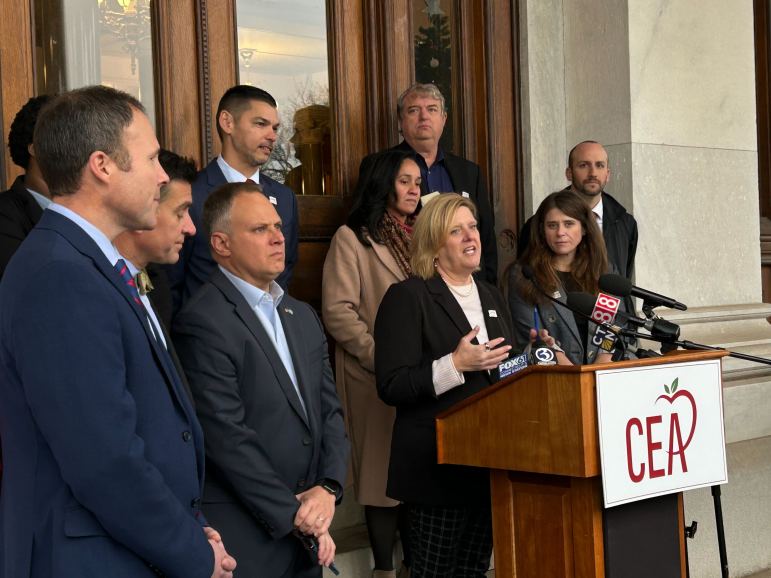
Connecticut Education Association President Kate Dias said the state’s failure to adjust the ECS formula baseline since 2013 has led to a “slow erosion” of educational staff, with consequences in the classroom.
“Last year we started to see it, where, ‘Well, do we have to fill that position?’ You know, that question starts to come up,” Dias said. One immediate result is larger class sizes. Dias said she’s seen proposals to put almost 30 kids in a single high school class.
“The optimal sweet spot is about 20 kids (per teacher),” Dias said. That’s “where a teacher can do really good work and students get the kind of direct instruction and support that they need. I would argue when you go down to the kindergarten or second grade, if we can get those closer to 15, you really get optimal opportunity for kids.”
Speaking on behalf of the Connecticut Association of Urban Superintendents, Meriden Public Schools Superintendent Mark Benigni described the governor’s budget as “a trainwreck for education” and “a complete disappointment.”
“To not have any increases built in and to think that these districts can continue to make a difference for some of our state’s most needy children just does not make a lot of sense,” Benigni said.
Rob Blanchard, a spokesperson for the governor, said, “Since taking office, Gov. Lamont’s budgets have increased school funding by 22%, including an additional $94.5 million in ECS in FY 2027, which has made our schools among the best in the country.
“As for funding in the next budget adjustment, the governor continues to meet with legislative leaders and looks forward to an agreement that continues to support our state’s outstanding schools.”

What happens if the governor’s budget becomes law?
In Putnam, residents will have to approve a 7.23% increase in their property taxes to cover everything Superintendent Rioux is requesting for fiscal year 2027. It would be a big change. Rioux said in the last several years, Putnam’s budget has risen by an average of 1.66% per year. Last year, the increase was just over 5%.
The increase is needed, Rioux said, because health insurance and special education have seen sharp cost increases in recent years.
But if residents reject the tax increase — meaning neither ECS nor local funding expands — Rioux said, “I could probably cut 10% of the teacher workforce, 10% of the of the non-certified staff, maybe even 15% of non-certified staff, all of the after-school programs, all of the clubs, all of the sports at the middle schools, all of the sports at the high schools, and I still would not be at a zero.”
He’s already eliminated health benefits from nine district positions to save money. But even that comes with a downstream cost. “My benefit pool is not as strong as some of the neighboring towns, so our application pool is going to be thinner. So there’s this ripple effect that kind of takes place,” Rioux said.
Hamden Public Schools Superintendent Gary Highsmith said every superintendent he’s spoken to has “very serious fiscal concerns for this year and for next year.”
It’s not just ECS funding that has people worried. The governor’s proposal also includes a $12 million cut to regional magnet schools, after which those schools would be allowed to start raising tuition. Local districts pay tuition for every student who enrolls in regional schools.
For Hamden, the hit could be as much as $1 million, the district’s chief operating officer, Thomas Ariola, estimates.
Highsmith and Ariola said even a building closure — often an extremely unpopular move that can permanently reshape a school district — might not be enough to balance Hamden’s budget if state and local funding don’t rise significantly.
“It isn’t easy enough to just say, ‘Close the school.’ It’s not easy enough to say, ‘Lay this person off.’ It would have to be a global change in Hamden,” Ariola said.
“A change as comprehensive as Tom is talking about, it’s something you plan for over the long period,” Highsmith added. If the district doesn’t get any additional funding whatsoever, “That gives us June and July to try to make a comprehensive, fundamental change to how we do business here in Hamden, and that’s not going to happen in two months,” he said.
Meriden Federation of Teachers President Matt Banas praised his district for “an outstanding job of doing more with less.” Still, the district is cutting 19 positions next year through attrition, “and that doesn’t even put us within touching distance of where we need to be in order to balance our budget.” (Benigni, Meriden’s superintendent, said he’s asking the city for a $6 million increase.)
Banas said with the state’s baseline funding remaining flat since 2013, his district has had to cut corners. Class sizes have grown, schools lack specialists like speech pathologists and psychologists and many students with special needs aren’t getting what they need. “It’s extremely difficult. You want to do the best, absolute best that you can for your students. But as class sizes continue to increase as programs continue to be cut, it just has become impossible to continue to do the job at the level that we want to.”
Banas said he doesn’t see the point of waiting for the results of a Blue Ribbon Panel to change ECS.
“We can’t put kids on hold for a year,” Banas said. “It’s obvious. It’s patently obvious what needs to happen.”
Meriden Superintendent Benigni concurred. “I don’t believe that you need another study. I believe we know the answer already.”
What if the legislature succeeds in raising ECS?
The governor’s budget doesn’t include an increase to the foundation amount of the ECS formula, but leaders in the General Assembly have indicated they want to raise it this year. Making that happen could be a challenge, especially as Lamont has signaled he wants the budget to stay balanced.
Nevertheless, if the legislature were to make up the full $4,500-per-student gap, Banas said the changes in Meriden would be profound.
“I would see specialists being hired back. I would see paraprofessionals being able to negotiate a better wage in their contract. I would see students in Meriden provided with the transportation that they desperately need to get to school,” Banas said. More paraprofessionals in particular would help ensure the district is meeting legal obligation to fulfill the needs of students with Individualized Education Programs, or IEPs.
CEA president Dias said if ECS gets a bump, she’d like to see more paid student teaching and better salaries for new teachers, both of which would help bring new people into the profession and shrink class sizes.
“Our starting salaries across the state are far below what competitive professions would be,” Dias said. “Get us out of the $40,000 starting range and into the 50, and our goal would be the 60.”
In Putnam’s case, the district is technically “overfunded” by $1.6 million because enrollment has declined since 2013. The district now has around 1,100 students. But, Rioux said, rising costs have far exceeded whatever overfunding the district is receiving. In other words, raising the baseline by $4,500 per student would still boost Putnam’s ECS grant considerably.
Benigni said bringing ECS in line with inflation would be a paradigm shift.
“Rather than us looking at what we’re going to cut, for the first time, we’ll be looking at, how can we make our district serve the needs of our students better,” Benigni said.
