


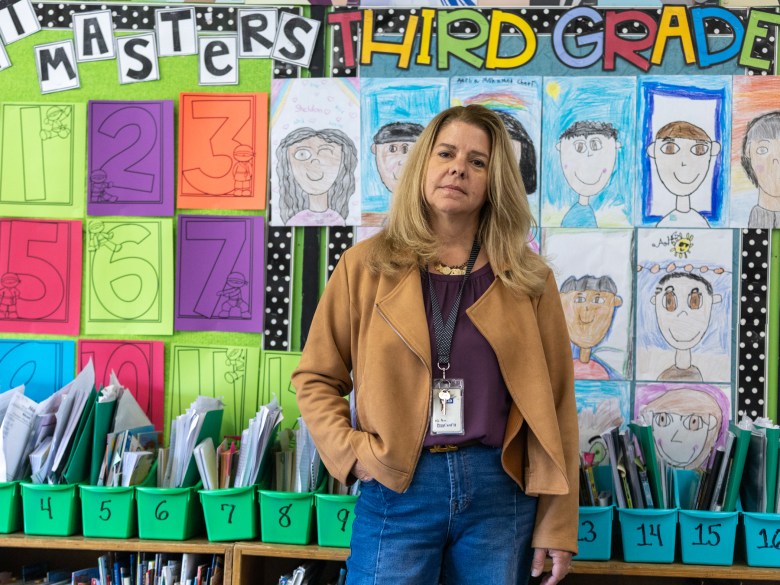
Erin Daly said the anxiety was already building at the start of summer break. That’s when some of her students told her they were “going into hiding” or said they wouldn’t be allowed to play outside.
“‘Getting caught’ and ‘rounded up’ were words that my students were using amongst themselves in conversations,” Daly said.
Then came the first week of school, and the Immigration and Customs Enforcement operation that sent shockwaves through the city of Danbury, where two-thirds of K-12 students are Latino. One story in particular grabbed the attention of students and teachers: Agents had approached a bus stop to detain parents dropping off their kids.
Daly is a third grade teacher and the president of NEA-Danbury, the district’s teachers union. She said after the ICE raids, one of her students refused to stand for the Pledge of Allegiance.
“I asked him why, and he said … ‘The flag does not keep me safe, and I’m not doing it anymore,’” Daly recalled. “It unleashed a huge assortment of emotion in my class from my other students.” Half the class, she said, was in tears.
“I’ll tell you one thing,” she said. “That bus stop incident from the first week of school traumatized so many of our kids, and I’m hearing that from all of my colleagues.”
“I’ve had students that have demonstrated a lot of negative behaviors in the classroom that they ordinarily wouldn’t have, or that they didn’t demonstrate in younger grades,” she added.
When asked for comment on those detentions, a representative for ICE shared a link to a statement released on Sept. 11, roughly two weeks after the Danbury arrests. The statement said agents with ICE’s Boston field office had arrested “118 illegal aliens,” of which “numerous have been charged with crimes.” It listed five specific individuals alongside their pending criminal charges or previous convictions.
The agency representative, who responded from a general email address and did not provide their name, did not say whether ICE is detaining green card holders or what individuals with legal residency can do to avoid being detained by agents.
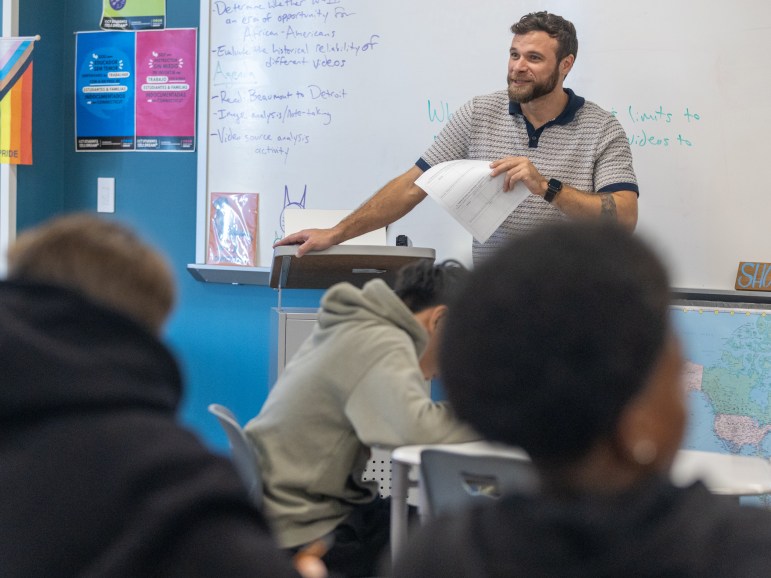
NEA-Danbury Vice President Julian Schafer, who teaches high school social studies, said students’ opinions of ICE have changed markedly since the August enforcement operation. Last year, he said, a fair number of his students expressed the belief that ICE was focused on removing dangerous criminals from the country.
“I think the blinds on that were ripped off this first week of school,” Schafer said. “It was clear mass enforcement — you know, parents being taken from a bus stop.”
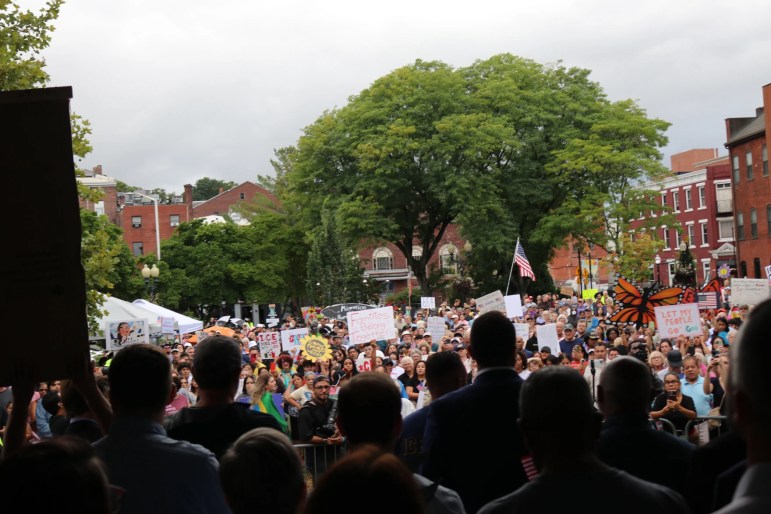
On Sept. 2, Danbury teachers, advocates and city leaders held a rally alongside U.S. Sens. Richard Blumenthal and Chris Murphy to condemn ICE and show support for the city’s immigrant community. Schafer was one of the speakers.
In his speech, he recounted how some of his students had seen ICE agents making arrests out the windows of their buses. A video of Schafer’s speech posted on Facebook drew over 100 comments, some defending ICE’s actions.
“Well, if they’re here legally, then these families have nothing to fear,” one user wrote.
“When laws getting enforced scares people, it implies that they know that they have been violating the law,” another wrote.
In early October, a group of masked protesters appeared outside Danbury police headquarters holding a sign reading “Keep New England White.” Daly described them as a “white nationalist neo-Nazi group.”
“Another level of hate being brought into our community,” she said in a text message.
The Connecticut Mirror spoke with several teachers in the Danbury area, and none expressed support for the scale of ICE arrests taking place under the Trump administration.
Schafer said he worries the detentions could potentially hurt Danbury’s tax base, which the city relies on to fund local services — including schools. “When, let’s say, an immigrant family is renting an apartment or a home, they’re paying a landlord property taxes through their rent,” Schafer said. “I’ve seen the local economy … struggle in the wake of these deportations because folks are not out patronizing local businesses.”
Outside Danbury, the impact of the late August ICE raids is less clear. In Windham, in Eastern Connecticut — which also has a majority-Latino student body — attendance during the first 10 days of school was actually 2% higher than the same period last year, according to District Superintendent Iris Gomero.
“The trends that I’m seeing is that our students are coming to school,” Gomero said. Those are “very intentional efforts that are happening from across the district. And it starts with students knowing that they’re going to be safe in our schools.”
That safety, Gomero said, comes in part through ensuring students and parents know the school’s policies around who is and is not allowed in the building.
“They know that if someone was to show up at our doors, that there’s a process and a protocol in place. That we would ask for ID, we would ask for judiciary subpoenas,” Gomero said. “And if that is not the case, then … we wouldn’t allow them to have access to our students.”
About 20 minutes west of Danbury via I-84 is Brewster, a New York town of fewer than 3,000 residents with a large Latino population. The proximity of the two municipalities means some people work in one and live in the other — as is the case for Tom Mullane, a Brewster social studies teacher and Danbury resident.
When immigration enforcement agents first started showing up in August, Mullane said, one of his close friends became afraid to leave the house, worried that the color of her skin could put her at risk of arrest.
Mullane said his friend is a Mexican citizen with permanent legal status in the United States. In the past, Mullane said, she was a visible participant in community events in Danbury, but ICE’s actions made her too scared to even shop for groceries alone.
The atmosphere in Brewster was entirely different. Although more than half of the students are Hispanic or Latino, Mullane said ICE wasn’t on their minds at the start of the school year. Instead, everyone’s attention was on something decidedly ordinary: The district’s new class schedule.
Below the surface, there are signs of disruption. Shannon Riley — a colleague of Mullane’s who also happens to be chair of the Brookfield Democratic Town Committee in Connecticut — said there are students in Brewster the district has yet to see this year.
“We’ve reached out to find out where they are and haven’t gotten any information,” Riley said. “They either have picked up and moved or they’re just afraid and don’t trust us to protect their identities.”
Mullane said he’s aware of a couple of isolated immigration cases. He’s written a letter of support for one student and talked to another whose relative was deported. And he feels there’s a sharp political divide in the community, as evidenced by opinions his students have expressed.
Mullane said he and his colleagues have become skilled in moderating political conversations when they occur in the classroom. But ICE is one topic he’s not sure they can manage.
“I feel bad saying this, but I really, I’ve avoided it,” Mullane said. “I’m worried that [these conversations are] going to go badly, even though I know that I facilitate them well.”
And the relative calm of the moment may be fragile.
“If ICE does in Brewster what they just did in Danbury, call me back and we’ll be having a very different conversation,” Mullane said.
