Faced with the mounting costs of building infrastructure that is resilient to the consequences of climate change, Connecticut lawmakers are weighing legislation that would pin the bill on fossil fuel companies that released harmful greenhouse gases into the atmosphere for decades, despite having knowledge of the damage being done to the planet.
The proposal, known as a climate “superfund,” is modeled after the successful federal program to force polluters to pay for the cleanup of toxic waste sites. Environmental advocates, including members of the Sierra Club, have identified it as one of their top priorities for this legislative session.
But the bill is also facing stiff headwinds from business groups, who argue that it would result in steep increases in the cost of gasoline and electricity bills.
Critics also note that the only two states to have successfully passed similar laws, New York and Vermont, have faced multiple lawsuits from the Trump administration and the fossil fuel industry seeking to block them. To date, neither state has collected any money on behalf of their climate superfund programs.
“The idea of holding accountable the people that are responsible for the harm, I think, is pretty logical,” said Rep. John-Michael Parker, D-Madison, the co-chair of the legislature’s Environment Committee.
“That said, there are some really important legal and practical considerations,” he added, pointing to the battles that have tied up efforts in other states. “We need to really make sure we’re learning from those as we inform how we approach this in Connecticut … so there’s a whole bunch of question marks that we need to answer.”
The legislation, House Bill 5156, directs the state’s Department of Energy and Environmental Protection to come up with a list of companies with sufficient ties to Connecticut that have globally produced more than 1 billion metric tons of greenhouse gas emissions over the last two decades through the extraction of fossil fuels or refinement of crude oil.
That threshold is roughly equivalent to all of the CO2 produced from burning gasoline to power cars and trucks in the U.S. in 2024.
The companies identified by DEEP would then be responsible for paying for a list of “adaptive infrastructure projects” that the agency deems necessary to respond to the impacts from climate change. The more emissions that a given company produced above the threshold, the more they would be on the hook to cover those costs.
Companies would have up to nine years to pay off whatever costs they are assessed to under the law, but at least 20% of the total payment would be due in the first year.
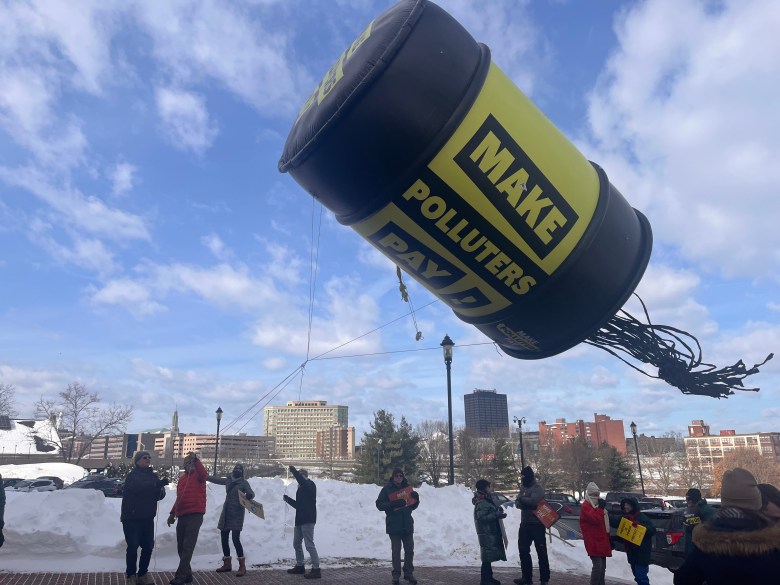
In late January, just before the start of this year’s legislative session, advocates held a rally on the steps of the state Capitol in Hartford calling for lawmakers to introduce a climate superfund bill. Flying overhead was a gigantic balloon shaped like an oil drum, emblazoned with the words, “make polluters pay.”
Julianna Larue, an organizer with the Sierra Club who spoke at the rally, pointed to damages from recent natural disasters — including $300 million associated with the 2024 Naugatuck Valley floods and up to $5 million spent battling a Berlin brush fire — as examples of kinds of costs that should be borne by contributors to climate change. The cost of building better infrastructure to protect against sea level rise in Connecticut was estimated to be around $5.3 billion by the Center for Climate Integrity, a group that supports polluter-pay legislation.
“The costs of climate change are already hitting home,” Larue said. “Let’s be clear, Connecticut communities are paying while polluters rake in profits and demand legal immunity. No industry is above the law.”
H.B. 5156 is pending before the legislature’s Environment Committee, which has yet to schedule a vote on the bill.
Gov. Ned Lamont’s office has yet to weigh in publicly on the bill.
Attorney General William Tong’s office said the legal issue is still evolving.
“This piece of legislation is currently being litigated in at least two other states and these issues are the subject of further legal scrutiny in other courts,” said spokesperson Elizabeth Benton in an email. “We support the defense of the law in those states, but the courts have not yet spoken on the legality of the law.”
During a public hearing last week, DEEP Commissioner Katie Dykes said her agency does not have an official stance on the legislation.
However, Dykes did call out the Trump administration’s rollback of many federal programs aimed at addressing climate change, which she said would result in worsening storms, flooding and wildfires in Connecticut.
“The impacts of climate change and extreme weather are very costly, and they are impacting the state, they’re impacting municipal budgets, they’re impacting communities and residents and businesses,” Dykes said. “So there are real costs associated with the delay in addressing greenhouse gas emissions.”
Connecticut is not the only state where lawmakers are considering whether to go after polluters to pay for climate-related damages. Similar bills have been introduced in Massachusetts, Maine, Rhode Island and New Jersey, according to the Natural Resources Defense Council.
In many of those states, opponents have argued that the bills amount to an unfair and retroactive penalty on companies that operated within the rules and regulations on emissions established by the states and the U.S. Environmental Protection Agency.
“It is exhausting how heavily regulated these products have been for the last 30 years,” said Chris Herb, the president of the Connecticut Energy Marketers Association, a trade group representing the state’s gas stations and fuel oil distributors.
“They didn’t miss the opportunity,” Herb added. “They highly regulated them, and they highly taxed them, and now they want to tax them again.”
Herb’s group estimated that the bill would result in $13 billion in penalties being leveled on large fossil fuel producers such as Exxon Mobil and Shell. Because those companies have a limited presence in the state, Herb said, they would simply pass those costs on to owner-operated gas stations and oil distributors, which in turn would have to raise prices on their customers. Herb said the increase would work out to around 33 cents for a gallon of gasoline as long as the penalties are collected.
Additionally, Herb said that some smaller suppliers would likely fall under the law’s 1-billion-metric-ton emissions threshold and thus avoid any penalties. If that were to happen, he said, it could create an competitive disadvantage that could force some larger companies out of the market,
“We don’t like taxes at all, but at least when they’re evenly applied, it creates a level playing field,” Herb said. “The competitive imbalances that this could create would never benefit the consumer.”
The bill is also opposed by the Connecticut Business and Industry Association, which has raised concerns about its potential impact on energy prices given the state’s reliance on natural gas to produce electricity.
State Sen. Saud Anwar, D-South Windsor, one of the sponsors of H.B. 5156, said that it should be up to the oil and gas companies — as well as their owners — to absorb the costs of any penalties levied under the bill. But if those companies do choose to pass along the cost by raising prices, Anwar said, they would have difficulty singling out customers in Connecticut from the global supply chain.
“It’s going to be a global impact, and they cannot target a state,” Anwar said. “Frankly, for what’s happening, Connecticut is a very small share of the overall fuel demand in the planet.”
Anwar said that he has not come up with his own estimates for the amount of penalties that would be leveled against fossil fuel companies, though he did not dispute the $13 billion figure presented by CEMA. “It would be in the billions for sure.”
Herb said that CEMA’s estimates were calculated based on the state’s size compared to neighboring New York, where the law set the amount of penalties at $75 billion. In Vermont, the costs of climate-related needs are being assessed by the state treasurer’s office.
Vermont was the first state in the nation to enact a climate superfund bill, doing so in 2024. One of the authors of that law, Democratic state Sen. Anne Watson, testified in favor of H.B. 5156 during last week’s public hearing before the Environment Committee. She noted that the law would not include any new restrictions on emissions or the use of fossil fuels.
“This bill isn’t actually about protecting the environment, but rather it’s about fiscal responsibility and protecting our people financially,” Watson said.