


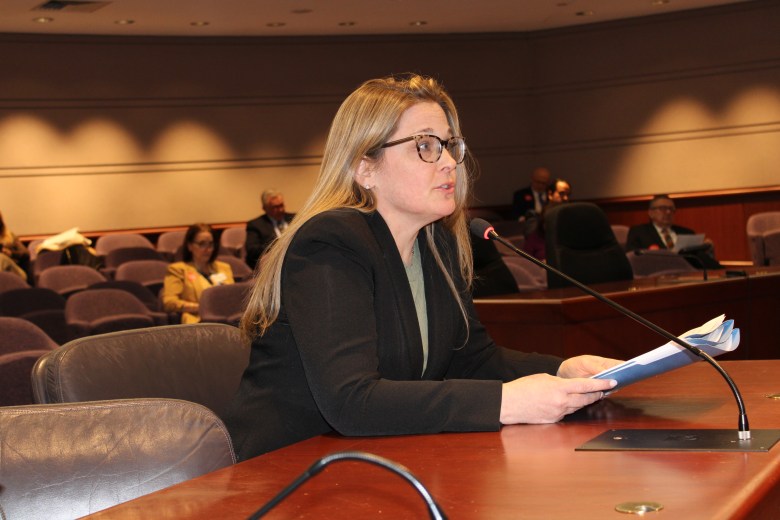
Connecticut lawmakers are considering a bill that could reduce prison sentences for victims of sexual abuse, domestic violence and trafficking in cases where the abuse they experienced was “a contributing factor” to the crime they committed.
House Bill 5306 would allow a judge to override mandatory minimum sentences for violent crimes, including murder, for certain defendants who survived “domestic violence, sexual assault, stalking or trafficking in persons.” The legislation was also proposed in 2025 but never made it to the floor for a vote.
Several states — including New York, Oklahoma, Georgia and Illinois — have passed similar legislation in recent years, in an widening effort to take defendants’ experiences of domestic violence and sexual abuse into account when weighing punishment for their actions.
“It is time that Connecticut adopt a trauma-informed sentencing framework that acknowledges the abuse that gender-based violence causes within the commission of crimes and within Connecticut’s criminal justice system,” said Meghan Scanlon, CEO of the Connecticut Coalition Against Domestic Violence, during a public hearing before the legislature’s Judiciary Committee Monday.
Under Connecticut’s proposed bill, a defendant would be permitted to provide evidence of domestic violence or trafficking during trial or at sentencing. They could also provide it at a sentence modification hearing; If the judge finds abuse was a factor in the defendant’s crime, the sentence must be reduced. If a defendant presents the same evidence to the state Board of Pardons and Paroles at a parole hearing, and that evidence is found credible, the board would have to hold a parole hearing within four months and give “substantial weight” to the information when making its decision.
Members of the Judiciary Committee, including state Rep. Craig Fishbein, R-Wallingford, raised several questions about the bill. Fishbein asked whether it might give victims of domestic violence access to relief that isn’t available to other defendants who may have been coerced into committing crimes, such as gang members.
“ You’re creating a protected class,” he said. “ I’m very sympathetic to domestic violence and victims of domestic violence, but two similarly situated individuals, both coerced to commit a murder and to have a different sentencing structure — I think you’ve got some significant issues here.”
Fishbein also questioned the type of evidence that would be allowed to support a defendant’s case. The bill would require people claiming to be survivors of sexual violence to submit two pieces of evidence. They could include records from hospitals, law enforcement or social services, a protective order, or a sworn statement from a clergy member, attorney, social worker or counselor.
Fishbein said the bill appeared to allow clergy members or attorneys with no direct knowledge of the defendant’s experiences of abuse to provide affidavits.
Anna VanCleave, a law professor and director of the Criminal Defense Clinic at the University of Connecticut, said she believes the proposal has sufficient protections built in to stop people without legitimate claims from seeking sentence reductions. The evidence presented would need to be “clear and convincing,” and the judge would have to determine the abuse or trafficking not only occurred, but contributed to the crime that the person committed, VanCleave said.
Attorneys with the state’s Division of Criminal Justice testified in opposition to the bill.
Deputy Chief State’s Attorney Lisa D’Angelo said in written testimony that the mandatory sentence reductions the bill would impose appeared “to be arbitrarily selected,” and “do not adequately reflect the varying degrees of offenses and circumstances involved.”
D’Angelo also wrote in her testimony that judges are already permitted, under current law, to consider histories of abuse or trauma when sentencing someone for a crime, or when modifying a sentencing. And she said when someone is sentenced to over a year in prison, the Office of Adult Probation has to prepare a presentencing report, which includes information like the person’s family history, educational background and medical history.
Rep. Pat Callahan, R-New Fairfield, a former chief probation officer, said that probation officers conduct thorough interviews before someone is sentenced by the courts, and that they ask about mitigating factors that should be taken into consideration.
“ In my experience over almost 30 years of doing this, I’ve never seen someone come forward and say, ‘You missed this in the investigation,’ because the investigation is so thorough with background and confirming different things that they said,” said Callahan.
But VanCleave said that it can take victims of domestic violence a long time to speak about their past experiences. Fear of their abuser or a conviction that no one would take their claims seriously, could prevent someone from disclosing abuse at the time of a trial, she said. For some people, she said, it takes time for them to recognize that what has happened to them was abuse.
“There have been clients who disclosed to me in their first interview their histories of severe abuse of all kinds. And I will also say that there are clients for whom it took years to disclose anything of that nature to me,” VanCleave said.
Kate Mogulescu, a professor at Brooklyn Law School who works with the Survivors Justice Project in New York, testified in favor of the bill, offering perspective from New York, which has had similar legislation on the books since 2019.
Mogulescu said nearly 80 people have been resentenced since the law passed, which has saved them a combined minimum of 230 years in prison. While opponents raised concerns the law would open “floodgates” for people requesting reduced sentences, Mogulescu said that hasn’t been the case so far. Of all the petitions for resentencing to date, 79 were granted, over 100 were denied and about 50 remained pending, she said.
Mogulescu took issue with the Connecticut bill’s evidence requirement, saying it might actually be too stringent for some survivors. Many victims of domestic violence do not interact with the police or with medical professionals, she said. “ I think many deserving survivors won’t be able to establish with documentation their abuse,” she said.
Betty Hines, the mother of a woman who has been incarcerated at York Correctional Institution for six years for killing her husband, said she believes a bill like this could help mothers like her, whose children had suffered from domestic violence. Hines said her daughter was originally sentenced to 50 years, but that was later reduced to 20 years.
Hines said she had witnessed her daughter’s physical abuse and taken her to counseling. She said the court did not take her daughter’s domestic violence into consideration.
“I want to see her come home and be a help to me, because I’m getting older and I’m going to need somebody to help me, to take care of me,” she said. “It’s just a lot.”
