



Hartford and Bridgeport have long been known as the poorest cities in the country, but there is another statistic that completes the poverty picture.
At the state’s southern tip is Greenwich, one of the wealthiest towns in America, and, not coincidently, the home turf of the Prescott Bush family. One business newspaper has called Fairfield County “the most unequal place in America.”
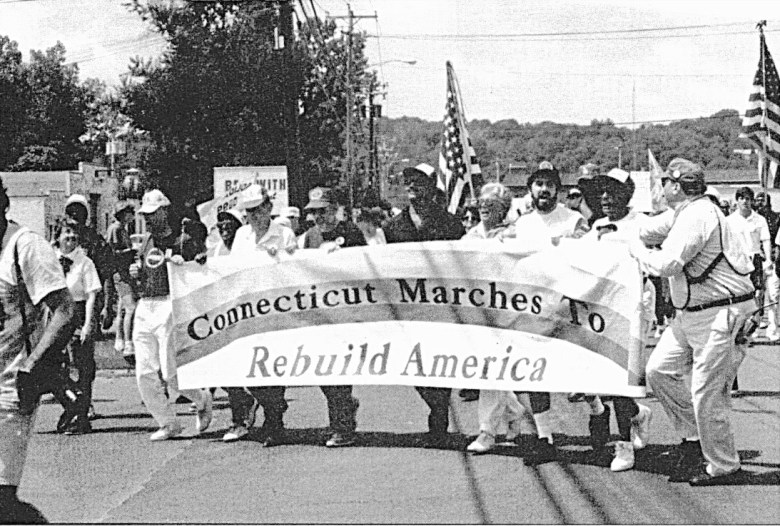
This disparity and the crumbling of many U.S. cities inspired the Rev. Jesse Jackson in 1991 to announce a Connecticut March to Rebuild America. Significantly, Bridgeport was chosen by Rev. Jackson as the starting point. On Sunday, August 15, Jackson and 2,000 others marched three miles through the city, including Father Panik Village, the nearly abandoned public housing project.
“Jobs are gone,” Jackson told an attentive crowd on the first day of the seven-day march destined for the state Capitol in Hartford. “Plants are closed. The tax base is limited. Children are neglected. Slums abound. This is a disaster born of greed,” he declared. “Bridgeport is a monument to Reagan-Bush economic policies.” Bridgeport’s mayor had only recently announced a plan to have the city file for bankruptcy.
Jackson had called on local unions and community groups to organize the march. Taking the lead was District 1199/SEIU, the largest health care union in the state, along with local community leaders like the legendary Cesar Batalla and the city’s Puerto Rican working families. District 1199 brought its Bridgeport nursing home workers, state employees, and community programs (homes for the developmentally disabled) into the effort. As a result of the march, Batalla and his allies went on to organize the Coalition to Rebuild Bridgeport.
The first Gulf War had ended three months earlier; U.S. soldiers had been sent to stop Iraq after the invasion of Kuwait. Jackson reasoned that if President George H.W. Bush could “mobilize our girls and boys to bail out Kuwait, he can mobilize our girls and boys to bail out Bridgeport.” The final cost of the war was $676 billion, three times more than the original Defense Department estimate.
According to District 1199’s Merrilee Milstein, union members joined the event to “draw attention to the need for a new domestic agenda.” The union supported Jackson’s demands for “spending more on schools instead of jails, spending more on health care instead of warfare, more to bail out cities and towns instead of savings and loan banks, and the retraining of workers” from defense-oriented to peacetime jobs.
Union vice president Milstein served as statewide coordinator for the march. She noted the widespread Bridgeport support from diverse individuals and organizations as a “remarkable outpouring of people who are demonstrating their concern for our state and our country.”
The health care union has long been known as an organization that prioritizes not only the “bread and butter” issues of its members but larger civil rights and social justice issues as well. It mobilized thousands of health care workers for the historic 1963 March on Washington, was the first trade union to oppose the Vietnam War, and actively supported Jackson’s two presidential bids.
New York mayor David Dinkins and Mayor Ray Flynn of Boston joined Rev. Jackson as the march stepped off on its 64-mile trek. Homeless veterans like Bob Weug who joined the head of the line. “Those other countries have their problems,” Weug told a reporter, “but good grief, don’t we have our own?”
On Saturday, August 20, Jackson stood in Hartford before 7,000 marchers, supporters, union members and city residents, making good on his pledge “to send out a distress signal from Bridgeport heard around the whole country.”
Steve Thornton’s latest book is Radical Connecticut: Peoples History in the Constitution State with Andy Piascik.