


The language was sharp, the exchange surprisingly caustic. At issue was how much the office of Attorney General William Tong could charge for copies of records sought under the terms of a law on books in Connecticut for 50 years, the Freedom of Information Act.
A hearing officer at the Freedom of Information Commission had recommended that Tong’s office not be allowed to charge $65 an hour for a lawyer to review and redact information exempt from disclosure, a task that could cost thousands of dollars. The AG’s representative was not happy.
“The commission’s construction leads to the absurd conclusion that every person can consume public resources without any limit,” said John Langmaid, an assistant attorney general.
The hearing officer, C. Zack Hyde, a lawyer in his fifth year with the agency, forcefully pushed back.
“I think the attorney general’s office has once again reiterated its position that the FOI commission is a waste of its time, which is not in fact the law in Connecticut,” Hyde said. “I think that if the Freedom of Information Act was applied more broadly and more liberally, they could just publish the information online.”
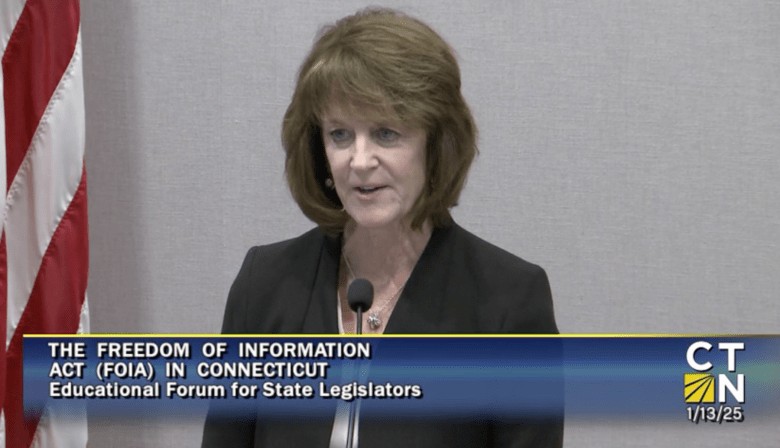
Watching that exchange in mid-January was Colleen Murphy, the commission’s executive director and general counsel. She had been a hearing officer earlier in her career. Now she was the boss, appreciating the young lawyer’s defense of the public’s right to know — and at a reasonable price, no less.
The fight no longer is Murphy’s, at least not officially. On Friday evening, her service will be toasted at the Old State House. She retired on Feb. 27 after 35 years with the commission, the last 21 as its leader.
Danielle McGee, a staff attorney at the FOI commission, has been chosen as her successor.
“Colleen Murphy is a once-in-a-generation public servant. Her career has been defined by intellectual excellence, principled leadership and an unshakeable commitment to open government,” said Owen P. Eagan, chairman of the Freedom of Information Commission. “She has been a cornerstone of transparency in Connecticut — a trusted advisor, a respected colleague, and a steady voice for accountability.”
Murphy is 61. That is public record, though the legislature recently acted to make that harder to find, striking the month of everyone’s birth from public voter registration rolls. The day of birth already was exempt.
It’s one of the many evolutions in Connecticut’s post-Watergate reform: a law that presumes every meeting and record produced by state and municipal government is public, unless it meets a specific exemption.
The exemptions once fit on a card that reporters could carry in their wallets. No longer.

The digitization of records makes them easier to transfer, but the internet and social media makes everyone a potential publisher. When Murphy was hired in 1991, the concerns over privacy were limited.
Usenet bulletin boards have been around since the late 1970s, and doxing, the weaponization of records to harass or intimidate, has been a thing since the 1990s, albeit in limited fashion. The more recent explosion of social media transformed doxing from a niche technique into a mainstream weapon.
“In the climate we’re in right now, there’s a particular desire to say, ‘Oh, we’ve got to shut this down, because we’re really afraid what’s going to happen with the information,’” Murphy said.
Murphy said the legislature is sensitive to how quickly and broadly public records can be shared. Urging lawmakers to take a longer, broader view of what is lost by concealment is difficult, she said.
A year after the slaughter of 20 children and six educators in the mass shooting at Sandy Hook in December 2012, the legislature restricted access to police records in homicide cases, most notably graphic photographs, videos and recordings of 911 calls.
It also flipped the burden of proof from the government, which previously had to justify withholding records, to the persons seeking them. They now have to show that public interest in their release outweighs the privacy interests of victims’ families. Murphy was a dissenting voice in the working group that produced the legislation.
“Yes, there’s upset and legitimate concern over that episode, but the answer shouldn’t be that we’re going to take police records out of the realm of the public, because, long term, you’ve got to make sure that there’s accountability and transparency in the world of law enforcement,” she said.
The commission’s conflicts with the the attorney general’s office involve cases with broader implications. One appeal of an FOIC decision to Superior Court tests the reach of “legislative privilege,” a constitutional protection against outside interference in the legislative process.
Late last year, Tong’s office asked a court to rule for the first time that all records relating to the “legitimate legislative activities” of the General Assembly are exempt from public disclosure. Last month, his office appealed the decision over the ability to charge for its lawyers’ time.
Murphy complained last year that the attorney’s general view of legislative privilege — essentially that everything “within the legitimate sphere of legislative activity” could be deemed exempt from public release — “would turn everything that we’ve done heretofore upside down.”
The question of whether the burden for reviewing documents for redactions rests with the public is new, Murphy said this week.
“I’ve never seen the state, state agencies and the attorney general make this broad claim about the interpretation of the fee provisions for electronic records,” she said.
Hyde, the hearing officer, said the burden rests with the attorney general’s office.
“They’re too lazy to separate their documents that need to be redacted from those that don’t, so that they need to review everything, every records request,” Hyde said. “So this is their fault for being lazy in their setup of their system.”
His recommended decision was accepted by the commission.
Eagan, the commission chair, called the fees excessive.
“I think they have a chilling effect on people’s request for documents, and I think it’s deliberate,” Eagan said.
Elizabeth Benton, a spokesperson for Tong, declined to comment on the pending appeals.
“As a general matter, the Office of the Attorney General is a strong proponent of transparency in government and fields dozens of requests each year from reporters and members of the public under the Freedom of Information Act,” she said via email. “While the Freedom of Information Act, by statute, expressly permits state agencies to charge a fee to cover a share of the associated expenses, the Office of the Attorney General very rarely does so.”
She noted that the legislative privilege and fee cases involved individuals involved in long-running disputes with the state.
“There are unfortunately individuals who have made repeated requests that have consumed tens and likely hundreds of thousands of taxpayer-funded resources with no apparent public purpose,” she said. “In those extraordinary instances, the Office of the Attorney General is obliged to guard tax dollars using the tools provided by our legislature.”
Murphy disagrees. Laughing, she said she does not expect anyoneof from the attorney general’s office, aside from a couple of old friends, at the party Friday.