


While many states watched their financial safety nets shrink last year, Connecticut bucked a national trend, building unprecedented safeguards against a recession and federal budget cuts.
The median state’s government ended the 2024-25 fiscal year with enough reserves to operate for 47.8 days, down from the record-setting 54.5 days established the prior year, according to a new report from The Pew Charitable Trusts.
At the same time, Connecticut built its rainy day fund from $4.1 billion to $4.3 billion, maintaining a reserve equal to about 18% of annual operating costs. State government here could operate for 67.4 days on emergency funds alone, according to Pew, up from 60.4 days the year before.
Connecticut, which had one of the smallest rainy day funds in the nation eight years ago, now ranks 13th nationally in terms of the days government could operate on reserves alone.
Equally important, Connecticut also used part of last fiscal year’s budget surplus to create a new $500 million emergency response fund to offset new federal cuts to human service programs.
Lamont already has directed more than $300 million of that response fund to create state health insurance subsidies for low- and middle-income families and to shore up Medicaid and other human service programs.
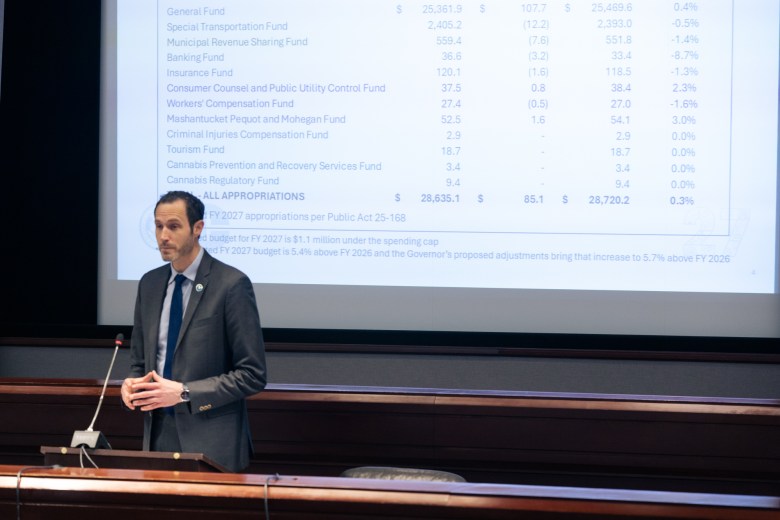
“Things have been great recently but at some point, there will be a downturn” in the national economy, said Lamont’s budget director, Office of Policy and Management Secretary Josh Wojcik.
And while a severe slump, such as the Great Recession that ran from late 2007 through mid-2009, would deplete all states’ reserves, a more moderate downturn would not shake government here to its core, nor trigger big tax hikes, Wojcik said.
“We would be in a good place in the state of Connecticut and not have to make draconian cuts that many other states would have to endure,” he added.
Nationally, median state reserves declined for the first time since 2009, Pew analysts Page Forrest and Justin Theal wrote.
“Although abundant federal pandemic aid and higher-than-forecasted tax collections helped bolster states’ financial cushions in fiscal 2021 and fiscal 2022, those temporary factors began to unwind in the ensuing two years,” they added.
Connecticut also benefited greatly from the roughly $3 billion in American Rescue Plan Act funds Congress awarded state government here in 2021, though agencies have expended nearly all that award.
But Lamont and the General Assembly also used an aggressive series of state budget caps enacted in 2017 to force much larger-than-normal annual surpluses. Unspent funds have averaged more than $1.8 billion since 2017, which represents 8% to 9% of the General Fund.
Since 2020, Connecticut officials have dedicated roughly $10 billion in surplus funds to whittle down the enormous pension debt the state built up between 1939 and 2010.
That legacy debt forced legislatures in the 1990s and 2010s to dedicate increasingly larger shares of the budget to pension contributions, stifling investments in education, health care, municipal aid and other core programs.
Wojcik noted that this fiscal year’s $3.3 billion in required payments into the pension systems for state workers and municipal teachers would be about $856 million greater had Connecticut not poured billions in surplus into its retirement programs since 2020.