



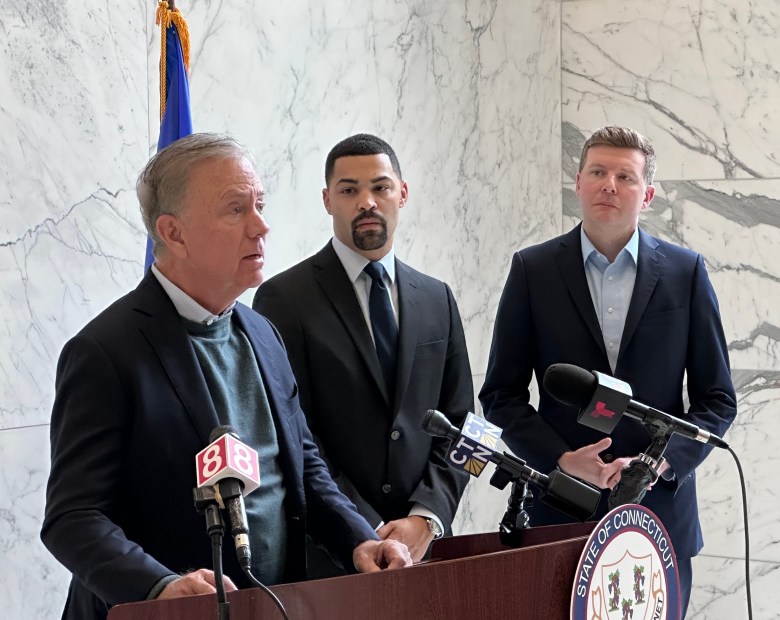
State Comptroller Sean Scanlon projected Wednesday that Gov. Ned Lamont is just a few months away from the first formal budget deficit of his administration, albeit one almost too small to measure.
And the $6 million shortfall Scanlon is tracking, roughly equal to 1/40th of 1% of the $27.2 billion budget’s General Fund, wouldn’t exist if the state still followed the pre-2017 budget rules.
Those laws bar the comptroller from counting more than $1.8 billion in income and business tax receipts that a special savings program withholds from the budget.
Those funds can be used after the fiscal year ends on June 30 to close any operating deficit. But since Lamont took office in 2019, those saved dollars have been used to build reserves and pay down pension debt.
The administration downplayed the shortfall and insisted state finances remain robust, but Republican legislative leaders said the governor and his fellow Democrats in the General Assembly’s majority have abandoned honest budgeting.
“Thanks to the progress we’ve made, the governor and legislature have numerous ways to address this small gap,” Scanlon said. Besides $1.8 billion in the income and business tax savings program, Connecticut holds a record-setting $4.3 billion in its emergency reserve, commonly known as the rainy day fund.
Together, those resources could close the projected $6 million deficit 1,000 times over.
Lamont’s budget spokesman, Chris Collibee, said Connecticut remains in a fiscally strong position, even as other states struggle.
“We’ve continued to build up our historic rainy day fund, while still making meaningful investments in education, infrastructure and public safety,” Collibee said. “Under Ned Lamont’s leadership, Connecticut has consistently ended the year with surpluses — not deficits — and that discipline is paying off. We’re going to stay focused, keep a close eye on the budget, and make sure we continue moving Connecticut forward on the strong path we’re on.”
Legislators built a modest 1% cushion of about $300 million into this year’s General Fund, and income and sales tax receipts have come in hundreds of millions higher than expected.
But, Scanlon noted, the budget was weakened by federal policy changes.
Connecticut links its state corporate tax system to the federal code, as do several other states. And since Congress and President Donald Trump last July extended federal corporate tax breaks that had been set to expire, Connecticut’s taxes on big business have come in $352 million below projections.
But that’s only part of the problem. Lamont and the legislature also failed to budget adequately for certain legal obligations.
One is Medicaid, a federal entitlement program run in partnership with states. That means it’s pointless for Connecticut to budget less for Medicaid than the projected demand, because federal rules stipulate all patients who qualify for health care assistance are entitled to it.
But Medicaid demand has remained greater than pre-pandemic levels, even though enhanced federal health care funds ordered in response to COVID expired in 2023.
Lamont’s budget staff projects the state Department of Social Services will overspend its $3.7 billion Medicaid line item by $85 million this fiscal year. The department overspent on Medicaid by more than $300 million last year and almost $160 million two fiscal years ago.
A second legal obligation pushing state finances into the red involves health benefits pledged to retired state workers.
Both the governor and General Assembly ignored Scanlon’s warnings one year ago to budget more for retiree health care.
When Lamont projected nearly two weeks ago that state finances still were on pace for a razor-thin $33 million operating surplus, that report ignored Scanlon’s estimate that the retiree health care was shy by $39 million.
The legislature’s nonpartisan Office of Fiscal Analysis agreed last Friday that the retiree health care costs and other problems create a small deficit projection.
“Our health care costs are growing, as they are for every state and every health care plan in the United States of America,” Scanlon said Wednesday. “I have tried to very clearly state those challenges … and to ask [the governor and legislators] to reflect what we believe is coming in the budget.”
Scanlon added, “I’ll let them answer for why they have not done that.”
Budget proposals from Lamont and from the legislature’s Appropriations Committee both underfunded retiree health care by roughly $90 million, based on the comptroller’s projected needs.
Many of Lamont’s fellow Democrats in the legislature’s majority argue Connecticut’s budget caps are too strict, siphoning too much money from core programs.
Republican lawmakers, who have been more supportive of the caps, say the governor and Democratic legislators simply are ignoring legal obligations rather than making cuts that would be tougher to defend politically.
The GOP has said Connecticut could reduce spending by trimming raises for state employees, finding more efficiencies at public colleges and universities, further shrinking agency staff and eliminating Medicaid eligibility for undocumented residents.
Underfunding of Medicaid and retiree health care together totals more than $120 million this fiscal year. Republican leaders in the House and Senate, Vincent J. Candelora of North Branford and Stephen Harding of Brookfield, said the scope of the budget problems being ignored is getting dangerously large.
“We’re not only raiding couch cushions now, we’re raiding under the mattress,” said Candelora.
“I think we’ve been playing funny math on our own budgets for years now,” Harding added.
Democrats counter that, in many years, at least one of the minority caucuses has failed to even create a balanced budget proposal, preferring to criticize without showing how it would solve tough problems.
Both Candelora and Harding said this week their caucuses would deliver a budget proposal for the next fiscal year before the regular 2026 General Assembly session ends on May 6.
