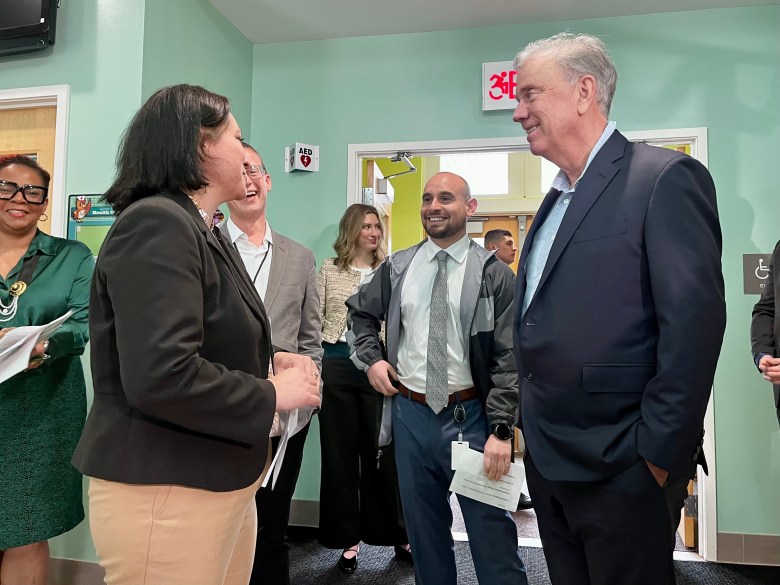
Connecticut is putting more money into case management and expanding a program that offers families child care and housing, officials announced Thursday.
The Office of Early Childhood is spending $750,000 and putting out a request for proposals to contract with an agency that will provide case management statewide for families in the Head Start on Housing. The Department of Housing is adding 250 rental assistance vouchers to the program.
Head Start on Housing began as a pilot program in 2022 and has grown since. Through the program, families that participate in the federally funded Head Start early care and education program can also get housing assistance through the state’s Rental Assistance Program.
“We found that homelessness is often not having a place and somebody to take care of your child so that you can get back to work and feel confident there’s a safe place for your child to be. That’s part of what we’re trying to do,” said Gov. Ned Lamont at a press conference in Manchester on Thursday.
The program is the only of its kind in the nation and now offers about 400 vouchers total. In December 2024, the state announced it was adding 50 new vouchers to the then-150-voucher program.
This week’s announcement comes as Lamont vies for a third term as governor and the state faces a severe lack of housing that’s affordable and available to people with low incomes. The homeless population has grown in Connecticut over the past few years, and Head Start on Housing prioritizes families who are unhoused.
The $750,000 is being reallocated from other parts of the Office of Early Childhood budget, Commissioner Elena Trueworthy said. The Department of Housing’s additional vouchers were approved in the last budget.
The program recognizes that children need housing in order to get the most out of their education, Trueworthy said. Research has shown that in the first few years of life, children’s brains are growing and developing rapidly, and those early years have long-term consequences for kids’ well-being.
“This funding will strengthen case management services. It will bring together in more alignment our systems across early childhood and housing to maximize the resources and impact that we have,” Trueworthy said.
The program cuts down on what can be long wait lists for families, Department of Housing Commissioner Seila Mosquera-Bruno said.
Shante Hanks, the Department of Housing’s Head Start manager, said that “stable housing changes the trajectory of children’s lives.”
Caitlin Crowe had been living in a car when she joined the program. The staff helped her find housing, she said.
“My life, my son’s life, everything has changed for the better,” Crowe said.
To qualify, families must be enrolled in a Head Start program and be experiencing housing instability. The Head Start program is for children ages 3 to 5, and families with low incomes based on federal poverty levels are eligible.