



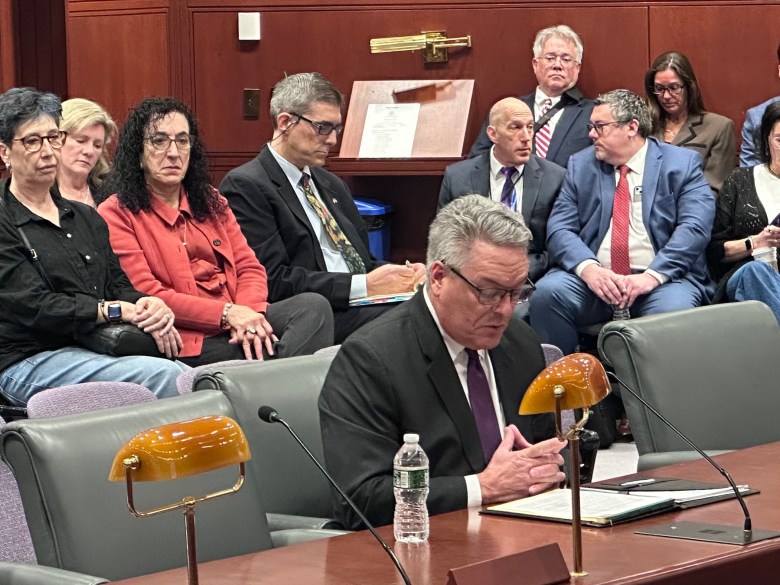
The legislature’s Judiciary Committee postponed confirmation votes Thursday on Gov. Ned Lamont’s latest nominations to the Superior Court after two politically connected nominees faced tough public questioning about their qualifications from skeptical lawmakers.
The governor’s former budget chief, Jeffrey Beckham, was grilled over his lack of legal experience, and a former Republican lawmaker, John Shaban, was challenged over a disorderly conduct charge in 2019 and a more recent unrelated administrative suspension of his law license in New York.
All 14 lawyers nominated last month as judges of the state’s trial court appeared in confirmation hearings before the committee Thursday, but Rep. Steven Stafstrom, D-Bridgeport, emerged from a closed-door caucus at 4:04 p.m. to tell an audience of mainly waiting nominees that no votes would be taken until late next week.
“Given that members are still in caucus and given the hour, we are not going to be voting on the nominations today — we’re not going to vote on any of the nominations,” said Stafstrom, the committee’s co-chair.
In a brief interview, Stafstrom declined to comment on any one nominee.
“With all the nominees before us, we look at a variety of factors, the most important among those are someone’s legal experience, their temperament, and also their intelligence or wherewithal in working within the judicial system,” Stafstrom said.

But Beckham and Shaban were the two facing questions that signaled uncertainty, at least among some committee members, about whether to vote to recommend they be confirmed by the House and Senate. Judicial nominations must be confirmed by majority votes in both chambers.
Beckham, 62, is a career state employee in the legislative and executive branches, most recently as Lamont’s top fiscal adviser as the secretary of the Office of Policy and Management. He last practiced law in a courtroom in 1990, when he was a junior associate, before being hired for a legal job in the legislature.
Sen. Gary Winfield, D-New Haven, the other committee co-chair, immediately made clear that tough questions were coming.
“I’m just going to get right into the question that’s in front of everybody. No need to play around,” Winfield said. “This committee is often engaged in asking folks with little or no experience in the courtroom about what makes them someone that we should endeavor to continue forward.”
“Your question assumes that you know that I don’t have a lot of courtroom experience, haven’t tried cases, have not been a practitioner in private practice, not to any extent and not recently,” Beckham said. “And I’m fully conscious of the fact that I have a lot of homework to do.”
Other judges have gone to the bench with little courtroom experience, some with backgrounds in corporate law. But Beckham acknowledged his resume is unconventional for a nominee.
“There’ll be a learning curve for me, and I’m committed to doing that work. I understand I’ll be given a mentor judge as well as there’s an experienced clerk staff in all the courthouses around the state that I expect to lean on and develop a relationship with them,” Beckham said. “I have a lot of work to do, and I’ve demonstrated an ability to do that. It’s the skill set that I think commends me, not the direct, substantive experience.”
Judicial nominations are made by the governor from a pool of candidates who have been approved by the Judicial Selection Commission, as Beckham was in 2010.
Rep. Craig Fishbein of Wallingford, the ranking House Republican on the committee, told Beckham he was troubled by how many years had passed since he cleared Judicial Selection and his lack of familiarity with the trial practice book or court operations in general.
“I take this process seriously,” said Fishbein, who referenced an answer in the questionnaire that nominees complete for the committee. “You said, ‘Criminal law presents an interesting challenge.’ What is your knowledge about criminal law in our courts?”
“Minimal. Back in the day, I was a temporary assistant clerk — a long time ago, admittedly,” Beckham said. “I do recall some trials. I do recall marking evidence and recording orders of the court, and those were fascinating, watching the lawyers elicit from the witnesses the evidence.”
Fishbein was not satisfied.
“My concern is that every single case that comes before a judge in our courts impacts someone’s life,” said Fishbein, a trial lawyer. “There is no, you know, ‘I’ll get my training wheels out. I’ll figure it out in six months.’ Because that very first case is impacting someone’s life.”
Stafstrom told Beckham he may be “overly optimistic” about the support the courts can offer new judges, given the lack of resources extended by legislature and governor in state budgets. It was a loaded remark, given that Beckham had played a significant role in shaping those budgets for a fiscally conservative governor.
Beckham offered no reply.
Shaban, 61, of Redding, served in the House from 2011 to 2017. He is a commercial litigator with Levine & Levine, a New York-based firm, who is licensed to practice in Connecticut and New York.
He disclosed in his confirmation package that he had been “privately admonished” in New York.
“Do you want to tell us more about that?” Fishbein asked.
Shaban said he was surprised to learn he had been suspended in New York for failing to file a renewal for a credential. He was reinstated.
“You were suspended September of 2022 and reinstated June 13 of 2024. During that period of time, did you file any filings in any New York cases?” Fishbein asked.
“Yes, I did, and that was the issue, because arguably, would have been the unauthorized practice of law in New York,” Shaban said.
Shaban said a grievance committee opposed his reinstatement unless the admonishment was public.
Rep. Jason Doucette, D-Manchester, then asked him to explain the disorderly conduct charge, which was reported by Kevin Rennie, a Hartford Courant columnist and former lawmaker, in his blog, Daily Ructions. The item was posted as Shaban tried to regain his legislative seat in 2020.
“Republican former state Representative John Shaban, seeking to return to the state legislature this fall, was arrested October 19th last year and charged with disorderly conduct at his Redding home. Shaban’s longtime girlfriend was charged with the same misdemeanor in the domestic incident.” Rennie wrote.
After a night out, Shaban told Rennie, he had taken the woman’s car keys, locked her out of his house and called an Uber, suggesting she had had too much to drink. The woman called the police.
“It’s substantially correct,” Shaban said of the blog post. “I mean, I think he might have overcooked a few things, but my then-girlfriend, now fiancée, we had an argument.”
Shaban said both of them were issued a misdemeanor summons, which he insisted should not be considered an arrest. The charges were not pursued after each completed a counseling program.
He called it a constructive experience.
“I think that’ll help me in this role, if affirmed or if confirmed,” Shaban said. “It was a learning experience. It’s one of those things that, you know, it was an unfortunate experience. I’m glad it was put behind us quickly, but it actually gave an opportunity to learn some things about myself and about our system.”
