




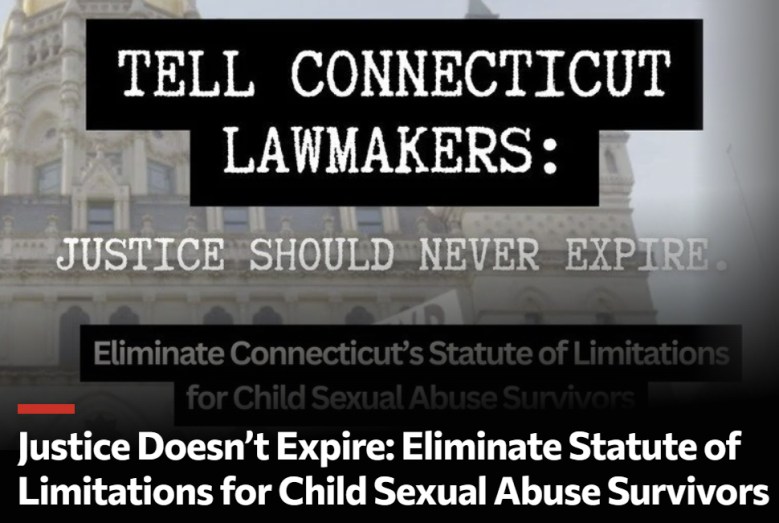
Every year, Connecticut delivers countless survivors of child sexual abuse the same devastating message: You waited too long. Not because their trauma was any less real. Not because the harm was any less severe. But because the law imposes an arbitrary deadline that ignores everything we know about how children survive sexual abuse.
Connecticut’s civil statute of limitations has long been out of step with science. Research is unequivocal: most survivors do not disclose their abuse until well into adulthood. Many spend years trying to understand what happened to them, especially when the abuse involved grooming, manipulation, or online exploitation. Yet once the deadline passes, survivors lose their right to seek justice forever.
I remember the moment I was told my claim could be time-barred. I had been abused as a student at Wolcott High School by an aggravated and years-long campaign of online sexual abuse. The abuse that happened to me wasn’t even considered a crime when I was first victimized; it had no name.
Now, after years of coming to terms with the harms that have happened to countless women who went to my high school and me, we know the name, we know the crime. Still, we all have limited access to justice because of the nature of Connecticut’s civil statute of limitations.
That isn’t justice, it’s a continuation of abuse.
Samantha and I know all too well that the harms of online exploitation don’t stay on the internet. It bleeds into every classroom, every therapy appointment, every nightmare. As survivors, our goal is to create a more just world than the one that we grew up in. But justice that’s time-barred is not justice.
Because in Connecticut, once the deadline passes, it is over. There is no second chance. No matter how strong the evidence. No matter how many other victims exist. No matter how much courage it took to finally come forward. No matter the emotional and psychological cost.
Childhood survivors across Connecticut share similar sentiments.
Carmelita Rifkin emphasizes that eliminating the statute of limitations is essential because memories of childhood abuse can remain inaccessible for decades. She shared:
“In my case they were repressed, and I didn’t remember what happened until I was a 35‑year‑old woman (and the mother of a 3‑year‑old daughter, which was the same age I was when I was abused). From my understanding, this scenario can bring back the memories.”
Another victim described to us how she kept her abuse buried well into her 30s. From age 7 to 11, she lived in fear, terrified that if anyone discovered what her mother’s live-in boyfriend was doing to her, she and her four younger siblings would be taken from their single mother and separated into foster homes. By the time she finally faced the fear and shame of her past, decades had passed, and she knew the window for justice had already closed.
Here is yet another victim sharing with us how the statute of limitations compounds the harm:
“As children we don’t always remember everything that happened to us. In my case I was 17 and in high school when I began to recall moments and sensations of abuse and tried unsuccessfully to speak about it with my parents. Due to their uncomfortable reaction and me not knowing exactly what took place, I never brought it up again. Sexual abuse affects me today as an adult in her 40s and I have no recourse to gain any form of justice. I was assaulted in college, also many years ago, and that too is something that I can do nothing about. As a survivor I should be able to take action without a time limit. Our lives are already challenging enough to navigate the after‑effects of abuse.”
This injustice is even more stark in the digital age. Technology has accelerated the scale and permanence of abuse. Deepfake sexual images of children can be created from a single photo. Anonymous platforms allow predators to hide. Exploitation can spread globally in seconds. Yet, our laws still operate as if child abuse is a simple, one‑time event with a predictable reporting timeline.
We call on the Judiciary Committee to eliminate the civil statute of limitations for child sexual abuse. We further call for a three‑year revival window for survivors whose claims were previously time‑barred. This ensures that perpetrators no longer benefit from the passage of time and the vulnerability of the child they harmed.
This is not a partisan issue. It is a moral one. When the law tells survivors they are “too late,” it is not just closing a case. It is closing the door on healing, accountability, public safety, and justice.
Connecticut must decide whether it will continue to let predators escape accountability because a child could not speak soon enough, or whether it will finally align its laws with the truth: trauma takes time, and justice should not have an expiration date.
Not for the children harmed in silence.Not for the survivors still finding their voices.Not for those who never had a chance the first time.
This legislative session, survivors are not waiting silently. A statewide Lobby Day at the Capitol on April 7 will bring their voices directly to lawmakers; voices once silenced by trauma, shame, and the ticking clock of the statute of limitations. It is an opportunity for Connecticut to confront the human cost of inaction.
Those who believe justice should not expire can sign the petition calling for the Judiciary Committee to act now. You can register here for Lobby Day on April 7 at the Connecticut State Capitol.
Every signature and every voice tells survivors and the Legislature that a child victim’s time has not run out.
Leah Juliett is an award-winning writer, speaker, and organizer whose work sits at the intersection of digital safety, LGBTQ+ equity, survivor justice, and tech accountability. She grew up in Wolcott. Samantha McCoy is an appellate attorney, activist, and master social worker specializing in trauma-informed practice and survivor-centered policy reform.