



This story is part of CT Mirror Explains, an ongoing effort to distill our wide-ranging reporting into a "what you need to know" format and provide practical information to our readers.
After years of seeing Connecticut’s bottle redemption rate dip below the 50% mark, lawmakers changed the deposit to 10 cents from 5 cents in 2024 to encourage more people to redeem their used bottles and cans.
Now that redemption rate sits at 97% in 2025 — meaning 97% of the bottles sold were returned in exchange for the deposit. But retailers and distributors argue that some of the increase in redemption rate might come from people traveling from neighboring states to redeem bottles not purchased in Connecticut, which would negate the purpose of the deposit and create revenue problems for them.
As a result, some legislators are now questioning whether the 10 cent program needs adjustment.
Here’s what to know.
Why does Connecticut have bottle redemption?
Oregon was the first state to introduce bottle redemption — at the rate of 5 cents in 1971 — with the goal of controlling litter from bottles and cans that ended up in the street. Nine other states have since added bottle bills, including Connecticut, which passed its 5 cent redemption bill in 1978.
That amount would equate to about 25 cents today if the deposit fee would have kept up with inflation, according to the Consumer Price Index’s inflation calculator, which it did not. Still, Connecticut residents received back $42 million from redemptions in 2023 alone.
Why the change to 10 cents?
Redemptions had been trending down in Connecticut for years, slumping south of 50% in 2020, despite a rate of well over 50% in the early 2010s.
When Oregon, which had a similar problem, bumped its rate to 10 cents in 2017, the state saw its returns increase by over 15 percentage points in the following years.
So, in an effort to increase the number of bottles and cans recycled and cut down on litter, Connecticut lawmakers in 2021 voted to raise the redemption incentive to 10 cents as of Jan. 1, 2024.
Two years after increasing its own redemption amount, Connecticut’s rate jumped from 50% at the end of 2023 to 97% by the end of 2025.
Isn’t a 97% return rate a good thing?
No, retailers and distributors argue. Retailers say that much of this increase is trucks from bordering states with low or no redemptions that have been traveling to their stores to redeem out-of-state bottles for cash in Connecticut.
And distributors say they have seen returns in certain parts of the state add up to more than the total number of bottles sold, and that out-of-state returns are to blame.
Under the current redemption system, retailers buy bottles for 10 cents from distributors and sell them to consumers with a 10 cent deposit fee. When consumers redeem their bottles, they get the money back from retailers and redemption centers, which in turn get 10 cents back from the distributor when they return the sorted bottles.
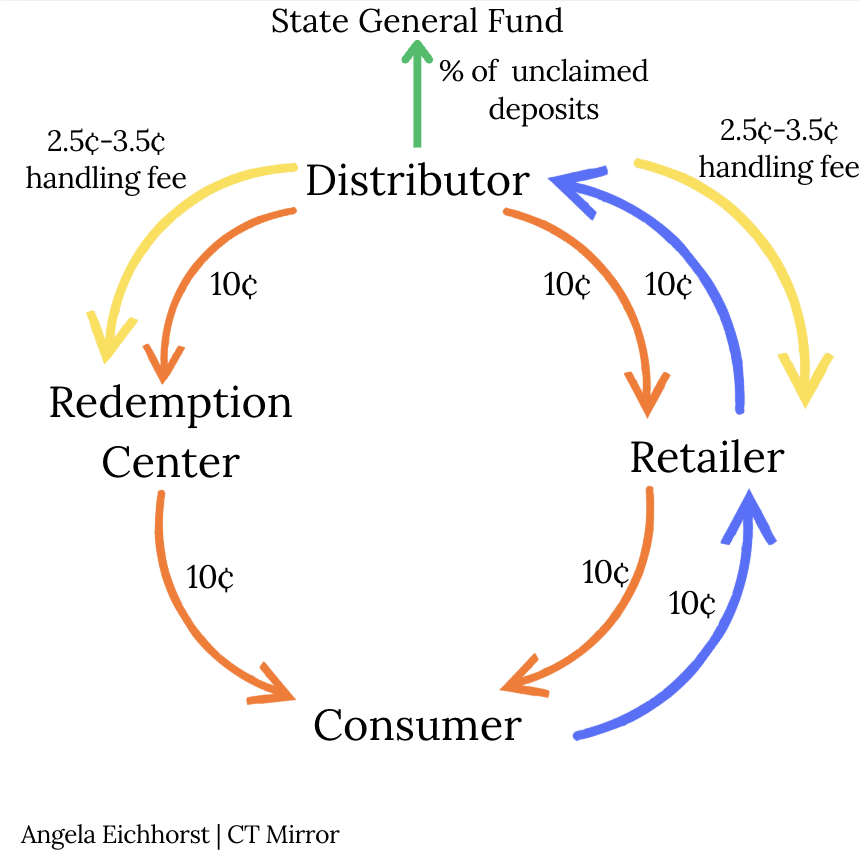
But distributors say they are spending more money redeeming bottles than they have been paid for. According to the state’s Department of Revenue Services, nearly 12% of wholesalers reported paying out more redemptions than they collected in deposits in 2025, totaling a loss of $11.3 million.
Any bottles consumers don’t redeem are considered forfeited. Distributors pay a portion of that cash to the state’s general fund and a portion to retailers and redemption centers as a fee (about 3 cents per bottle) that they use to operate their recycling rooms, and in some cases turn a profit.
What are lawmakers doing now?
In the 2024 session, lawmakers made it illegal to knowingly redeem bottles from another state. And in 2025, they passed an emergency certification bill to crack down further, raising fines, allowing local police to go after out-of-state violators and requiring redemption centers to keep track of bulk drop-offs.
In 2026, two additional bills have passed to the Senate floor, one hoping to bring the incentive back down to 5¢ if the redemption rate exceeds 100% and the other to overhaul the system by putting the burden on distributors.
In a press conference on Wednesday, House Speaker Matt Ritter, D-Hartford, said he did not want to see the redemption rate moved down to 5 cents this session.
“We’ll give it some time to see where it works its way through,” Ritter said.
Where do bottles go once they are redeemed?
Once containers are sorted and cleaned, distributors funnel them into recycling streams. Aluminum cans are shredded into scrap metal and recycled into raw aluminum to be made into cans again. Glass is crushed and made into new containers or construction materials. PET plastic can be used in new bottles and packaging.
Single stream recycling can prevent contamination from other materials, increasing the quality of the recycled materials.
Connecticut has gradually been expanding the types of containers that are redeemable. In 2009, the legislature added bottled water to the existing list of soda and beer. And in 2021, the legislature included hard seltzers, hard ciders, juices, coffee and energy drinks.
Nips are currently not eligible for redemption, but consumers pay a 5-cent surcharge that goes towards environmental efforts in the town where they were purchased.
