


Experts in juvenile justice say Connecticut has taken a step back from its role as a longtime leader in programs designed to meet the needs of teenage girls.
The state began incorporating what are known as “gender-responsive” strategies — methods that take into account the specialized needs of young men and women — into the juvenile justice system about 25 years ago. Over that time, the state passed multiple laws limiting detention for certain offenses, and it established new programs geared specifically toward girls — including a specialized probation model.
But Erika Nowakowski, executive director of the Tow Youth Justice Institute, said after state lawmakers decriminalized certain “status offenses” like truancy in 2007, it also eliminated funding for programs designed to help young women.
“What we needed to do is, instead of eliminating them, we probably needed to keep them and open up a different access door to them,” Nowakowski explained.
In a report last month, the Tow Youth Justice Institute found that while girls remain far less likely than boys to end up in the criminal justice system, their numbers have grown over the last few years. In 2022, 1,370 girls were involved in the system; in 2024, that rose to 2,510.
Of about 700 girls who were either placed in a detention facility or under the supervision of juvenile probation in 2024, just over half were found to have significant mental health needs, the report found. And about a third were dealing with substance abuse, “family distress” or “anger and aggression.”
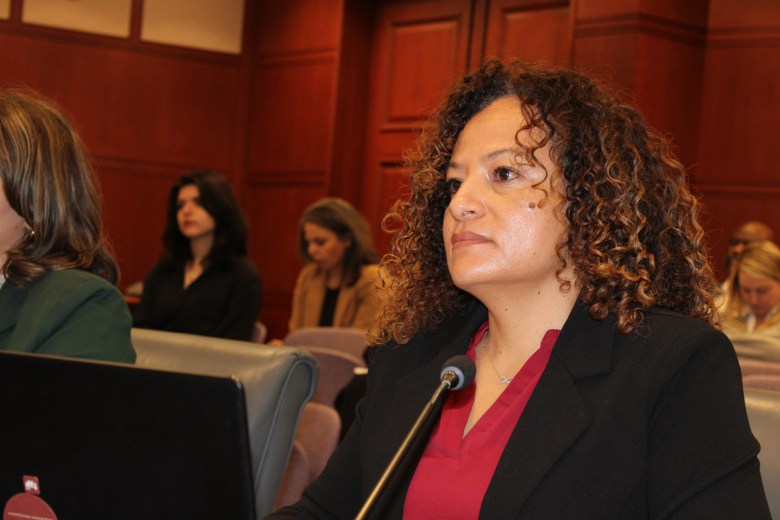
At a meeting of the state’s Juvenile Justice Policy and Oversight Committee on Friday, Nowakowski moderated a panel discussion of several experts who underscored the unique needs of teenage girls who enter the juvenile justice system.
Stephanie Covington, a researcher in trauma-informed and gender-responsive programs, who has worked with Connecticut, said at the event that programs designed for girls must focus on trauma. She said girls in both the juvenile justice system and the child welfare system often have few supportive adults in their lives.
“ Relationships are key. How do we provide girls with relationships, pure relationships and adult relationships that they can count on?” Covington said.
Tracie Bernardi Guzman, founder of Reentry Solutions CT, an organization that supports individuals returning from incarceration, said relationships and mentorship are important from the first day girls enter the system.
“We should give girls an opportunity to open up, because when they feel safe and relieved and not judged, that’s when they are more willing to talk,” said Bernardi Guzman, who was incarcerated as a young adult.
Caught in two systems
Data from the Tow Youth Justice Institute’s report showed that about half the teenage girls admitted into a Connecticut detention center in 2024 were also under the care of the state Department of Children and Families. Broadly, girls outnumbered boys in the child welfare system.
The institute found similar trends during the preceding two years, as well.
And while neglect was the main reason — by far — that both boys and girls end up involved with DCF, data showed girls were several times more likely to be removed from a home because of sexual abuse.
Attendees at the JJPOC panel on Friday highlighted various ways the state’s child welfare and juvenile justice systems intersect and asked what changes might improve outcomes for teens who find themselves involved with both systems.
Conditions at the residential homes run by the Department of Children and Families, known as STTAR homes, have come under increased scrutiny over the last two years. In October 2023, state lawmakers held a hearing about reports from a state residential facility for girls located in Harwinton. Police and EMS workers were continually being called to the facility to respond to a variety of complaints, including physical and sexual abuse of the girls by staff members and multiple instances of girls running away from the facility, sometimes stealing vehicles that belonged to the state.
In response, the Department of Children and Families promised a series of changes to facility operations, including reducing the number of teens in each home from six to five, adding staff members and creating two new Intensive Transitional Treatment Centers for youth with higher needs.
Last July, officials with DCF told the Juvenile Justice Policy and Oversight Committee they’d sent funding to the residential facilities to boost staffing and expand programs and activities for the teens. They also gave each of the homes $35,000 for outside security cameras. Officials also said they’ve developed a new process for referring young people with serious needs to Psychiatric Residential Treatment Facilities, increased their visits to the homes and have been providing specialized trainings to program staff.
Frank Gregory, DCF’s administrator of behavioral health community services, told the Connecticut Mirror in December that reducing the number of young people in the facilities gives staff the ability to devote more individual attention to each teen and build stronger connections.
But nonprofit leaders and some state officials say they still have concerns about the STTAR homes.
Martha Stone, an attorney and founder of the Center for Children’s Advocacy, has said some of the young women that end up in the STTAR homes were already involved with the juvenile justice system and only got in more trouble once they were there.
“That’s the irony. They go to a place that’s supposed to keep them safe and then they end up getting arrested at the STTAR homes for additional charges,” Stone said.
An audit report published in August 2025 found that children ran away from DCF care about 3,700 times between 2021 and 2023, with an increase of 42% over the time period. According to the audit, DCF had at times failed to put into place controls that would ensure the children were safe and frequently failed to document why individual children ran away.
Frank Gregory, DCF’s administrator of behavioral health community services, said girls at the STTAR homes have complex needs, and running away is one of their coping mechanisms.
“Certainly the circumstances of their life thus far, and some of the behaviors … put them at heightened risk for exploitation and victimization, including human trafficking,” said Gregory, who added that this wasn’t a failing of the STTAR homes.
“These are some of our most vulnerable youth, and there is no other way to say that,” said Ken Mysogland, the department’s chief administrator of external affairs. “And we recognize they require some very specialized programming.”
Rep. Toni Walker, D-New Haven, said during the event Friday that she doesn’t think the state should arrest young people who run away from residential facilities.
“What’s the difference between sending them to prison for not going to school or arresting them because they’re adolescents and they’re running?” she said. “We’ve got to look at these laws.”
Christina Villatoro, a director with Community Solutions Inc. said at Friday’s forum that residential treatment models should shift away from a mindset of controlling the child’s behavior and forcing compliance. She said she doesn’t think that’s helpful.
Instead, she said, programs should focus on teaching young people skills rather than rewarding them for following certain rules.
“Really taking a look at, what are they running [away] towards?” Villatoro said. “If it’s connection, if it’s relationships, if it’s parents … what can we do to support that so we can keep them safe?”
Vinny Russo, chief administrator of government affairs and policy at DCF, said the department has worked to develop preventative programs. That includes a newer program, Community Pathways, that connects families with children to in-home behavioral health and support to provide mental health, substance abuse and parenting services. Russo also said during the Friday event that DCF is working on establishing a model for therapeutic foster care.
Experts at the forum also raised concerns about the lack of services and programs available for teenage girls housed at York Correctional Institution, the state’s women’s prison.
According to the Tow Institute report, 19 minor girls were housed at York between 2022 and 2024 for an average of about two months. Their experience there can be isolating, since they must be housed separately from adult women — and programming is limited.
Gender-responsive strategies certainly haven’t disappeared from state systems.
The Judicial Branch has been using gender-responsive probation officers to provide specialized supervision for women since 2006 — one of the changes that has survived from the period when the state prioritized these strategies. Lead probation officer Camila Tougas said during Friday’s panel that the officers work with teens and their families, focusing on each young person’s goals and allowing them to decide who they want to be providing support.
Covington, the researcher who has worked with Connecticut on trauma-informed care, said the state has a lot going for it. But she said it needs to shore up its programs.
“You’re an interesting state. You’re small. You have resources — you have financial resources, you have workforce resources, you have intellectual resources,” Covington said during Friday’s event. “Other states are suffering. You really aren’t.”

