


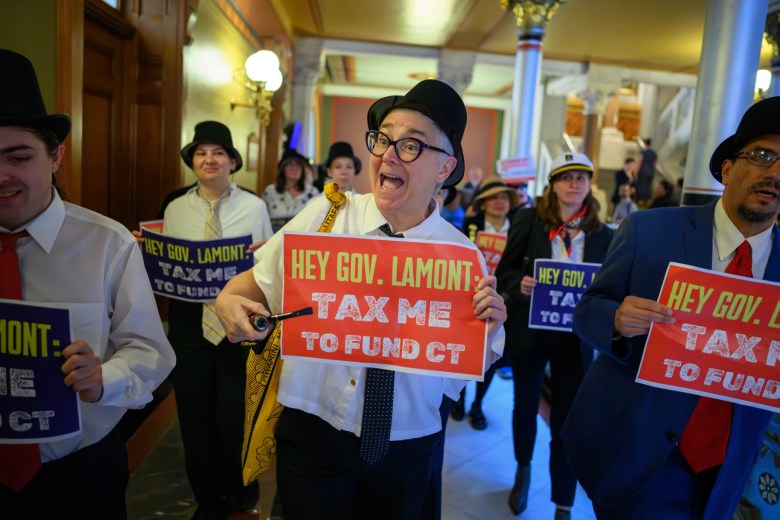
About a dozen people dressed as Mr. Monopoly spent Tax Day at Gov. Ned Lamont’s office, asking for a fairer tax system with over 1,500 postcards from residents across the state.
“We have working families saying we are doing what we can with what we have [and] we can’t take it anymore,” said Norma Martinez-HoSang, the director of Connecticut For All, a statewide coalition of social justice advocacy groups.
Her organization helped organize the event that saw advocates alongside the Mr. Monopoly lookalikes at the State Capitol Wednesday. They all chanted on the front lawn, “Fund Connecticut. Tax the Rich.”
Small business owner Lauren Anderson, who runs a community book space in New Haven called Possible Futures, said Connecticut lawmakers love a ribbon-cutting, but that energy doesn’t match their policies.
“If everyone paid their fair share, including the biggest corporations and the wealthiest individuals in Connecticut,” Anderson said, “we could invest in a foundation that small businesses depend on: healthy workers, strong communities, and customers who can afford to spend.”
Alicia Hernandez Strong, a fourth grade teacher within the New Britain Public School district, said a billionaire’s tax would help fund state services and school programming that are at risk of being cut.
“If we do tax the wealthy, then we’ll be able to guarantee great schools for every child,” Strong said, “not just the children and the families who can afford to live in these wealthier towns.”
Americans for Tax Fairness released a report Wednesday, noting that Connecticut’s billionaires have seen a 34% wealth growth within the last 16 months. The data in their report is listed as their own.
A debate on tax relief
Rep. Jason Doucette (D-Manchester) pointed to the policy decisions from Washington as a strain on what he called Connecticut’s “tax inequity problem.” He serves as chairman of the tax equity caucus.
“How are we going to fund SNAP and public benefits, which have been slashed down in Washington?” Doucette said. “We’re facing a real crisis, and it’s only getting worse.”
Senate President Pro Tempore Martin M. Looney (D-New Haven) and Senate Majority Leader Bob Duff (D-Norwalk) said in a written statement that it’s a problem Democrats are addressing in Connecticut.
“This is the most expensive Tax Day in recent memory. The only people catching a break are the wealthy and well-connected,” they said. “Here in Connecticut, Democrats are doing the opposite. We are working to cut the sales tax on groceries, clothing, and everyday essentials to put money back in the pockets of middle-class families.”
Connecticut Republican Chairman Ben Proto disagreed. He said Gov. Lamont and Democrats are ignoring what he says is the one true problem weighing on the state’s tax system: property taxes.
“It is the most regressive tax that we have. It’s the only tax where, when you get the bill, you have to pay it. There’s nothing you can do to minimize it,” Proto said.
House Republicans released a $27.9 billion budget plan Tuesday that is meant to ease property tax pressures, lower household costs, address the school funding crisis, and provide millions in tax relief.
Strong, the New Britain school teacher, agreed to a certain extent. According to her, property taxes are only part of the problem.
“We can’t rely on any type of tax that targets working class people,” Strong said. “We have to target people who won’t really be affected.”
Proto said he worries targeting the ultra wealthy will force them to leave Connecticut.
“The people who are clamoring for higher taxes on the ultra wealthy end up paying higher taxes because the ultra wealthy leave,” Proto said. “They take jobs with them. They take economic growth with them. They take state revenue with them.”
Proto pointed to Massachusetts and its millionaires tax, saying that it drove wealthy residents away. According to the Boston Globe, IRS data found that even though less people left between 2022 and 2023 than the year prior, the total net loss was slightly more in the adjusted gross income, by about $0.3 billion.
Tax debates are expected to continue with the last few weeks of the legislative session ahead.
This story was first published April 15, 2026 by Connecticut Public.