



This story is part of CT Mirror Explains, an ongoing effort to distill our wide-ranging reporting into a "what you need to know" format and provide practical information to our readers.
Prediction markets have exploded in popularity over the past couple of years. Users can bet on the outcomes of everything from elections to sports to award shows.
The proliferation of these platforms in the U.S. has also captured the attention of state officials and members of Congress. And for a growing contingent inside and outside of Washington, there are concerns over fraud, insider trading and gambling addictions.
That has prompted debates over who should regulate prediction markets and whether to place more guardrails to protect consumers.
Connecticut officials and lawmakers have increasingly been at the forefront of this issue both from Capitol Hill and back at home.
Here’s what to know.
What are prediction markets and are they different from gambling?
Prediction markets are online platforms where you can bet on outcomes of real-world events. They offer them in the form of “event contracts.” You can buy a yes contract — that an event will occur by a deadline — or a no contract.
Two of the biggest companies dominating the industry are Kalshi and Polymarket.
Kalshi is an U.S.-regulated exchange. Polymarket is a crypto-based platform that was banned from operating in the U.S. for several years until late last year. Both companies have established partnerships with professional sports leagues and newsrooms.
Skeptics of the platforms believe they mirror gambling and sports betting.
Platforms like Kalshi dispute that characterization, arguing that buying event contracts function “similar to the way that stock and derivatives exchanges work,” according to its website.
Who regulates prediction markets?
Regulation has emerged as a hot topic pitting the federal government against states.
The Commodity Futures Trading Commission — an independent federal agency that has jurisdiction over derivative markets — is overseeing prediction markets. The Trump administration, including CFTC Chairman Michael Selig, have asserted that this agency has sole authority over these exchanges.
That has put them on a collision course with states like Connecticut. Attorney General William Tong argues prediction markets are operating in violation of state laws.
Connecticut’s Department of Consumer Protection Gaming Division sent cease and desist letters to Kalshi, Robinhood Derivatives and Crypto.com in December, saying “only licensed entities may offer sports wagering in the state of Connecticut.” The agency alleged that they are also in violation for offering wagers to those under 21.
Tong argued the law establishing the CFTC as a governing body was regulating futures contracts for agricultural commodities and physical commodities “that have economic value.”
“Trading on whether somebody has been assassinated or not has absolutely no economic value,” Tong said at a Friday press conference.
Critics contend prediction markets are circumventing states’ sports betting laws and operating in places that have banned the practice. Connecticut authorized sports wagering in 2021, but it remains illegal in 11 states. DraftKings, FanDuel and Fanatics Sportsbook are all licensed to operate as online sports betting in Connecticut.
The CFTC sued Connecticut, Arizona and Illinois earlier this month for seeking to regulate prediction markets.
The Trump administration has been friendly to the prediction market industry.
And Donald Trump Jr. serves as a strategic adviser to both Kalshi and Polymarket, and his venture capital firm has made a strategic investment in the latter.
Why have these platforms come under fire?
They have become controversial amid accusations of insider trading over well-timed bets, specifically around war, that have led to major payouts.
Some eyebrow-raising bets came right before the U.S. capture of Venezuela’s president and the military strikes against Iran. That raised the question of whether individuals with material nonpublic information used that knowledge to place such wagers, including those in the government.
As the platforms face criticisms and a wave of new federal legislation, Kalshi and Polymarket have instituted some changes to try and combat insider trading.
Ethics regulations that govern executive branch employees prevent them from participating in gambling activities while on duty for the government or on government property, according to a White House official. It also prohibits using nonpublic government information for personal gain.
Selig testified at a House Agriculture Committee meeting last Thursday that the CFTC is taking precautions as the chief regulator.
“I want to be crystal clear to anyone who engages in fraud, manipulation, or insider trading in any of our markets: we will find you, and the full force of the law will come to bear,” Selig said.
What are CT lawmakers proposing in Congress?
There are a litany of legislative proposals seeking to rein in prediction markets. Both of Connecticut’s Democratic senators introduced their own bills last month.
U.S. Sen. Richard Blumenthal introduced the “Prediction Markets Security and Integrity Act” with U.S. Sen. Andy Kim, D-N.J.
The bill would prohibit individuals or prediction market operators from using “material, nonpublic information” in wagering and prevent them from creating or participating in listings that present a conflict of interest. It would restrict operators from offering listings that are susceptible to “manipulation or fraudulent activities” like war, death or military action.
It would also bar prediction markets from targeting individuals and advertising to individuals under age 21 as well as anyone with gambling disorders or addictions. And it would require site operators to verify users’ names, ages and locations.
Blumenthal recently wrote a letter requesting the commissioners of professional sports leagues to provide details on partnerships with prediction markets by May 1.
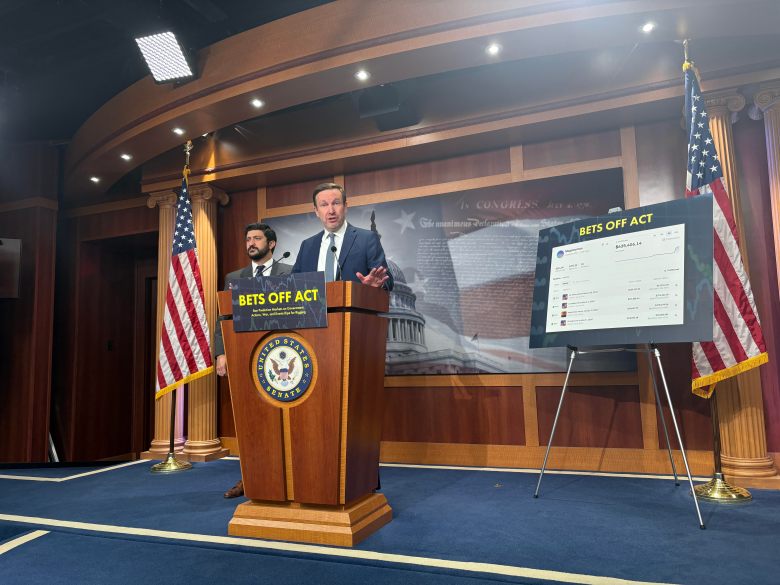
U.S. Sen. Chris Murphy introduced the “BETS OFF Act,” which goes farther than many of the bills proposed so far.
His bill with U.S. Rep. Greg Casar, D-Texas, would prohibit wagers on terrorism, assassination and war. It would also ban trades on nonfinancial government actions and events where the outcome is known in advance or someone has complete control of an outcome.
The prohibition would apply to bets on the length of the Super Bowl halftime show, the winners at the Academy Awards and the words used in a political speech because someone knows the outcome beforehand.
Other pieces of legislation would ban members of Congress and executive branch employees from betting on policy and political events. It’s unclear if any of these bills would gain traction in the Republican-led Congress.
The Connecticut Mirror/Connecticut Public Radio federal policy reporter position is made possible, in part, by funding from the Robert and Margaret Patricelli Family Foundation.
