This story has been updated.
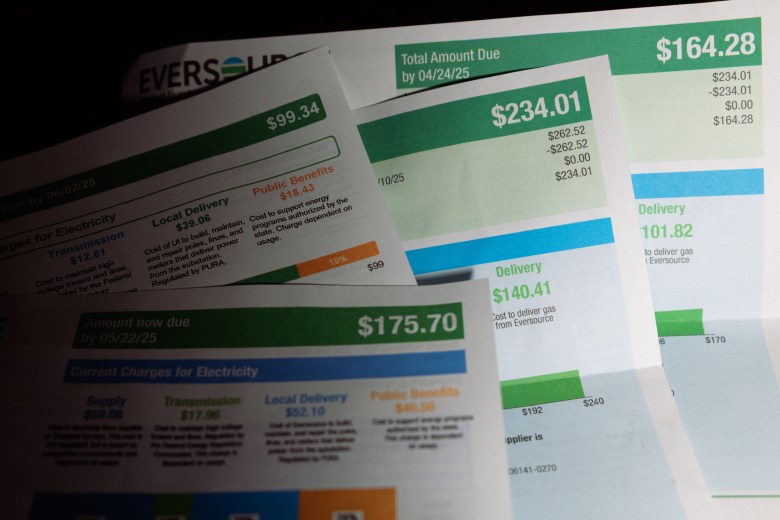
Electricity rates in Connecticut will decline by nearly 15% in May, after state regulators on Wednesday approved changes that will all but remove the public benefits charge from customer bills.
The Public Utilities Regulatory Authority voted unanimously in favor of the rate adjustments, which largely affect the costs borne by utilities for various state-mandated policy programs such as clean energy procurements and benefits for low-income customers.
The changes will result in a 4.3 cent-per-kilowatt-hour decrease for Eversource customers — equivalent to about $30 off the average user’s monthly bill — and a 4.9 cent-per-kilowatt-hour decrease for United Illuminating customers, or about $34 a month, according to PURA. Precise savings will vary depending on each customer’s usage and rate class.
Both regulators and utility officials said the biggest drivers of savings were Connecticut’s long-term agreements to purchase electricity from two nuclear power plants: Waterford’s Millstone Nuclear Power Station and Seabrook Station in New Hampshire.
The cuts also reflected savings that resulted from last year’s passage of Senate Bill 4, an omnibus energy bill intended to help provide residents relief from surging energy costs. Proponents of that legislation took a victory lap Wednesday following the announcement of lower rates.
“Today’s announcement by PURA is good news for residents, who are soon to get some much-needed relief,” Gov. Ned Lamont said in a statement. “This is the direct result of the difficult but necessary decisions we made over the past few years, including restructuring utility arrearages and betting on nuclear power to offset the volatility of fossil fuel prices. I’m glad these decisions are paying off and helping to lower bills for our residents.”
The new, lower rates will take effect May 1 and last through April 30, 2027. PURA may also decide to enact further changes to the public benefits charge in September.
In response to Wednesday’s decision, Eversource spokeswoman Jamie Ratliff cautioned that the decreases in the public benefits charge are only temporary and come at a time when the savings are likely to be offset by higher electricity usage during the summer.
Ratliff also said the utility had pushed for steeper cuts during last year’s adjustment of the public benefits charge. Instead, PURA, which was then under the leadership of former Chair Marissa Gillett, opted for a more modest approach. (Gillett stepped down from her role in October, and the board has since been filled with four new members.)
“The former PURA leadership set the rates higher than the actual cost of those state-mandated contracts last year, despite our strong recommendation to the contrary,” Ratliff said. “Customers are basically seeing a refund of that cost.”
Ratliff said customers could experience another increase in the public benefits charge once that payback period ends next year. And, while she acknowledged that the newly-appointed PURA board has taken some steps toward stabilizing price swings within the public benefits charge, she said the company is “committed to advocating for bill stability and predictability for customers and [is] eager to continue working with the new PURA commission on solutions to advance that goal.”
A spokesperson for United Illuminating did not immediately respond to a request for comment on Wednesday’s decision.
PURA’s decision did little to alter the two largest components of electric bills: supply and distribution charges. New summer supply rates are typically announced in June.
“The issue is supply, and at the end of the day you’re nibbling around the edges when you’re talking about public benefits,” said House Speaker Matt Ritter, D-Hartford. “We need more supply.”
One of the top Republicans on the legislature’s Energy and Technology Committee, state Sen. Ryan Fazio, R-Greenwich, predicted on Wednesday that much of the reduction to the public benefits charge would wind up shifted onto other parts of customers’ bills due to circumstances mostly outside of lawmakers’ control. (Fazio is also seeking the Republican nomination for governor in this year’s elections.)
Connecticut’s contracts to purchase nuclear power perform best, Fazio argued, when the price of natural gas is high — as it was this winter and since the beginning of the Iran war in February.
At the same time, the state — like the rest of New England — relies on gas to fuel many of its power plants, meaning higher prices also drive up the cost of electricity generation that is paid for through the supply portion of customer bills.
“Today’s announcement is mostly because of external factors — not entirely, but mostly because of external factors — like the supply rate of electricity on the market going up,” Fazio said.
The Millstone contract, in particular, was widely blamed for a temporary spike in utility bills that occurred during the summer of 2024. Since then, that agreement and similar deal with Seabrook have returned $450 million to the state’s electric customers over the last two years, according to Department of Energy and Environmental Protection Commissioner Katie Dykes.
“Because these contracts lock in energy at fixed prices, it demonstrates the benefits and the foresight of the state’s investment in zero-carbon, nuclear energy and other renewable resources,” Dykes said. “We appreciate that this has been a critical tool to help insulate us and our ratepayers, from some volatility in fossil fuel prices that are driven by geopolitical events.”
PURA’s decision on Wednesday also allowed Eversource to add $100 million to a reserve fund used to pay down the costs of responding to various storms between 2018 and 2023. Eversource has been engaged in lengthy discussions with PURA about recouping those costs — which the company says amount to more than $1 billion in total — including the possibility of securitizing them in order to lessen the impact on customers.
Interim Commissioner Everett Smith addressed the storm costs issue in his comments prior to Wednesday’s vote, saying he would have preferred to utilize the timing of reduced rates to set aside up to $250 million toward paying down those costs.
“Accumulated storm costs are a bill that will have to be paid,” Smith said. “Taking advantage of this and every opportunity to do so now reduces the ratepayer impact in the future.”
Eversource officials have urged PURA to resolve the issue of storm costs in time to coincide with the introduction of new electric distributuon rates in mid-2027. Those rates will be determined through proceedings with PURA that are expected to begin later this year.
Clarification:
This story has been updated to clarify comments by Eversource’s Jamie Ratliff.