



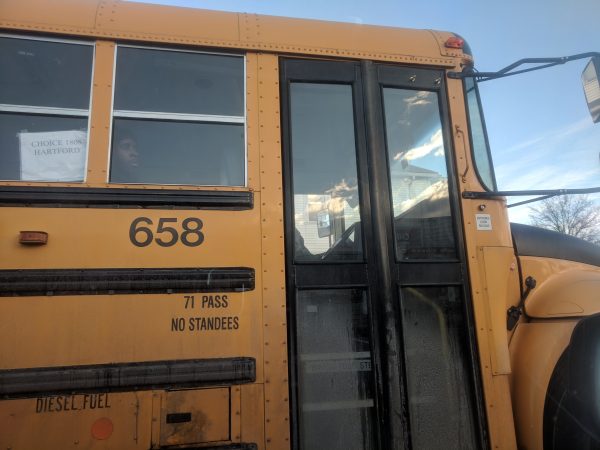
A 9-year-old girl in a nearby school system starts her day before sunrise.
Three months ago, her family lost their apartment. Now they’re living in a motel off a busy road, two towns away from her school. Under federal law, she has the right to stay in that school — to keep her teacher, her friends, the routines that make her feel safe in a world that suddenly isn’t.

But getting there each morning? That’s where everything falls apart.
Some days, there’s a ride. Some days, there isn’t. And when there isn’t, she misses school — not because she doesn’t want to go, but because the system meant to get her there simply doesn’t work. She is not an exception. She is one of our neighbors.
In Connecticut, more than 5,100 students are experiencing homelessness — a 44% increase since 2021. These are children in every ZIP code — in our towns, in our schools, sitting in classrooms next to our own kids.
Homelessness is not somewhere else. It is here. It is part of us.
The federal McKinney-Vento Act guarantees that students experiencing homelessness can remain in their school of origin and receive transportation to get there. This is not optional. It is the law.
And yet, in Connecticut, that promise is too often broken.
We know what happens when transportation fails. Nearly half of homeless students nationwide are chronically absent. When kids miss school, they fall behind. When they fall behind, the path out of homelessness becomes harder.
The law says we must get these students to school. The problem is how.
Connecticut still relies on a transportation framework built decades ago — designed for stable bus routes, not for a child who moves mid-year to a motel across district lines.
When traditional buses can’t accommodate a student, districts are forced into impossible choices. They may send a full-sized bus for a single child at enormous cost, or scramble to find drivers in a shrinking workforce.
Too often, the result is simple: the ride doesn’t come. It’s not for lack of effort. It’s because the system itself is outdated.
Current law requires any vehicle transporting a student to have specialized commercial registration and permanently affixed signage — rules built for large bus fleets. These requirements make it nearly impossible for community-based drivers or flexible options to help.
In other words, people who are willing to help can’t. And solutions that work elsewhere can’t be used here.
That’s what makes this so frustrating: we already know how to fix it.
In 37 states — including Pennsylvania, Colorado, Delaware, and California — students are allowed alternative transportation models that are safe, accountable, and flexible. In those states, safety is ensured through background checks, driving record reviews, and monitoring.
What keeps a child safe isn’t a sign on a car. It’s the qualified adult behind the wheel. Connecticut doesn’t have a safety problem. It has a rulebook problem.
Policymakers are considering legislation – House Bill 5259 – to strengthen protections for students experiencing homelessness. That’s an important step – rights only matter if they can be realized. A right to transportation is meaningless if the ride never shows up.
Every day, I see what school stability means for these children. It’s more than academics. It’s connection. It’s routine. It’s a place where a child can feel like a child again.
When that connection is broken — when a child misses school because no one could legally get them there — it’s another fracture in an already fragile life.
We talk about ending homelessness. We talk about education as the great equalizer. But we cannot stabilize a child’s future if we cannot get them to school on a Tuesday morning.
This is not an unsolvable problem. It requires something simpler: updating outdated rules so Connecticut can use the same safe, flexible solutions already working in most of the country.
That 9-year-old girl will wake up again tomorrow and get ready for school. Whether she makes it there should not depend on a rule written before she was born. She is our neighbor. She is part of our community. And she deserves a fair shot — just like any other child in Connecticut.
We can do better. The only thing standing in the way is the willingness to act.
Sarah Fox is President and CEO of the Connecticut Coalition to End Homelessness.