Legislators will try for the third year in a row to address the fallout from private equity ownership of three Connecticut hospitals. Despite years of bipartisan calls for reform, proposals to curb such investment have failed to pass.
But the co-chairs of the Public Health Committee say this year will be different. They’ve been in regular talks with Gov. Ned Lamont’s office over the last several months. And even though Lamont and lawmakers put forth separate proposals, the two are meant to complement each other.
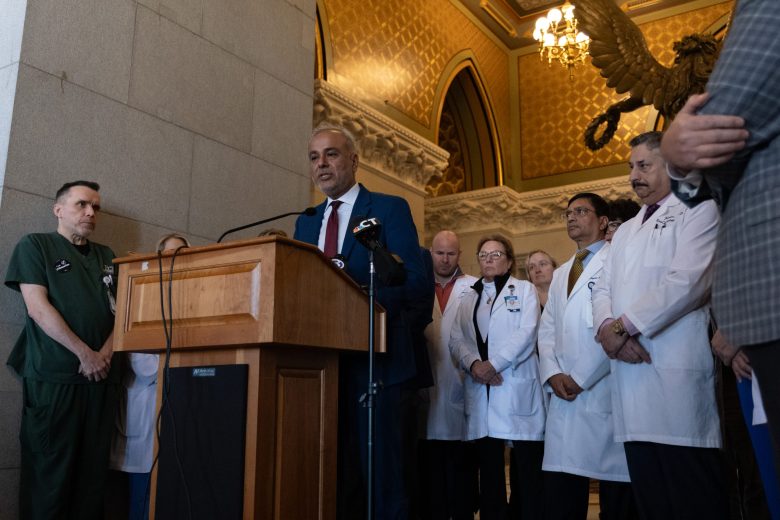
“Our hope is that both of them will succeed,” Public Health Committee co-Chair Sen. Saud Anwar, D-South Windsor, said. “We have been in robust conversations for the past two months.”
Last year, the governor and legislators also put forth two separate proposals, each with a different philosophy for how to prevent private equity investors from harming Connecticut hospitals. But the session ended before lawmakers could thread the different approaches in time to get a bill passed. Each side pointed fingers at the other for the failure.
This session, a proposal from lawmakers — Senate Bill 196 — would prevent any private equity investor from owning a majority stake in the main campus operations of any hospital and from any involvement in a hospital’s clinical decision making.
The legislation would also prevent hospitals from selling the buildings of their main campuses to a real estate investment trust in a transaction known as a “sale-leaseback.” The sale-leaseback is one way that private equity investors generate returns from hospital investments, but the deals leave the hospitals on the hook for paying rent.
The bill passed the Senate on Wednesday and heads next to the House for a vote.
Cathryn Vaulman, a spokesperson for Lamont, didn’t confirm whether the governor supports S.B. 196 but reiterated his commitment to reining in private equity.
“For the past several sessions, the Governor has put forward comprehensive legislation to ensure financial oversight of hospitals to help us protect patient care,” Vaulman wrote in an emailed statement. “Profits should not come before people.”
Lamont’s proposal this year — House Bill 5045 — seeks to increase oversight of private equity investors through the “certificate of need,” the state approval process for major health care transactions, like mergers, acquisitions and unit closures.
The bill would, among other provisions, require state approval for any transfer of a large physician practice involving a private equity entity. It would also require approval for the acquisition of 20% or more of a health entity’s assets or operations by any organization, including another health system or a private equity investor.
Anwar’s co-chair on the Public Health Committee, Rep. Cristin McCarthy Vahey, D-Fairfield, said it helped the conversations this year that all the hospitals previously owned by the bankrupt, formerly private-equity backed hospital operator, Prospect Medical Holdings, had found new buyers.
At the start of the year, Manchester Memorial and the Rockville campus officially became part of Hartford HealthCare. In March, the University of Connecticut Health Center, the state’s flagship academic medical institution, took over Waterbury Hospital.
But during last year’s legislative session, in the immediate wake of Prospect’s January 2025 bankruptcy filing and before those deals had come together, there was some fear that legislation could, for example, inadvertently box out a potential buyer for one of the hospitals.
“A year ago, there was uncertainty about what some of those provisions that we were discussing might mean, and now those are resolved. I think that is a really big factor in terms of our ability to move forward,” McCarthy Vahey said.
She added that she believes this is just the beginning of addressing private equity health care. The situation with Prospect brought to light the many other parts of the industry where private equity investment plays a major role. And federal cuts to health care could make private capital more necessary.
“We are only going to see increasing pressure on health care costs and funding. As the Medicaid cuts continue to come, there will be more pressure to be using private dollars. And how those dollars get used, how that occurs, is going to have an impact,” McCarthy Vahey said.