


A Connecticut Vietnam veteran and his daughter filed a lawsuit Monday against the U.S. Department of Veterans Affairs for denying her application for benefits, alleging it is discriminatory based on the sex of the parent.
Ron and Michele Christoforo are challenging a federal statute that says children who have certain birth defects are eligible for VA benefits if their mother served during the Vietnam War between February 1961 through May 1975. Vietnam veterans have presumed exposure to Agent Orange, the chemical herbicide that was used by the U.S. military in Vietnam and has been linked to health issues like cancer and birth defects.
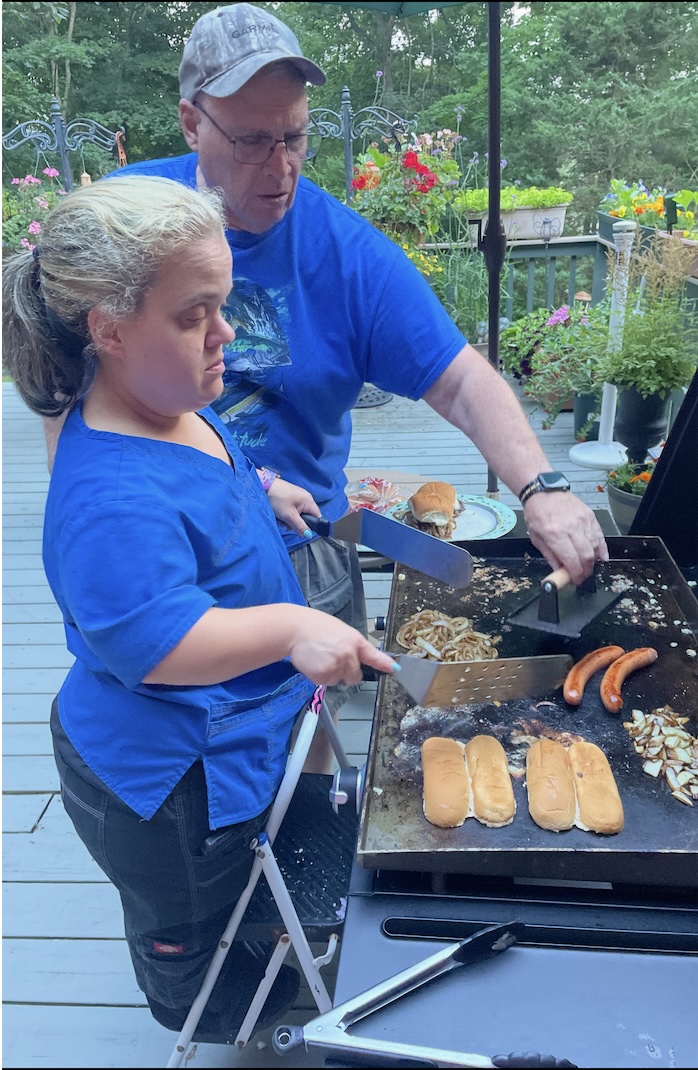
But children of Vietnam veterans, like Michele Christoforo, who was born with a genetic disorder that causes dwarfism, aren’t able to qualify since her father, Ron, was the one who served abroad. She said achondroplasia has affected all facets of her life.
“My life is a constant struggle,” Michele Christoforo said in an interview. “I have to have things adapted to me. I’m 4 feet 2 inches. I can’t reach normal counter heights. I cannot reach a sink without a step stool. I get lots of pains in my legs and knees.”
“Sometimes I am overlooked for things because of my stature. I am more than capable of doing anything, and I have been turned down for jobs because of my stature, which is unfair, and it makes it hard to make the kind of money you need to survive in life,” she continued. She currently works as a veterinary technician.
A North Haven native, Ron Christoforo voluntarily enlisted in the Army in 1969. During his three years of service, he was deployed to Vietnam for a year and assigned to the 5th Special Forces Green Berets, where he said he was exposed to Agent Orange.
He returned to Connecticut after his deployment and worked in telecommunications, where he met his wife. In 1992, they had Michele, who was born with achondroplasia. Neither of her parents have a family history of achondroplasia.
“They really don’t know what Agent Orange does to people. They have an idea of some of the stuff, but we’re living it as real people,” Ron Christoforo said. “And we have things that happen to us that we can’t explain. And I believe a lot of this has to do with Agent Orange.”
“For that whole year, I was exposed to Agent Orange — not knowing it was there, what it was going to do to me,” he continued. “I was just in it.”
Ron Christoforo applied for VA benefits for both himself and his daughter in 2022. A few months later, the VA rejected the request for his daughter, citing the rules regarding eligibility.
Michele Christoforo applied for benefits last month and received another denial from the VA in mid-April. She has a year to apply for an administrative appeal.
The Christoforos are represented by Yale Law School’s Veterans Legal Services Clinic and are challenging the statute as “both illegal and unjustifiable discrimination on the basis of sex.” The lawsuit was filed in U.S. District Court for the District of Connecticut and argues that it violates the Fifth Amendment’s due process clause.
“Michele and Mr. Christoforo respectfully ask this Court to declare unconstitutional the exclusion of children of male Vietnam veterans with birth defects from eligibility for VA benefits that are available to children with the same conditions born to women Vietnam veterans,” the lawsuit reads. “Today, this statutory sex discrimination is justified by neither science nor law.”
The U.S. Department of Veterans Affairs declined to comment, saying it doesn’t comment on pending litigation.
Veterans of the Vietnam War exposed to Agent Orange have suffered from disabilities linked to the toxic exposure. The lawsuit cites studies that toxic contaminants in the herbicide have led to higher rates of birth defects in children of these veterans compared to the general population.
Congress approved benefits for children of Vietnam veterans who were born with spina bifida, a condition where the spinal cord doesn’t develop properly during pregnancy. More than a dozen birth defects — including achondroplasia — were added into that coverage in 2000, but only to “children of women Vietnam veterans.” Spina bifida is the exception, and the children of male veterans are eligible for benefits.
The lawsuit cites about 200 children with birth defects were born to women who served in Vietnam, compared to around 350,000 affected children to men who served.
For the Christoforos, the diagnosis has shaped all of their lives. They retrofitted their house to have lower sinks, toilets and counters — something that has helped Michele but has become a challenge for her parents as they age.
“Michele will face increasing financial, physical, and emotional challenges from living with achondroplasia and require ongoing medical care, specialist appointments, and adaptive accommodation throughout her life,” the lawsuit reads.
Some of the eligible benefits for children of women Vietnam Veterans (CWVV) include monthly payments, health care benefits through the CWVV program, and job training called Veteran Readiness and Employment for those between the ages of 14 and 31.
Michele Christoforo said access to such benefits could help her eventually live on her own. And when it comes to medical treatments, she said people with achondroplasia typically need to manage arthritis and get physical therapy to help with joint pain as they age. And many need a wheelchair when they reach their 50s and 60s.
“I would like out of all of this to receive enough benefits where I can get a house for myself and live on my own, make that house adaptable for me,” she said. “It’s getting harder for my parents right now as they get older.”
A couple of bills have been introduced in Congress to address this. The Agent Orange Relief Act of 2025 would, among other things, provide the same level of benefits to the children of Vietnam veterans regardless if their mother or father served. The House bill has a little over a dozen co-sponsors, including U.S. Rep. Jahana Hayes, D-5th District.
U.S. Sen. Richard Blumenthal, D-Conn., has been pushing for the passage of The Molly R. Loomis Act, which would require the Toxic Exposure Research Working Group to “conduct research on the diagnosis and treatment of health conditions of descendants of individuals exposed to toxic substances while serving as members of the Armed Forces.” That working group spans multiple federal agencies, including the VA.
For Ron Christoforo, he wants his daughter to have the same access to same benefits as other children of Vietnam veterans.
“I want to be clear that what this means — the United States government is telling my daughter my service counts for less, the sacrifices that I made, the sacrifices my family has made, is worthless because of my sex,” he said. “This just is not right.”
The Connecticut Mirror/Connecticut Public Radio federal policy reporter position is made possible, in part, by funding from the Robert and Margaret Patricelli Family Foundation.
