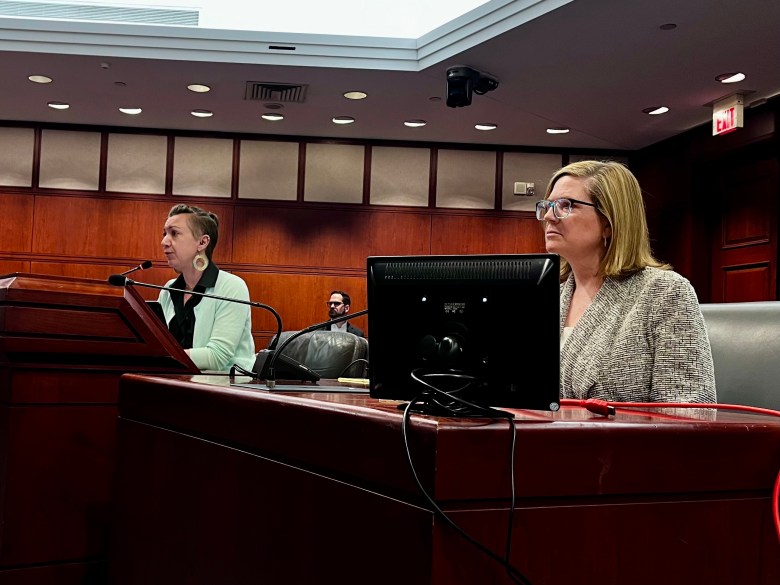
The state building and fire code failed to gain legislative approval Tuesday, as the proposal from the Department of Administrative Services came under fire for changes advocates said would make it harder to build new housing.
The Regulation Review Committee voted down the proposals, which have been years in the making, along party lines Tuesday. Housing advocates and lawmakers were concerned about provisions that would have required wider access roads for fire trucks, allowed local fire officials to decide which side of the building should be adjacent to an access road and limited developments to sites located closer to access roads.
“Housing is supposed to be one of our most important things, but we don’t want to make the rules so heavy-handed that we can’t do that housing,” said Sen. Cathy Osten, D-Sprague.
Connecticut updates its state building and fire codes every four years, and those rules govern many of the details on how new development goes up in the state. Adjusting building and fire codes to make it easier to build housing has been the latest focus of several pro-housing groups across the country as many states, including Connecticut face a severe shortage of affordable places to live.
Earlier in the session, lawmakers repealed a provision that would have allowed a single stairway as a means of egress in certain multi-family developments. DAS had then pulled the proposal and removed the single-stair provision.
But housing advocates and lawmakers took issue with the new version because of three major policy changes.
One would have required wider access roads for fire trucks — 26 instead of 20 feet at certain locations such as near a fire hydrant — for new multifamily developments. DAS officials said this would help improve safety and bring the state into compliance with international code.
Osten said she was worried about roads where that wasn’t possible, such as Route 138 which is bordered by a river and a ledge. Advocates wrote letters saying there was a lack of evidence that the 20-foot roads had caused safety problems.
“In the midst of an ongoing state housing crisis, where affordable housing units are in ever-higher demand, we must scrutinize potential regulations that appear well-intentioned but would in fact have a harmful effect on the state and its residents,” said a letter from the Open Communities Alliance.
Another would leave it up to local fire officials to decide which side of the building should have road access. State Fire Marshal Lauri Volkert offered the example of a building that might have inoperable windows on one side and balconies on the other. The fire officials would likely want the access road to be on the balcony side, Volkert said.
Advocates feared that policy would allow local fire officials to effectively block new construction. Nick Kantor, program director of Pro-Homes Connecticut, said in a letter to lawmakers that it would create “unwieldy local discretion that makes development in smaller unconventional in-fill lots too unpredictable for no clear safety advancement.”
Kantor also said in his letter that the limitation of new developments to sites closer to access roads would make it hard to build in some suburban or rural communities.
“While we fully support necessary safety regulations, we are concerned that several of the proposed changes do not appear to be clearly supported by demonstrated safety needs, but would make certain types of much-needed multifamily developments significantly more difficult, costly, or even impossible to build,” Kantor said.
DAS Commissioner Michelle Halloran Gilman said the process had gone on for years, with plenty of time for public comment. She also said there were opportunities for developers to apply for a waiver of the code in instances where it’s not possible to comply with the regulations.
“I do want to acknowledge that our agency recognizes the governor’s commitment, the legislature’s commitment to affordable housing, and so we do everything we can within our code process… to work with developers, to get to a place of yes, and to work with our local officials,” Halloran Gilman said. “So I would not categorize ourselves as anti-homes.
“What we’re talking about today here is lowering the safety standard that’s in that approved code from where it started to where the proponents would like it to be,” she added.
It’s uncommon for the agency to bring forward a proposed fire and safety plan that doesn’t pass. Typically, when there are points of contention, DAS will withdraw the proposal and adjust it. That’s already happened once this session with the single-stairway provision.
The single stair legislation was another push from housing advocates. They said that, paired with modern fire prevention technology, the single stairs would have been safe and made it easier to build housing.
“I am thoroughly disgusted in this committee. I just want to say that the public opinion period is over. The public hearing is over, and last night, at four o’clock, we get a letter from a group — Pro Homes — that want to throw crap in the game. I’m very disappointed that we’re even talking about this,” said Rep. Ben McGorty, R-Shelton, of Tuesday’s vote.
Committee co-Chair Rep. Christie Carpino, R-Cromwell, thanked the agency for its work. “I actually wanted to publicly thank you for making sure the public safety is paramount,” Carpino said.
Co-Chair Sen. Sujata Gadkar-Wilcox, D-Trumbull, said she shared concerns about blocking the construction of more housing.
“Some of those may, in fact, hinder our other goal, which is a crisis area of housing. How do we balance the two?” Gadkar-Wilcox said.
The committee rejected the proposal without prejudice meaning that it can go back to DAS for more work and be presented to lawmakers by as early as next month. DAS officials said they’ll have to go back through the Codes and Standards Committee, which is a group of experts that provides technical review to DAS on code changes.
They said it’s unlikely they’ll be able to bring it back to the Regulation Review Committee before September, meaning the new code wouldn’t go into effect until January. If Tuesday’s proposal had passed, the agency planned to implement the new code by July 1.