



When Connecticut passed its climate change curriculum requirement in 2022, it sent a clear message that preparing students for the future means equipping them to understand one of the most urgent challenges of our time.
As a teacher, I’ve seen firsthand how this shift has transformed classrooms where curiosity, creativity, and purpose are at the heart of learning.
This year, my students are participating in the Connecticut Coalition for Climate Action’s climate poster contest, an initiative that brings the curriculum to life in a way no textbook alone ever could. What started as a legislative requirement has grown into something far more powerful: a movement that connects learning to action.
The climate curriculum gives students the foundation they need, including science, data, and critical thinking skills in a way that helps them to understand climate change beyond just headlines and scary social media posts. The poster contest provides an opportunity to apply that knowledge in a way that has truly ignited their engagement. My students aren’t just learning about rising temperatures or renewable energy; they’re expressing their ideas, concerns, and solutions through art.
I’ve watched students debate messaging, revise their designs, and think deeply about how to communicate an urgency for action. They ask questions that go beyond the assignment: How do we inspire people to care? What can individuals really do? What does a sustainable future look like? These are not abstract exercises, in fact, they are the early stages of civic participation.
Then something remarkable happens, selected posters are displayed at the State Capitol, where students see their ideas elevated in the very place where decisions about Connecticut’s future are made. For many of my students, it’s their first time inside the Capitol building. It’s no longer an abstract symbol of government; it becomes a real, accessible space where their voices belong.
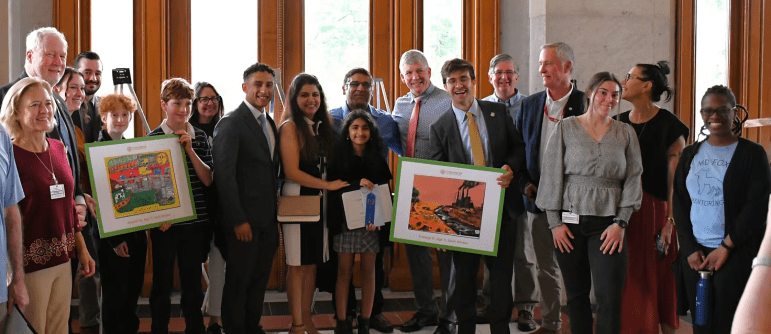
Even more impactful, students have the opportunity to step onto the floors of the House and Senate, witnessing our state leaders in action. They see debate, collaboration, and the complexity of policy making unfold before them. It’s a powerful lesson: democracy isn’t distant, it’s something they can be part of.
These experiences turn a classroom project into a civic milestone. Students begin to understand that their perspectives matter, not someday, but now.
Last year, the Coalition expanded the contest to include scholarships for the top three winners, a meaningful step that recognized the importance of supporting art and education. For many students, especially those who may not always see themselves reflected in traditional academic accolades, this kind of recognition matters. It tells them that both their voices and their visions for the future matter.
The poster contest culminates around Earth Day, a moment that reminds us all that environmental stewardship is a shared responsibility.
As I look at my students’ posters, full of color, urgency, and imagination, I’m reminded that the goal of education isn’t just to inform. It’s to inspire and I believe it’s working.
Timothy Stankye is an Eigth Grade Science Teacher at Long River Middle School in Prospect.