


This story has been updated.
After a lengthy debate that stretched over two days — with multiple attempts by Republicans to modify the legislation — the Connecticut House of Representatives on Friday passed a bill placing certain restrictions on federal immigration officers and creating a method to sue agents for constitutional violations.
The bill passed 91-53, largely on party lines, with four Democrats joining all the House Republicans in voting in opposition. The bill was immediately transmitted to the governor for signature.
In a statement on Friday, Gov. Ned Lamont said he was “looking forward to signing the bill into law.”
“The people of Connecticut should not fear for their safety when visiting hospitals, schools, and religious and government buildings. The provisions included in this bill include commonsense measures to protect peoples’ constitutional rights from federal overreach,” said Lamont.
The bill passed in the Senate last week on a party line vote before arriving in the House, where it faced debates that veered into historic disagreements over how much local and state law enforcement should be able to cooperate with federal immigration agents and whether the state’s laws were restricting police officers’ ability to do their jobs and exposing them to liability.
In a press briefing Thursday morning, Rep. Steven Stafstrom, D-Bridgeport, gave examples of several people who were detained by federal immigration authorities in Connecticut, including a 16-year-old student at Meriden’s Maloney High School, a nursing student at Southern Connecticut State University and a 19-year-old high schooler in Cheshire.
“These are not abstract instances. This is not some sort of partisan statement,” Stafstrom said. “This is a very measured response to federal overreach and a way to protect people living here in the state of Connecticut from, frankly, a lawless and out-of-control ICE.”
The bill establishes “protected areas” — including schools, hospitals, social service agency facilities and houses of worship — where people cannot be arrested solely on the basis of a civil offense, such as an immigration violation. It prohibits law enforcement officers from wearing masks while on duty. It bans former federal law enforcement officers who were found to be guilty of misconduct or retired during an investigation from being hired by Connecticut state or local police, and it requires police officers to complete 480 hours of training before they can be hired by state agencies.
The bill also includes a section that allows state residents to sue federal law enforcement agents for violations of their constitutional rights, a proposal created in response to the fatal shooting of Alex Pretti by a U.S. Customs and Border Patrol agent in Minneapolis in January.
“ Today, there’s a gap in our law. While Section 1983 of the Federal Civil Rights Act permits such [law]suits against state and local officials, no equivalent federal remedy reliably reaches federal agents who trample civil liberties,” Stafstrom told lawmakers during a floor debate.
It gives the state inspector general the right to investigate the use of deadly force by federal agents or the death of someone who was in the custody of federal agents, and it removes immunity from officers who arrest or assault someone taking photos or videotaping their actions.
House Minority Leader Vincent Candelora, R-North Branford, said he was not against allowing the inspector general to investigate deadly use-of-force instances that involved federal officers. But he said the bill sends a signal to law enforcement that they could be prosecuted for simply doing their jobs.
“Where I get a little concerned is trying to create these state criminal charges for federal officers. Federal law covers that,” said Candelora.
Candelora said he felt the bill was mainly political and that it would have little concrete effect. Like Republicans in the Senate, he argued that the Supremacy Clause of the Constitution prevents the state from imposing regulations on federal immigration officers. Instead of making state laws, he said, lawmakers should be pushing the state’s federal representatives to make changes at the federal level.
House Speaker Matt Ritter, D-Hartford, said during a press briefing Tuesday morning that the legislation included “basic things” like requiring officers to wear a badge or some form of identification.
“In America, and in what other world, can somebody detain somebody and arrest somebody where we don’t know who they are, don’t have a name tag and identification. … It’s hard to fathom for a lot of Americans, I think, on both sides of the aisle,” Ritter said.
Rep. Craig Fishbein, R-Wallingford, said he expected the bill to be challenged in court as has happened with laws in other states that seek to address the behavior of federal immigration agents. The U.S. Department of Justice filed a lawsuit earlier this week against the state of New Jersey for a law it passed limiting mask-wearing by law enforcement.
“The state of Connecticut is, in effect, saying to federal law enforcement, ‘We don’t want you within our borders. We don’t want you enforcing federal law. We don’t want you enforcing immigration law.’ and that’s not something that I adopt,” said Fishbein.
Stafstrom said there had been widespread support in a public hearing in March for the bill; he said people are more concerned to go to the hospital or appear in court because they’re afraid of encountering federal agents and being detained. Fishbein, in contrast, said he was comforted by the presence law enforcement officers.
Republicans raised concerns about a part of the bill that removes immunity from officers who interfere with someone videotaping or recording. They questioned what would happen if the person filming gets extremely close to the officer, prevents the officer from doing his or her job, or threatens the officer. Fishbein proposed an amendment clarifying that an officer would need to have intentionally assaulted or falsely arrested the person recording in order to lose immunity.
“As I read this section, if officers are in the midst of performing their duties and you get a couple of people right within a couple of feet trying to film them, they’re interfering with the officers doing their duty, and they get knocked over, it seems like [the officers] are going to be liable for this,” said Rep. Pat Callahan, R-New Fairfield. “That just doesn’t work.”
Stafstrom countered that under the bill, only officers who purposely assault or interfere with someone videotaping would face liability. The amendment failed.
Republicans also raised an amendment that would modify the Trust Act, a law that governs how state and local law enforcement interact with federal immigration officers, to expand the situations in which local law enforcement could cooperate with federal authorities.
Rep. Tom O’Dea, R-New Canaan, said everyone agreed they didn’t want federal immigration officers entering schools, but he said that hasn’t happened. He acknowledged that ICE agents “made mistakes” in their conduct but he said Connecticut’s lack of cooperation was not helping.
“We are not making the jobs of our law enforcement officers locally and federally any easier with this legislation, and we’re not making our citizens any safer,” said O’Dea. “We’re making it much more difficult, and we’re creating more problems, and we’re creating a less safe environment for not only our citizens, but those that are here illegally.”
That amendment also failed.
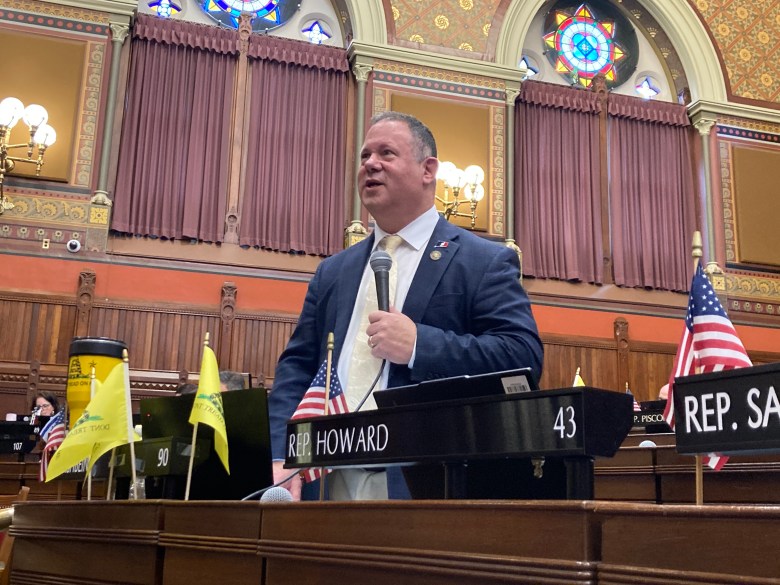
Rep. Greg Howard, R-Stonington, said he was concerned that some of the provisions of the bill — like protected spaces and the mask ban — would affect local and state police.
Stafstrom said he wasn’t aware of instances where Connecticut police officers would be in the position of arresting someone for a civil violation in a protected space, and said they hadn’t seen any indications that Connecticut police officers were using masks to conceal their identity.
“I don’t see this as a swipe at law enforcement,” said Stafstrom.
Multiple Republicans said the bill would have a negative effect on law enforcement, dissuading them from taking action and causing problems with recruiting and retention.
Rep. Joe Poletta, R-Watertown, said he felt the bill would both have a negative effect on law enforcement and it could jeopardize federal funding. “People want affordability, and they want public safety. Right now, we’re lagging in both of those,” Poletta said.
Rep. Cara Pavalock-D’Amato, R-Bristol, said that U.S. Immigrations and Customs Enforcement plays an important role, working to curb human trafficking and criminal networks and arresting people who could pose a threat to others. She said that without enforcement of immigration laws, the legal immigration system is undermined.
“Ultimately, it comes down to balance — we can be a nation that welcomes immigrants; we can also be a nation that enforces laws. These are not contradictions, they are responsibilities,” Pavalock-D’Amato said.
Pavalock-D’Amato said supporting ICE isn’t equivalent to rejecting immigrants. She also pointed out that a law in California requiring federal immigration officers to display identification was recently struck down.
Howard also brought forth an amendment that would create further carveouts for police officers to be in the vicinity of polling places in response to a bill the House passed prohibiting law enforcement officers from being within 250 ft. of any elections site. There are exceptions for officers voting off-duty, in transit, who reside in the area, have a legal warrant for a detention or arrest or get permission from the Secretary of the State or the moderator.
That amendment also failed.
In addition to the other provisions, the bill also establishes new regulations around the use of data from automatic license plate readers.
In February, CT Insider published an investigation that found license plate readers in at least six police departments in Connecticut that use Flock had been searched by out-of-state agencies for reasons related to immigration enforcement.
The bill restricts the amount of time that data is retained to 21 days, and it bans the use of data for immigration enforcement, investigating people who have sought or received abortions or transgender care, or finding the identity of someone “engaged in an activity protected under the First Amendment to the United States Constitution.”
This story has been updated to include comments from Gov. Ned Lamont.
