



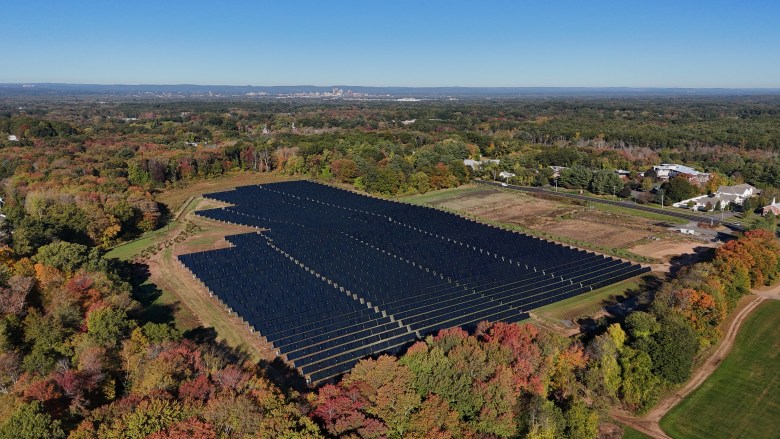
Connecticut doesn’t need to search for new answers to rising electricity costs, we already have one. It’s called community solar, and in Connecticut it exists through the Shared Clean Energy Facility (SCEF) program.
While it has operated largely outside the spotlight, SCEF has delivered something increasingly rare in energy policy: real, measurable savings for residents, especially those who need it most, without increasing costs to the system.
The question now is not whether this proven model works; it’s whether Connecticut will choose to expand it or allow a successful affordability tool to stall while energy prices continue to climb.
SCEF addresses a basic but widespread problem: many residents cannot install solar panels on their own homes. Renters, families in multifamily housing, and homeowners with shaded or unsuitable roofs have long been excluded from the financial benefits of solar. Community solar changes that by allowing customers to subscribe to a shared project and receive credits directly on their electric bills, at no cost whatsoever.
For participating households, the impact is substantial. Subscribers receive bill credits of roughly 2.5 cents per kilowatt-hour over 20 years, resulting in substantial savings. According to Eversource, SCEF projects awarded through Year Six of the SCEF program are projected to save subscribers over $200 million over the projects 20-year term. SCEF projects awarded to our company alone are estimated to generate more than $50 million in bill savings for residents, whose participation spans over 100 towns. Notably, about 90% of SCEF subscribers qualify as low-income customers, those most disproportionately affected by rising energy costs.
But a critical argument for community solar isn’t just who it helps. It’s how the underlying economics work. Operational community solar projects in Connecticut are delivering electricity at approximately $0.088 to $0.099 per kilowatt-hour, well below current standard utility supply rates of about $0.126 to $0.137. When you isolate the energy component, excluding renewable energy credits and capacity value, the cost of energy generated by these SCEF projects is closer to $0.06 per kilowatt-hour.
That difference is significant. It means utilities can procure electricity from these SCEF projects at dramatically lower prices than they would otherwise pay, by margins that can approach a savings of seven cents per kilowatt-hour. Community solar doesn’t add cost to the system; it delivers lower-cost energy directly into it.
And yet, despite these clear advantages, opposition to community solar often centers on concerns about “cost” impacts. When utilities warn that community solar will cost more, they ignore the benefit of the energy supplied by these projects and the benefits that the projects are providing to the grid. Obscuring the fact that existing projects are already delivering electricity directly to the distribution network well below their own supply costs.
Any discussion on the potential costs of community solar must address important questions that remain unanswered:
- If utilities are purchasing electricity at a lower cost through SCEF projects than traditional generation sources, where is the claimed cost increase coming from?
- If private developers are financing and building these projects – and paying to upgrade the grid to have them connected – what financial burden is being placed on Connecticut’s utilities?
- And perhaps most importantly: if customers already pay delivery and distribution charges to utilities – charges that remain in place regardless of where their electricity is sourced – why should expanding utilities’ access to lower-cost energy increase overall costs to residents? The grid is still being paid for. The only difference is that a portion of the electricity is now cheaper.
These questions go to the heart of the issue. Is the system being designed to maximize affordability for Connecticut families or to maintain the status quo?
Despite its success, SCEF remains limited in scale and is set to expire in 2027. Demand for the program already exceeds available capacity, leaving many eligible residents without access. Connecticut’s leaders now face a clear choice. They can build on what is already working by expanding SCEF into a broader, more durable community solar program that reaches more residents and maximizes cost savings. Or they can allow uncertainty to slow progress, leaving more and more families grappling with ever-increasing electric bills.
At a time when affordability dominates kitchen-table conversations and business planning alike, Connecticut should lean into policies that produce real cost relief and increase energy supply. Strengthening community solar through a new SCEF program means more affordable energy not just for those who can afford to participate, but for everyone who pays an electric bill.
William Herchel is CEO of Verogy, West Hartford.