A legal battle over medication abortion cast uncertainty in recent days over patients’ ability to access it.
On Friday, a federal appeals court blocked the mailing of mifepristone, a key drug in the country’s most commonly used medication abortion regimen. By Monday, the U.S. Supreme Court issued a one-week stay on the lower court’s decision, temporarily restoring access to the treatment.
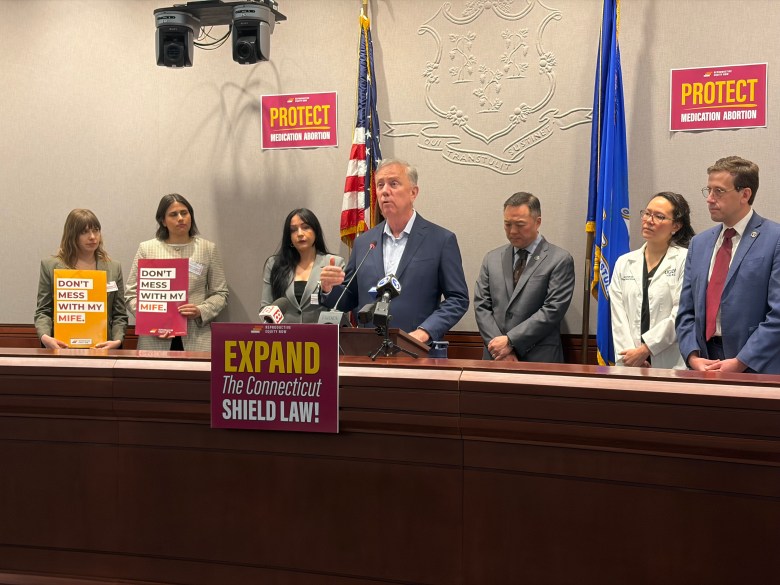
Connecticut elected officials and advocates gathered Tuesday morning to decry the “chaos” and encourage — with less than 48 hours to go in the legislative session — the strengthening of state laws that protect reproductive care providers.
Gretchen Raffa, chief policy and advocacy officer for Planned Parenthood of Southern New England, said Connecticut residents can be assured that access to care remains uninterrupted.
“The most important thing for patients to know is that they can continue to access safe and effective medication abortion at Planned Parenthood of Southern New England in-person or through telehealth,” Raffa said during an interview on Monday.
At a press conference Tuesday morning, Gov. Ned Lamont reminded Connecticut residents of state resources available to access information in the wake of federal uncertainty.
“They’re turning the clock back on reproductive rights, and we’re not going to let it happen,” Lamont said. “Dial 211. We can make sure you know exactly what your rights are.”
Over half of abortions in the United States are medication abortions, and nearly two-thirds of medication abortions use mifepristone taken with another drug, misoprostol. Mifepristone is also used to manage miscarriages.
But there are alternative medication abortion regimens. On Saturday, PPSNE and other reproductive care providers pivoted to a misoprostol-only regimen for telehealth abortion care. By Monday afternoon, they were back to prescribing the regimen that includes mifepristone, following the Supreme Court’s reversal, Raffa said.
The Supreme Court’s temporary stay expires on May 11. The parties in the case must file briefs by May 7.
“We’ll see what happens next. I don’t have further clarity than that,” Attorney General William Tong said. Tong on Monday joined a coalition of 22 states to file an amicus brief urging the Supreme Court to stay the lower court’s ruling, though by the time they filed the court had already issued the temporary stay.
The case has brought renewed uncertainty for people in states with abortion bans for whom reproductive care via telehealth is the only option. But Andrea Contreras, a doctor and family planning fellow at the University of Connecticut Health Center, said there are also implications for many Connecticut residents who access the medication via telehealth.
“They might not have transportation and [they might have] childcare issues. They might not be able to get a day off work,” Contreras said. “Sometimes getting this medication mailed to them … is the only way they can access this care.”
Last year, Connecticut lawmakers passed legislation to safeguard against threats to mifepristone access. An ‘emergency certified’ bill included $800,000 in funding to Planned Parenthood of Southern New England to support the organization in stockpiling the medication.
Raffa confirmed that the organization has spent the money on stockpiling both mifepristone and misoprostol.
‘Shield law’ legislation
The confusion in the courts has renewed calls in Connecticut to pass a legislation — Senate Bill 295 — that would strengthen the state’s “shield law,” which aims to protect patients and providers involved in reproductive and gender-affirming care from out-of-state legal action.
The bill would expand the shield law to include protections for those who provide reproductive or gender-affirming care services via telehealth from out-of-state lawsuits.
UConn Health OB-GYN Cara Delaney said telehealth-specific legislation would help more Connecticut physicians feel secure providing abortion care via telehealth across state lines.
“There are providers that are providing this care across state lines,” Delaney said. “And there would be more that would be providing this care if there was a shield law that protected them.”
Anne LaMonica, associate director of the Connecticut Catholic Public Affairs Conference, urged lawmakers not to approve the legislation. In written testimony, LaMonica said the bill would allow “prescribers to reach into another state, without licensure in such state, and treat residents in that state in violation of that state’s laws.”
The legislation would also give reproductive and gender-affirming care providers the option to put a practice name, instead of a specific physician name, on prescriptions — and allow them to opt into the Secretary of State’s address confidentiality program.
With 48 hours to go, the chances the legislation will pass through both chambers seemed slim. But Sen. Matt Lesser, D-Middletown, said the Senate Democratic caucus “overwhelmingly” supports the bill; members just want assurance that the House would also take it up if the Senate passes it.
House Speaker Matt Ritter, D-Hartford, said during a separate press briefing on Tuesday that the House would “certainly be interested in it.”
“If they can get us the bill by tomorrow, we will certainly look at that,” Ritter said.
“Everyday, it seems to be harder and harder to believe some of the things that are happening in courts across the country,” Ritter added. “That’s a safe, effective drug that has been used for a long time, and it is a personal, individual decision that folks make.”