Connecticut’s first-in-the-nation tire recycling program suffered a setback last week, as lawmakers failed to act on legislation that would have mandated the participation of retail stores that take in the vast bulk of the state’s discarded tires.
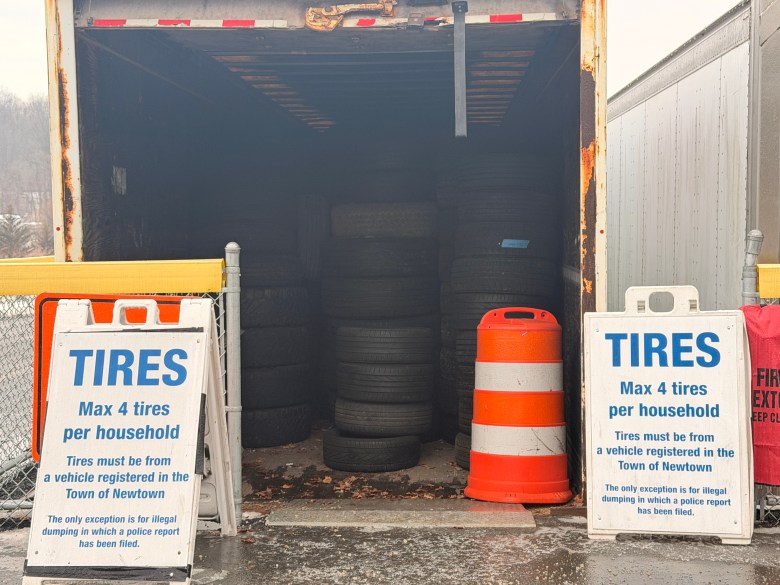
The program, known as Connecticut Tire Stewardship, allows residents in participating towns to drop off old tires for free at their local transfer station, after which point manufacturers must ensure those tires do not end up in a landfill. The program launched on limited basis in four towns in late March. Since then, it has expanded to another eight towns.
Supporters of the program have sought to ensure wider access through tire retailers. Legislation proposed earlier this year, House Bill 5157, would have required stores to participate in the program no later than July 1, 2027. The bill was the result of negotiations between lawmakers and retailers who had previously opposed efforts to join the manufacturer-led program on the grounds it would interfere with their own recycling efforts paid for through tire disposal fees.
Retailers already serve as a collection point for discarded tires when customers go to buy new ones. By extending the deadline for their participation out another year, program organizers hoped to work out a compromise that would get the retailers on board with the program’s expansion.
The bill passed the House with bipartisan support in April. However, the Senate never took the bill up for a vote before the session ended at midnight on May 6.
“It’s disappointing, and it was going to help complete a piece,” said Jesse Schofield, the executive director of Connecticut Tire Stewardship.
The sponsor of the bill, state Rep. Joe Gresko, D-Stratford, said it fell victim to threats of a filibuster from Senate Republicans, who have the advantage of eating up time under the legislature’s tradition of unlimited debate. In the end, he said, Democrats opted not to risk spending several hours debating the bill during the session’s final days.
“I asked for it to be called sooner rather than later, because towards the end of session, things like a threatened filibuster work,” Gresko said. “That’s what happened to the tire bill.”
The senator charged with shepherding the bill through the upper chamber, state Sen. Rick Lopes, D-New Britain, pointed the finger at his colleague, state Sen. Rob Sampson, R-Wolcott, as the source of the gridlock. Lopes said when he approached Sampson about running the bill, the senator responded that he “hated” it and planned to speak against it.
“It was implied that he’d be speaking for a long time,” Lopes said.
In an interview on Monday, Sampson denied ever making such a threat.
“It’s well known that I didn’t like the bill, but I never threatened to filibuster,” Sampson said. “The Democrats never brought it forward.”
When asked what his concerns about the bill were, Sampson said it would have imposed a mandate on businesses, who he said would have to pass along those costs to customers. He also said that the tacit support from some large retailers, such as Town Fair Tire, did not reflect sentiment throughout the industry, as he understood it.
“I don’t think it’s necessary,” Sampson said. “It’s a burden on businesses and it doesn’t do anything to solve the problem of tires on the streets.”
Currently, the fees to support Connecticut Tire Stewardship are collected from tire manufacturers — such as Bridgestone, Continental, Michelin and Goodyear — through a system also known as extended producer responsibility. Those companies have the option of baking those costs into the sticker price of new tires being sold in Connecticut. While Schofield said his organization does not track which companies have decided to pass along the costs, the fee is about $2 per a standard car tire.
Retailers, however, favor a system where the fee is broken out as a separate line item on a customer’s bill, similar to their existing practice of charging a fee for disposing used tires to customers who come in to buy new ones.
Those disposal fees are not tracked or regulated by the state, and can vary from store to store. Critics also charge that some retailers simply pocket the fees before reselling or illegally dumping the tires.
In order to join Connecticut Tire Stewardship, retailers would have to agree on a way to collect one standardized fee on sales of new tires to support the program.
“I think we were kind of all in agreement, prior to the bill being killed, that the mechanism of collecting the eco-fee, or whatever you would like to call it, the tire fee, needed to be ironed out,” said Michael Barbaro, the president of Town Fair Tire.
Without an agreement between retailers and manufacturers over the best method for collecting fees, customers in Connecticut could also end up being charged twice for disposal: once through the sticker price of a new tire, with the money going to Connecticut Tire Stewardship, and again through the disposal fee charged by the store to take away the customer’s old tires.
Schofield, the program’s director, said he planned to continue discussions with retailers to develop a solution that will ensure their participation. But without a firm deadline in place, he said, it is unclear whether there will be enough pressure to reach an agreement.
“It’ll probably change some of the conversations going forward,” Schofield said. “I know some of these parties, especially the retailers, they were supportive [of the bill], to know there’s a time when everyone will have to be participating so that it kind of is an even playing field.”
Town Fair Tire’s Barbaro said he also expects talks to continue, though he did not believe that any retailers would voluntarily join the program on their own.
One of Barbaro’s concerns with the current system is that his company could be charged the $2 fee by manufacturers for new tires that are shipped and stored in Connecticut, but ultimately sold at one of the chain’s stores outside the state. He said he expected that issue to be worked out during the discussions with lawmakers and the program’s staff.
“I’m not going to just sit here and wait, and I don’t think anybody will,” Barbaro said. “I think you know, the plan is to try to figure this out.”
House Minority Leader Vincent Candelora, R-North Branford, was critical of the original effort to develop a manufacturer-led recycling program, but he ultimately supported H.B. 5157. Candelora said his stance stemmed from the concern that Town Fare Tire — which operates a large warehouse in his district — could opt to relocate if it were charged more for tires that end up being sold in other states.
“I said it would be nice if this bill could move, it just never did,” Candelora said.
Gresko, the author of the bill, said he planned to propose similar legislation next year that would keep the original July 2027 deadline in place — with the hope that negotiations with the retailers continue to be productive. “The first thing I did was say, ‘Hey, let’s keep going.’ They agreed, and we’re gonna try to make that happen.”
In the meantime, Schofield said he will continue working with municipal leaders to open more free drop-off locations at local transfer stations. He said another 11 towns are expected to sign up for the program in the next week.
During its limited launch in April, the program collected over 41 tons of tires, according to a spokesperson.