



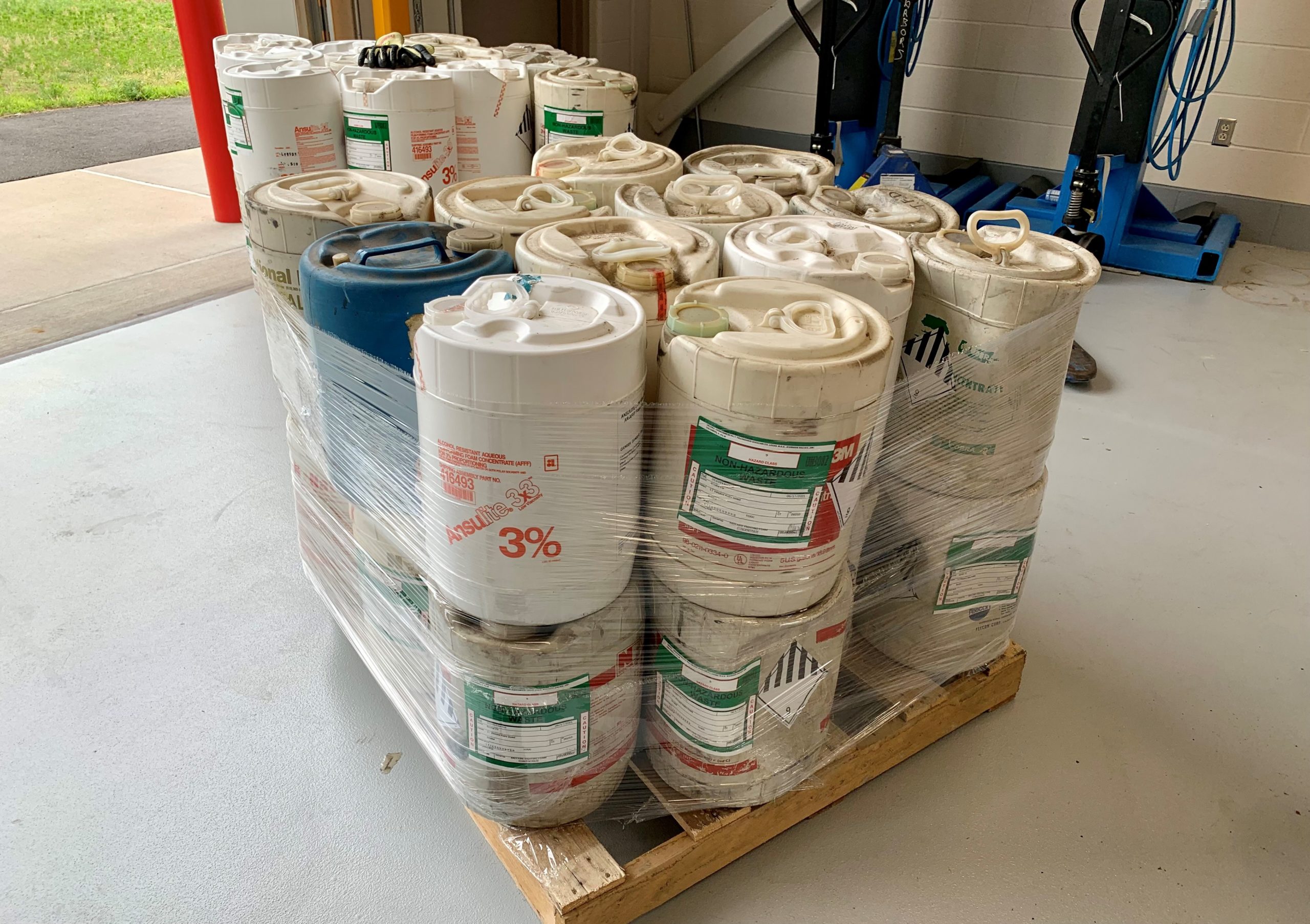
Canton residents were shocked when, in 2019, it was revealed that Cherry Brook Primary School had been contaminated with dangerous forever-chemicals from fire-fighter training. Local and state representatives worked quickly to address harms, protect students, and seek redress through a state-wide lawsuit against involved chemical corporations.
Canton, and Connecticut more broadly, serves as an example of how local and state-level governments can do everything in their power to remediate environmental contamination and associated harms, but still fail to protect civilians from corporate malfeasance.

Furthermore, not all states are willing or able to enact a similarly comprehensive response. Federal regulatory pressure should be placed on the chemical corporations who knowingly provided military and civilian contractors with a dangerous, highly-toxic product to address the root source of contaminants.
AFFFs and their impact in Connecticut
Cherry Brook Primary School services around 400 children from pre-k to third grade and functions as the district’s sole primary school. As such, the majority of Canton children attend. The Canton Volunteer Fire Department, located four miles from the school, used its grounds to conduct training in 2014 and possibly 2007-2008.
These trainings included the use of Aqueous Film Forming Foam (AFFF ), commonly known as fire-fighting foam, which contains a class of chemicals called Polyfluoroalkyl substances (PFAS). PFAS don’t readily break down in soil and ground water and are incredibly toxic to human and environmental health. Their exposure has been linked to various cancers, immune system damage, and developmental defects. The revelation that AFFFs had been used on school grounds sparked widespread outrage and concern. This fear was escalated by the accidental spilling of over 50,000 gallons of AFFFs into the Farmington River from Bradley International Airport in the same year.

Credit: CONNECTICUT DEPARTMENT OF ENERGY AND ENVIRONMENTAL PROTECTION
State actions and AFFF regulations
In response , then-Canton school superintendent Kevin Case shut off the school’s wells and shipped in bulk water supplies until contamination levels could be assessed. Independent water and soil testing was conducted from 2020-2022 by GZA Geoenvironmental. They found that PFAS were detectable at trace levels in well water in 2020, but not in 2022. However, PFAS were detected in the groundwater, indicating a leaching of contaminants into surrounding groundwater. GZA recommended any PFAS-contaminated soil be excavated to remediate this problem. Most recently, state senators procured a $500,000 grant in 2024 to assist in remediation activities at the school.
Additionally, Gov. Ned Lamont created the Connecticut Interagency PFAS Task Force , headed by the Department of Public Health and Department of Energy and Environmental Protection . State legislators have implemented corrective measures identified by the task force, including a mandatory takeback program of existing AFFF stocks launched and funded in 2020, and the banning of PFAS-containing fire-fighting foam in 2021.
Federal regulations aren’t as wide-reaching. In 2023, the U.S. Environmental Protection Agency required manufacturers to strictly monitor their production, use, and disposal of PFAS. These regulations, while promising, fail to adequately control the gravity of PFAS production and contamination.
Canton’s rapid response to CBPS’s contamination, securing of funding, and comprehensive legislative action were essential in remedying existing harm and preventing future leaks. These actions address the damages to existing and future Canton residents. The production of PFAS-containing materials in the absence of federal oversight, however, cannot be addressed by states alone.
Who is accountable?
In addition to practical and legislative measures, the State of Connecticut is taking legal action to address AFFF contamination. The State of Connecticut filed a 2024 civil suit against the largest producers of PFAS and AFFFs: EIDP, Dupont, Chemours, Corteva, and 3M.
They allege that these corporations knowingly produced and sold PFAS-containing products despite their risk to human and environmental health, and are thus seeking injunctive and monetary relief. Progress has stalled, however, as the defendants seek to move the case to federal court. Connecticut is part of a larger series of lawsuits aimed at holding corporations accountable for PFAS contamination.
The fate of CT v. EIDP et al. is made more pessimistic by the 2024 reversal of the Chevron deference doctrine. Under the doctrine, judges deferred to the EPA’s interpretation of vague regulatory language in environmental rulings. Now, judges can pick apart existing statutes based on their own judgement.
Chemical corporations are seeking to leverage this newfound judicial oversight by moving cases to the Supreme Court, who have demonstrated their affinity for deregulation. It is unclear how this will impact recent federal PFAS regulations, although legal experts predict a slowing of regulatory implementation.
States like Connecticut have exhausted the practical, legislative, and judicial resources available to combat PFAS contamination, and require federal backing to place adequate pressure on chemical corporations.
Looking forward
Connecticut has proven its dedication to the protection of human and environmental health and set an admirable standard of contamination response for other states to follow. This action, although laudable, only represents half of the solution needed to address AFFF contamination.
The persistence of PFAS suggests that long-term remediation is necessary to address any health impacts AFFF-contamination had on Cherry Brook Public students and faculty. Chemical corporations need to be held accountable for their production of hazardous materials before they leach into the environment to avoid this fate.
Chemical corporations have skirted state-led action to combat their production of PFAS, so it is time for the federal government to enforce a comprehensive ban on PFAS-containing materials. In the absence of this bold move, states will continue to put their resources towards achieving incomplete remediation.
Ava Lashgari lives in Canton and is a graduating senior at American University.