Every Wednesday, a group of mothers get together at a church in Hartford to coordinate grassroots advocacy efforts — with coffee and scrambled eggs on the side.
The women, who are from Central and South America and the Caribbean, came to know each other through the immigrant rights organization Hartford Deportation Defense. Last spring, they started talking about the support they found lacking at their sons’ and daughters’ schools, and they formed a committee.
“We want our neighborhood schools to be of high quality, so we identify the issues facing the schools here, put them to a vote, and organize ourselves to put them to action,” said Ruth Valera, an organizer with Hartford Deportation Defense who has taken a lead role on what they call the schools committee.
The group has since grown to more than 15 mothers, and they meet every Wednesday. In just a year, the women have advocated for translation services at schools and public meetings, pushed the city to improve school facilities, and — importantly — provided support to each other when they need it.
Their work follows in the footsteps of similar groups like Make The Road’s “Warrior Mothers” group, which pushed for access and interpretation for parents with limited English proficiency in a 2022 campaign called No Más Barreras, Acceso a la Educación, or No More Barriers, Access to Education.
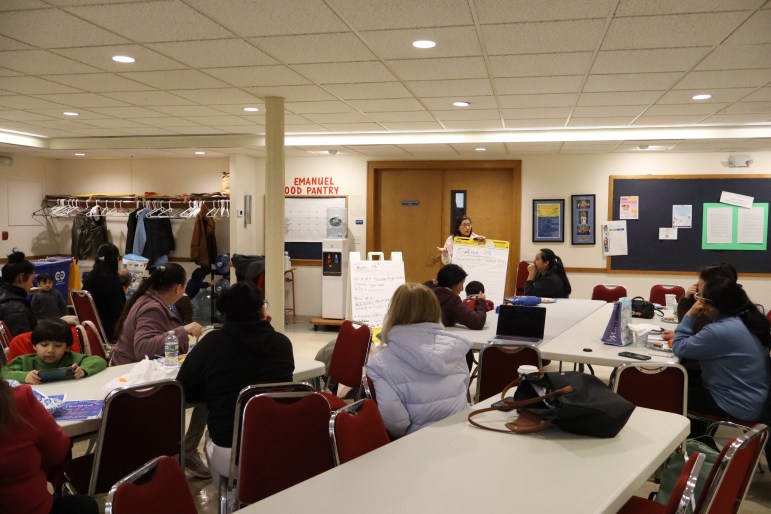
Overcoming language barriers
As Spanish speakers, some of whom speak little to no English, the mothers on the committee had faced challenges in communicating with teachers, administrators and city leaders about their children’s needs.
The state passed legislation in 2023 and adopted a Bill of Rights for English Language Learners in 2024, but implementation has been mixed and funding is lacking. Valera said parent-teacher meetings are still difficult to navigate for non-English speakers, and many still don’t know they have the right to request a translator.
Committee member Yaritza Mogollon said, “It’s difficult for parents who just speak Spanish to know the rights they have in a school and what they can request for their children. It hinders you, it acts as a barrier, it creates a sort of wall.”
But the schools committee wants their shared language to be their strength.
Committee members have worked together to craft testimony, in Spanish, that they present at public meetings — like city budget hearings — where they want to be included in the conversation and ask questions.
In partnership with the Connecticut Appleseed Center for Law and Justice, the committee received a grant from The William Caspar Graustein Memorial Fund, which they’ve used for in-person translation services at those public meetings.
“The parents expressed interest in being able to have the professional interpretation there, and also someone who was an interpreter who was familiar with the context and background of understanding of the Hartford education system,” Executive Director of Appleseed, Patricia O’Rouke, said.
The committee brought along a translator to a city budget hearing in Hartford in early April, and she translated testimony in real-time for members of the city council.
Then in late April, the city deployed an AI translation service for the first time at a public hearing, with large screens displaying the Spanish and English translation of comments by city council members and members of the public in real-time.
Mogollon, who gave testimony in Spanish at the hearing, said she had some trouble with the system. “It was sort of like, even though you were reading it, it was moving either too slowly or too fast,” she said.
Demanding facility improvements
Hartford city budget meetings aren’t always well-attended — many people watch online or write comments on social media. But mothers on Hartford Deportation Defense’s schools committee show up.
It’s another one of their strengths.
Rosalinda Perez joined the committee last fall, after she heard that Hartford Mayor Arunan Arulampalam had paused state-funded renovations at six of the city’s public schools.
“I would not have known the details on why the city paused renovations to the building where my daughter goes to school if I was not in this group,” Perez said.
Many of the members’ daughters and sons attend the six schools, and they’d seen first-hand the poor conditions and need for improvements.
Mothers Griselda Ramirez and Emilia Fuentes both testified to the city council about the renovations.
Ramirez wrote in testimony that the bathroom at her son’s school is broken, and sometimes he isn’t able to go during the school day. “When my son gets home, the first thing he does is use the bathroom,” Ramirez wrote in testimony she submitted in early April. “Investing in our public schools is not a luxury; it is an emergency.”
Fuentes told city council members about an incident where her daughter wet herself “because there was a huge line in the only bathroom working in the school.”
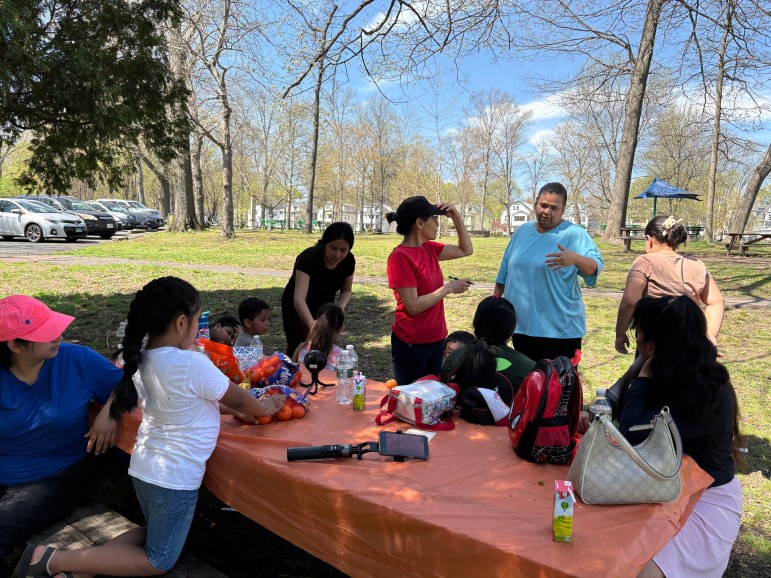
Helping each other
The mothers on the schools committee are also empowering each other.
They go to parent-teacher meetings together, and they remind each other about the resources that are available to them: Asking for an interpreter in meetings, or a translation app on their phones, for example.
“You just have to go to one parent-teacher conference, and if the majority of the mothers here go in the morning and you can only go in the afternoon after your work shift, you won’t go alone, I will go with you regardless,” Mogollon said to the group during a recent meeting.
Mogollon has been a leading member of the parent-teacher organization at Maria Sanchez Elementary since last fall. She joined the committee earlier this year.
“We support one another, and since some of us live close to each other, we also check in to make sure everything is okay — or we walk the kids to school together, and none of this would have been possible if we hadn’t been part of the group,” Mogollon said.
Valera said committee members have a lot on their plates, from work to child care needs. But they try to help each other by carpooling to meetings. And there’s always something to eat.
Valera and Fuentes arrive earlier to cook eggs together, warm up tortillas, cook oatmeal and cut fruit to share so they don’t have to worry about getting breakfast.
They talk about advocacy and organizing, of course, but they cover a lot of other topics — from diapers to new school uniforms.
“We take care of each other because for us it’s necessary,” said committee member Rosalinda Perez. “In my case, I don’t have family in this country, so when I go to the meetings, besides learning, I feel all of the mothers are my family.”
Next on the agenda: The group plans to propose a traffic light in front of Maria Sanchez to improve safety. And while they wait for action by the city, they plan to stand there with posters telling drivers to slow down for children.
The mothers also want schools to print out parental rights information when annual school calendars are distributed. And they’ll be tabling at events to recruit more members.
On May 21, Hartford’s city council is expected to approve its final budget, and these mothers are hoping the testimony they provided will be heard and considered.
“Ideally, we will keep pushing until Hartford Public Schools has the money it ought to have, so that all the resources our children need are available,” Valera said.