


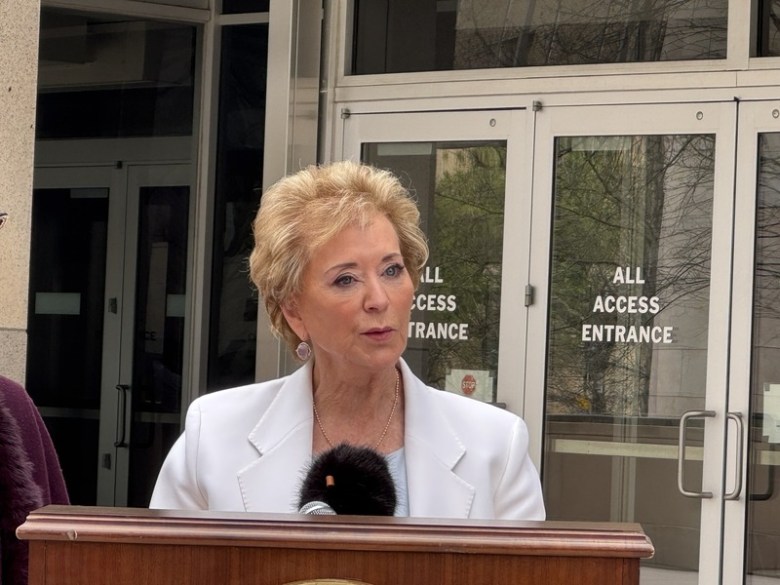
WASHINGTON — U.S. Education Secretary Linda McMahon took heat Thursday over forthcoming changes to the federal student loan system that will impose new borrowing limits for professional and graduate students.
Lawmakers took specific aim at stricter loan caps set to be established for students pursuing advanced programs that do not fall under the department’s “professional” classification, such as nursing, teaching and social work.
Members on both sides of the aisle voiced their criticisms during a hearing of the U.S. House Committee on Education and Workforce, where McMahon defended the incoming federal student loan overhaul as well as President Donald Trump’s administration’s separate, ongoing efforts to dismantle the 46-year-old department.
McMahon emphasized that her department is “not making any kind of a judgment relative to professional degrees” and instead is trying to “bring down the cost” of tuition.
The secretary pointed to “exorbitant” college costs, noting that “students are burdened with debt.”
Megabill provision
The imminent shifts to the federal student loan system stem from congressional Republicans’ tax and spending cut megabill that Trump signed into law last year. The department this month published the finalized regulations consistent with the law’s directive. Most provisions will take effect July 1.
The regulations eliminate the Grad PLUS program, which allowed for graduate and professional students to borrow up to the full cost of attendance.
Graduate student loans will also have a $20,500 annual cap and $100,000 aggregate limit. Professional student loans will have a yearly limit of $50,000 and aggregate cap of $200,000.
But the programs falling under the department’s “professional” category — and thus eligible for the higher borrowing limit — are limited to pharmacy, dentistry, veterinary medicine, chiropractic, law, medicine, optometry, osteopathic medicine, podiatry, theology and clinical psychology.
The agency has also clarified, in an agency fact sheet on the finalized regulations, that the “professional” student classifications “do not express a value judgment about the importance of any occupation or field” but instead serve a “loan-administration function.”
‘Tone-deaf’ message
Rep. Jahana Hayes said she was “very concerned” about the department’s “professional” student classifications, noting that these limits “make higher education, especially master’s degree programs, more difficult to afford for nursing, social workers (and) teachers.”
The Connecticut Democrat clapped back at McMahon’s assertion that the overhaul is about bringing down college costs, saying: “The people who can afford it don’t apply for these programs, the people who can afford it don’t need student loans, the people who come from communities like mine and just want to go back and serve those communities are the ones who are going to be most affected, not the colleges, not the universities, not the board of directors, not the top 1%.”
Rep. Joe Courtney, also a Connecticut Democrat, blasted the regulations’ exclusion of nursing from the “professional” category as “one of the most insulting, tone-deaf messages to 5 million nurses imaginable across the country.”
Courtney added that the exclusion “will, in fact, raise education costs for critically needed nurses,” and pointed to a petition from the American Nurses Association that received more than 245,000 signatures and urged the department to include nursing programs in its “professional” definition.
McMahon defended her department’s “professional” classification to the panel, arguing that the agency “looked very, very carefully at the entire nursing profession,” and “95% of the nurses that are in programs do not exceed these caps.”
The secretary added that “78% of the nurses that are moving for graduate programs do not exceed or come up to these caps.”
Even some Republican members on the panel, whose party championed the “big, beautiful” law that sets forth the student loan overhaul, called into question the new limits.
Rep. Lisa McClain, chair of the House Republican Conference, asked McMahon “if there’s any way, or you had any thoughts on: Can we explore opening the nurse graduate programs up to expand these caps or lift these caps, because it’s a good return on investment, and we sure do need them?”
In the GOP’s tax and spending cut law, “one of the things we did was we put the caps on, but we had some carveouts and caveats … and I think this sector of graduate nursing programs was just an unintended consequence, perhaps, that got overlooked,” the Michigan Republican said.
“And what I’m here to do is really advocate for these programs, because I think they’re extremely important.”
Legislation to reverse the caps
Bipartisan efforts are underway in Congress to both address the forthcoming loan limits and expand the “professional” student definition.
Rep. Mike Lawler, a New York Republican, introduced a bill in December that would expand the “professional” definition to also include “nursing, physical therapy, occupational therapy, ministry, social work, audiology, physician assistant, public health, business administration and management, accounting, architecture, secondary education, and special education.”
Rep. Tim Kennedy of New York brought forth legislation in December with fellow Democratic Reps. Jill Tokuda of Hawaii and Rep. Shomari Figures of Alabama that would ensure graduate and professional students are subject to the same annual and aggregate loan caps.
Rep. Ritchie Torres, a New York Democrat, introduced a bill that would “restore the full loan limits that were narrowed” under the GOP’s mega tax and spending cut law.
In the upper chamber, Sen. Angela Alsobrooks, a Maryland Democrat, introduced a companion bill to Torres’ in March, which has drawn more than a dozen co-sponsors.
Meanwhile, a handful of Democratic lawmakers brought forth a resolution this month that seeks to reverse the forthcoming student loan regulations through the Congressional Review Act, a procedural tool Congress can use to overturn certain actions from federal agencies.
Those lawmakers are: Rep. Suzanne Bonamici and Sen. Jeff Merkley of Oregon, Rep. John Mannion of New York, Rep. Lauren Underwood of Illinois and Alsobrooks.
This story was first published May 14, 2026 by States Newsroom.