


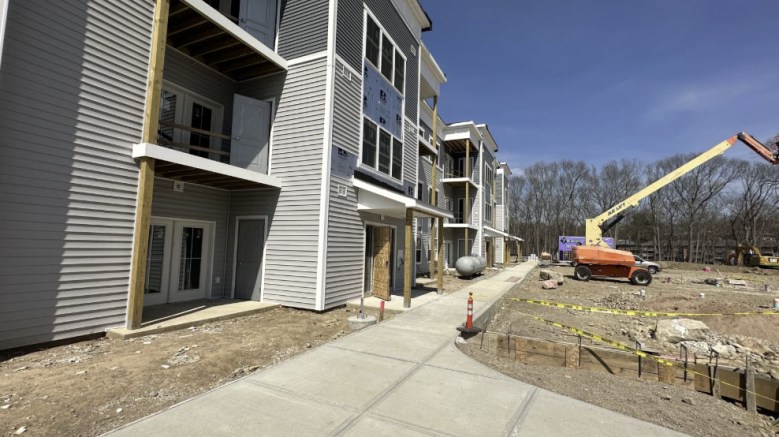
Connecticut’s congressional delegation voted Wednesday for federal legislation that aims to boost the supply of housing, the latest version of a bipartisan bill that has cut through the tense gridlock at a time when affordability is top of mind for Americans.
It’s the second time the House passed the bill, which has gone through a series of changes in recent months and had been stalled since March. It could once again face revisions as it makes its way back to the Senate before it can go to the president’s desk.
But the overwhelming margins of support in a deeply divided Congress, plus President Donald Trump’s endorsement, give the legislation some momentum. Supporters hope they can wrap it up this session, ahead of November’s midterm elections.
Cost of living issues remain a top priority for voters in both parties as they prepare for elections that could change the balance of power in Congress. Still, limited scheduling, upcoming recesses and priority bills like Republicans’ push for immigration funding could stand in the way.
All five Democratic lawmakers in the Connecticut delegation backed the 21st Century ROAD to Housing Act, which easily cleared the House in a 396-13 vote. All 13 opposed were Republicans.
The legislation, among other things, seeks to ease the construction of new homes, expand access to different types of housing and boost homeownership.
U.S. Rep. Joe Courtney, D-2nd District, called it a “rare bipartisan breakthrough.”
“Eastern Connecticut communities need more housing supply to meet demand and bring down costs. The 21st Century ROAD to Housing Act is a pragmatic package of federal reforms to generate new housing construction, expand affordable rental housing, prevent homelessness and bring homeownership within reach for Americans,” he said in a statement. “There is more work ahead for Congress to deliver robust investment into housing that capitalizes on the reforms made in this bill.”
Echoing Courtney, U.S. Rep. John Larson, D-1st District, praised passage of the bill, adding that more work needs to be done federally. He also invoked his upbringing in Mayberry Village, public housing in East Hartford where he grew up that has been an integral part of his story in politics.
“Growing up in Mayberry Village in East Hartford, my parents worked hard to afford and eventually own their home,” Larson said in a statement. “Unfortunately, today, as interest rates continue to skyrocket and the cost of living rises, the dream of homeownership feels increasingly out of reach for our nation’s young people, especially as residents are even getting priced out of their rentals.”
“This bill will spur rapid housing construction and expand access to affordable housing and homeownership opportunities, while putting real protections in place to protect renters from greedy, corporate landlords,” he added. “I will continue to focus on common-sense solutions to build more homes and bring down costs, including a Renter Tax Credit and new incentives to power the housing boom our nation needs.”
Changes to the legislation softened a provision that places limits on large institutional investors, which has been a priority for the president. And the House bill added new community banking rules that were sought after by Republicans — and could be an issue when the bill returns to the Senate.
The Senate version placed a ban on institutional investors who have 350 units or more from purchasing more single-family homes, with some exceptions. They would be able to build single-family housing to be used as rentals, otherwise known as build-to-rent, but those investors would need to sell those properties after seven years and give renters the first chance to buy. The House bill takes out the seven-year divestment.
Like the rest of the country, Connecticut has similarly suffered from a smaller supply of housing, coupled with high home prices and increases to the cost of building materials caused by the pandemic.
Connecticut has seen a small uptick in affordable housing over the years. Between 2011 and 2025, it increased by nearly 17%. But the state is seeing issues with rising housing costs that are playing out elsewhere in the U.S.
“This is the first time that we’ve been in this position of having bipartisan stakeholders come to the table to at least discuss many of these issues,” Amy Peltier, coalition and advocacy director at the Partnership for Strong Communities, said.
While there have been changes to the bill in recent months, Peltier feels optimistic about a number of the provisions, including a more streamlined process for inspections that allow people to use housing vouchers more quickly. She noted that administrative burdens have delayed or prevented them from getting into homes.
She also pointed to measures that encourage local solutions to address homelessness as well as more flexibility in funding to preserve older housing stock.
The Partnership for Strong Communities has been supportive of the bipartisan effort but noted when it came up for a vote in the Senate a couple of months ago that it would like to see Congress do more on rental assistance.
The next steps are unclear — whether the Senate will ultimately accept the House’s bill or negotiate a new version. The authors of the Senate bill had been pushing for the House to take up their legislation, but leadership is reportedly hinting that they could get behind the House.
Both of Connecticut’s U.S. senators, Richard Blumenthal and Chris Murphy, supported the Senate version in March. But at the time, Murphy said he still had some concerns regarding the new investor ban — a provision that had been recently added into it.
The intention of the provision is prevent corporate landlords from buying up single-family homes and potentially pricing out individual buyers. But he worries about the unintended consequences on other types of investors and choking off other housing options for the state, like rental properties.
Trump had been pushing for the House to rally behind the Senate’s version. But a day before the vote, he backed the House’s legislation and wants the Senate to take it up. He called on lawmakers to “resolve any remaining differences expeditiously.”
Peltier hopes Congress doesn’t let up on the issue, arguing that “we’re already years behind in what we need to accomplish” on housing.
“This as a positive step forward towards bipartisan support for a housing supply bill,” Peltier said. “In this environment, we really need to be bipartisan.”
“We really need that sort of national and statewide cohesion that I think we saw as a missed opportunity this last session,” she said, referring to the end of Connecticut’s General Assembly session. “We really hope that at the federal level we can make this work.”
The Connecticut Mirror/Connecticut Public Radio federal policy reporter position is made possible, in part, by funding from the Robert and Margaret Patricelli Family Foundation.
