



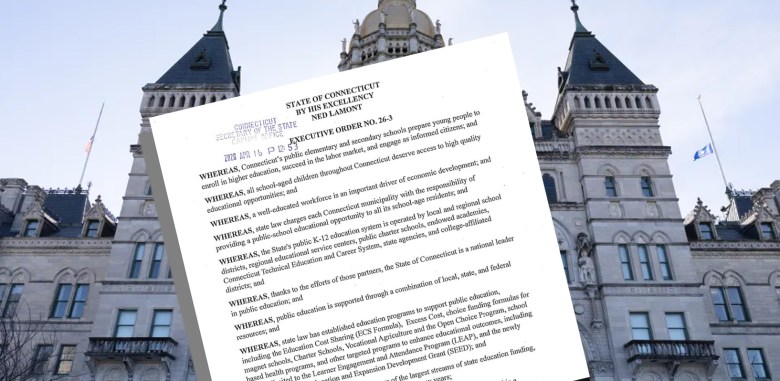
As drafted, Gov. Ned Lamont’s Executive Order establishing a Blue-Ribbon Commission on Education Funding and Accountability appears to limit the Commission’s remit to suggesting reforms to the state’s Education Cost Sharing (ECS) formula and other state programs that supplement local property taxes to fund our K-12 schools.
If the governor’s goal for this commission is to solve the fundamental problem with our K-12 financing system, this limited mission sets the commission up to fail.
Despite ECS funding, property-rich districts continue to spend more on their schools while taxing themselves at lower rates to pay for it.
My analysis of 149 of 169 K-12 districts based on 2023-24 data shows that even if the ECS were fully-funded at a foundation level of $16,000 per pupil (at the cost of an additional $1 billion in state income and consumption taxes) as some are advocating, average expenditure per pupil in the state’s 30 property-richest K-12 districts would still be 23% higher than in the 60 poorest districts. At the same time, the richest districts would pay property taxes to fund their schools (the “K-12 tax rate”) at less than half the rate of poorest ones.
This regressive taxation to pay for a public good is deeply problematic. To solve the problem, what is needed is not ECS reform but property tax reform. That is the only way to achieve “ZIP-code neutrality” in our K-12 financing system.

The commission needn’t look far for a model that would achieve this. In 1997, Vermont replaced local property taxation to fund its K-12 schools with a statewide K-12 property tax.
In the Vermont statewide property tax, local school districts approve school budgets and inform the state of the funding they need. The state calculates the statewide K-12 funding requirement and collects the needed revenue by levying property taxes on each town at a rate that is proportional to the expenditure per pupil the town proposes to fund. The higher the spending per pupil, the higher the tax rate and vice-versa.
This system is known as “equal funding for equal effort.” It preserves local control over K-12 budgets, but not over the property tax rates that fund them. Crucially, the equal funding formula would sever entirely the links among local property values, spending per pupil and K-12 tax rates. Equally important, the statewide property tax would achieve this while imposing no additional fiscal burden on the state.
The impact of this statewide property tax design on Connecticut K-12 districts would depend on the target spending per pupil and tax rates set by the state, and on districts’ expenditure-per-pupil choices. My analysis assumes spending and tax rate targets equal to the statewide averages for 2023-24: $19,625 and 1.65%. Assuming this, here’s what the statewide property tax would mean for a representative wealthy (Westport) district and a representative poor district (Waterbury):
- Westport’s 2023-24 property value per pupil was $2,017,000. Expense-per-pupil was $26,8604. Property taxes allocated to K-12 schools was 1.3% of property value per pupil. Under a Vermont-style tax, if Westport chose to maintain its 2023-24 expense per pupil, its state property tax rate would be 2%, the same as for any other district choosing to match Westport’s per-pupil spending.
- Waterbury’s 2023-24 property value per pupil was $255,000. Expense-per-pupil was $20,266 funded by a K-12 tax rate of 1.9%. Waterbury’s choices under the statewide tax would range between maintaining 2023-24’s expense-per-pupil, in which case the state property tax rate would fall to 7%; or maintaining the 2023-24 tax rate, in which case the expense per pupil would be $24,800, a 22% increase over 2023-24.
A similar picture emerges when we compare the statewide property tax’s impact on average expense per pupil and tax rates for the 30 districts in Q5 and in Q1.
- If wealthier districts chose to maintain 2023-24 expense per pupil, the average K-12 tax rate would increase from 1% to 2%. To minimize that rate increase, the wealthiest districts would have to reduce expense per pupil below 2023-24 levels.
- If the poorer districts chose to leave spending per pupil unchanged from 2023-24 levels, the average tax rate would fall from 2% to 1.5%. If these districts chose to maintain their 2023-24 tax rates, average expense per pupil would increase by 36%. By contrast, fully funding ECS would only increase the poorer districts’ expense per pupil by 13%, while requiring the state to raise an additional $1 billion in general revenue.
Property-owners in richer districts might object to a reform where a portion of their property taxes pays for the education of children outside their own district. It would be argued that this violates the principle of “local control” although. as noted, the Vermont statewide property tax preserves local control over school budgets.
In any case, K-12 school finance is already “socialized” to a degree. A portion of the property taxes paid by the owner of a $10 million home on Round Hill Road in Greenwich pays for the education of several children living in the town’s Chickahominy neighborhood. By moving to state K-12 property taxation, we would merely be extending the boundaries within which K-12 financing is socialized from the edge of town to the state line.
A more legitimate concern with the statewide property tax is the burden it would place on income-poor homeowners in property-rich districts. The solution to this problem would be to defer the state’s K-12 property tax obligation for these homeowners until they sell their homes or die. The state could issue revenue bonds secured by tax liens to fill the resulting temporary K-12 school revenue gaps.
In sum, the only reform that would sever the links among local property values, per-pupil spending and K-12 tax rates is a statewide property tax. Notwithstanding the limits of the governor’s charge to the commission, I urge it to give careful consideration to a statewide K-12 property tax.
Daniel Badger, Jr. lives in West Hartford. His full study on which this commentary is based, including references and data sources, is available here.