



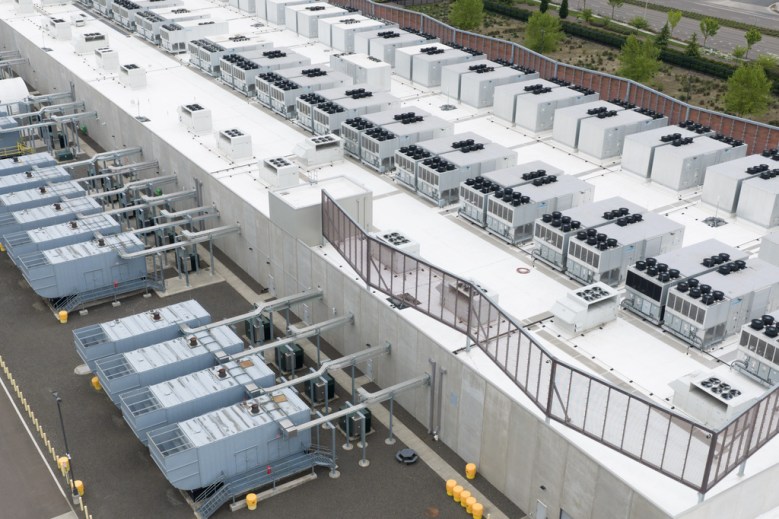
Headlines in Utah lately have read like a far-flung dystopian novel: “Outrage over Kevin O’Leary’s 40,000 acre data center” – “‘Hyperscale’ data center could create massive heat island near Great Salt Lake” – “Planned data center in Utah will consume more power than the entire state.” This project, approved despite ongoing protests, will be nearly four times the land area of Hartford (11,123 acres).
Connecticut residents should thank our lucky stars we need not face such a threat to our environment, public health, and quality of life.
But we could. Developers may well be courting our elected officials right now.
As the use of artificial intelligence explodes, so does the demand for data centers. Common sense tells us that Connecticut, as a small and densely populated state, would not be a good candidate to host these titanic computing factories. And yet, one could have made a similar argument that Utah is unsuitable for these water-guzzling facilities due to its chronic drought issues and the Great Salt Lake’s historic low water levels.
Data centers have been around for a long time in various forms, accommodating computing operations, cloud storage, or web hosting. Only recently has generative AI turned the industry on its head, spawning specialized “AI only” data centers that require exponentially more space. For instance, a traditional data center located in downtown Waterbury occupies just 3,000 square feet; compare that with a generative AI only facility currently under construction in Pennsylvania that will occupy 1.1 million square feet on a 78-acre campus.
And square footage isn’t the only thing these AI data centers are ravenous for: water and energy needs are monumental compared to their traditional counterparts. That’s because of how generative AI creates original content. In order to synthesize a single image of “cute corgi cuddling with baby duck,” literally millions of photos and text descriptions must be fetched and analyzed, not to mention the virtually infinite content that trained the AI to recognize those inputs.
Currently, Connecticut has a number of traditional data centers, but no AI only facilities.
Let’s not mince words: the environmental impact of these projects will be devastating. If the data center is considered “hyperscale,” so will be the associated loss of land, water consumption, fossil fuel usage, and noise and air pollution. Even facilities many times smaller than the Utah monstrosity can still easily consume resources on the scale of a town or small city.
Apologists will argue that data centers generate tax revenue, create jobs, and initiate positive ripple effects for local economies. Indeed, these enterprises promise a windfall for the investors and potentially the host communities. I am not in a position to make a financial argument against data centers (not to say it couldn’t be done, especially considering the borrowing habits of project funders). My objections are rooted in the resulting sacrifice zones, and the humans and wildlife that will suffer.
Like Maily Kocinski in Wisconsin, whose backyard creek turns milky, smells like chemicals, and occasionally dries up since the Beaver Dam data center began construction. Or Alexis Easter in Tennessee, who lives a block away from where 35 unpermitted methane turbines were discovered churning out air pollution to power one of Elon Musk’s data centers. Or Beverly and Jeff Morris in Georgia, who can no longer flush their toilet without manually filling the tank, thanks to the water consumption of the neighboring Meta data center.
What I wish more folks would understand is that by the time an application hits the desk of a permitting agency, it is often already too late. As long as the developer complies with the laws in place at the time of submission, there is relatively little leeway for regulators or commissioners to reject a compliant proposal.
Generally speaking, this is a good thing: it means that a single, articulable standard is applied to everyone, and that arbitrary motives (be those personal grudges or outright discrimination) cannot influence the outcome. But it also means that no matter how many residents write letters saying, “I purchased this house 40 years ago because of the beautiful view out my back window,” governments are constrained by their legal purview. Unless, of course, they want to open the taxpayers up to a costly lawsuit.
Fortunately, we are still in the “before the application hits the desk” stage, where a timely ounce of prevention can preclude the need for a pound of cure. Here are some measures we can take to limit the damage hyperscale data centers can do to our state.
- Reduce AI usage. Cutting back on AI usage reduces the demand for data centers. Just as some people choose not to eat animal products due to moral objections, we can refuse to use AI in our personal lives. Many environmentalists, artists, and academics around the world already do. And the benefits of kicking the habit go beyond data centers – our dangerous and ethically irresponsible dependence on AI can lead to addiction, a loss of critical thinking, and loneliness.
- Plan ahead. Enshrine your community’s values in relation to data centers and AI in your municipal Plan of Conservation and Development, the 10-year master plan each town is statutorily required to produce. While these plans are not enforceable, they send a strong message to developers about the appetite for a proposal.
- Zone ahead. Zoning, on the other hand, is enforceable. Standards related to building size, use, setbacks, and more can be adopted into zoning regulations through text amendments. The catch is that these regs must be in place before a proposal is under consideration.
- State legislative actions might include requiring an “AI Killswitch” that allows users to opt out of AI features with a single click; stipulating that data centers provide their own renewable energy and water at no cost to ratepayers; or even outright prohibiting AI data centers in our state. Of course, given that our lawmakers couldn’t even unanimously ban conversion therapy (Rob Sampson, I’m looking at you, buddy), I am not optimistic.
- Be careful about organizing. I am a vocal opponent of NIMBYism (or, when a neighborhood protests development proposed for “their backyard,” despite the fact that the world needs apartment buildings, warehouses, solar energy, etc.). Remember that if it’s not in your backyard, it’s in someone else’s. When a wealthy community successfully fends off a developer, the likely outcome involves the project to a disadvantaged area where the citizens may struggle to attend public hearings or pool money for a lawyer. How else can we explain that “nearly 80% of U.S. incinerators [are] located in marginalized communities” or that Consumer Reports found “people of color and low-income residents are disproportionately affected by Amazon’s warehouses?” So when we gather our torches and pitchforks to run a data center out of Greenwich, let’s be mindful that it may very well end in Bridgeport. This is why the most effective interventions will occur on the state (or, as long as I have my head in the clouds, federal) level, to ensure we are not simply shifting the burden to an under-resourced neighbor.
Data centers in Connecticut are not a foregone conclusion. We still have time to mitigate, if not altogether halt, the insidious creep of this hyperscale problem.
Christine O’Neill of Wolcott works as an environmental planner and holds a Masters in Energy and Environmental Management from the University of Connecticut.