This story has been updated.
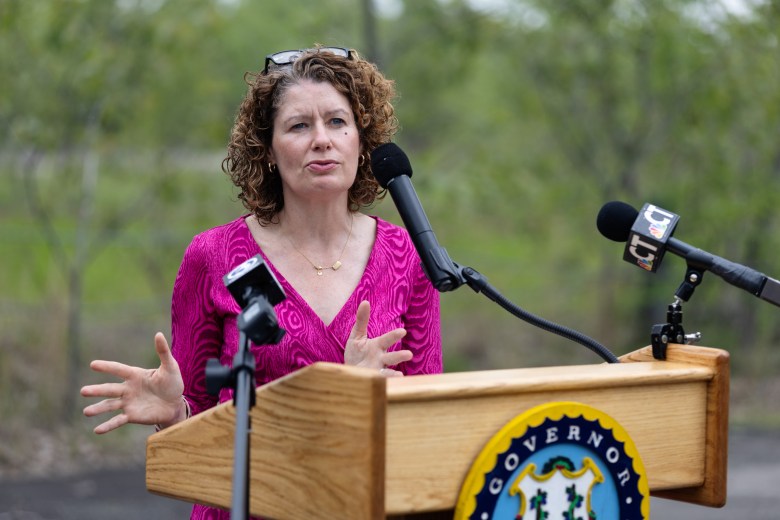
Connecticut Department of Energy and Environmental Protection Commissioner Katie Dykes will step down after nearly eight years as the head of the agency, she announced Friday.
Dykes, who was appointed by Gov. Ned Lamont in 2019, said it was her decision to leave and allow new leadership to take over. She said she plans to spend time with her family this summer and then “explore new professional opportunities” in the state.
DEEP Deputy Commissioner of Environmental Quality Emma Cimino will serve as the interim head of the agency starting in July, the governor’s office announced.
“For many years, Katie has been a trusted advisor and an innovative, effective leader for DEEP, working tirelessly to secure clean, affordable energy, tackle our toughest pollution challenges, modernize environmental regulation, and invest in our parks and natural resources, all while building a capable team that will carry the department’s mission forward,” Lamont said in a statement Friday.
He continued, “Deputy Commissioner Cimino is a skilled, experienced leader who knows DEEP well, and I appreciate her willingness to serve in this leadership position.”
During her tenure, Dykes oversaw efforts to reduce greenhouse gas emissions from power plants and vehicle exhaust, helped to negotiate a power purchase agreement with the owners of the Millstone Nuclear Power Station and revamped an antiquated program for the cleanup of old industrial properties.
She also navigated the agency’s response to the COVID-19 pandemic, which saw a surge in new visitors to state parks even as strict capacity limits were put in place.
In an interview Friday, Dykes said her role at DEEP had been a “dream job” as the daughter of an environmental science teacher who grew up in West Virginia.
“We’ve accomplished so much under Gov. Lamont’s leadership,” she said. “The governor is someone who’s been a strong supporter, both of affordable, clean, reliable energy, and of investing in the outdoors and environmental protection.”
Dykes also said she believes it’s time for new leadership to take over, and that building a “strong team” of people around her at DEEP has been the biggest accomplishment of her tenure.
“I think that it’s a good thing for DEEP, you know, to every now and then have the chance for new leadership to step up and to take the agency forward and into the next chapter, and so this feels like the right time for that transition to occur,” she said.
A graduate of Yale Law School, Dykes’s professional background is largely in energy policy and regulation, having served as the chair of the Public Utilities Regulatory Authority and the deputy commissioner of DEEP’s Energy Division under former Gov. Dannel P. Malloy.
That focus, however, sometimes put her at odds with environmental activists who wanted to see the state government move more forcefully to address climate change and lower greenhouse gas emissions.
“She saw some incremental steps forward, but was unable to shake the stranglehold that the fossil fuel interests have on our state,” said Sam Dynowski, the president of the Connecticut chapter of the Sierra Club.
Connecticut did successfully meet its initial target for lowering CO2 emissions in 2020, but that milestone was largely attributed to the pandemic keeping many cars off the road for a year. In the years since then, overall emissions have increased.
During Lamont’s first term, Dykes supported joining a multistate effort, known as the Transportation Climate Initiative, aimed at using incentives to lower emissions from motor vehicles. Lamont was ultimately forced to back down from that plan after opponents labeled it a “gas tax.”
Later, in Lamont’s second term, a bipartisan group of lawmakers helped to defeat an effort backed by DEEP to adopt a timeline to phase out the sale of new, gas-powered vehicles by 2035.
Lori Brown, the president of the Connecticut League of Conservation Voters, said that Dykes was often the leading voice within the administration pushing for those programs.
“The politics really killed a lot,” Brown said.
In 2023, Republican lawmakers also attempted to block Dykes’s reappointment due to a spat over her agency’s implementation of updates to the state’s bottle deposit program. DEEP interpreted the expansion to cover hard seltzers made with spirits, which lawmakers said had not been their intent despite failing to define hard seltzers in the law.
“Overall there’s certainly been policy issues we have conflicted over,” House Minority Leader Vincent Candelora, R-North Branford, said Friday. However, he said those disagreements never resulted in him questioning her ability to manage the agency.
“I think she was always advancing the policies that were given to her,” he said.
The last year has also brought new challenges to DEEP from President Donald Trump’s efforts to roll back longstanding federal regulations aimed at ensuring cleaner air and water and protecting the environment.
Twice, the federal government has sought to halt work on the offshore Revolution Wind project, which is contracted to supply power to Connecticut and Rhode Island. Dykes, working with the attorneys general in both states, sued to overturn the Trump administration’s actions in federal court.
“This has been an extraordinary assault on our environment, and on public health,” Dykes said Friday. “But I have to say, over these two years, I’ve been incredibly proud of the way that we’ve been able to… work with Gov. Lamont in standing up for clean energy.”
This story was updated with comments from several advocates and lawmakers.