


Carrie Frail was in the process of leaving an abusive relationship when she discovered she was pregnant. Her partner told her he could hit her in the stomach until she had a miscarriage, and it would save some money.
“I firmly believe he would have killed me at some point, whether accidentally or intentionally,” Frail said.
She had a medication abortion at a Planned Parenthood clinic in St. Louis, Missouri, in 2008 while serving in the U.S. Air Force. She was relieved to have the option of using medication instead of a procedure, and it let her take less time off work. It wasn’t an easy decision, she said, but she knew if she hadn’t done it, she never would have been able to get away from that partner.
“I was too wrapped up mentally and emotionally in my life with him that … I needed to be able to leave without giving him a phone number or letting him know where I was,” Frail said. “I still believe that an abortion saved my life.”
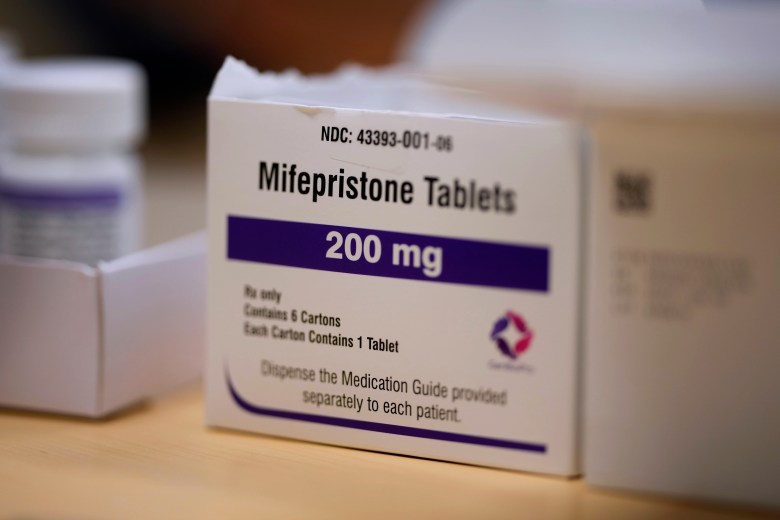
Access to telehealth prescriptions of mifepristone, one of two drugs used to terminate a pregnancy in the first trimester or to treat miscarriages, is threatened by an ongoing lawsuit in Louisiana. That state government has sued the U.S. Food and Drug Administration, trying to strike down the agency’s 2023 rule allowing the medication to be dispensed without an in-person visit.
Researchers, advocates and survivors of domestic violence say it’s vital to keep telehealth access available for people in abusive relationships who need discreet abortion options. The Louisiana lawsuit, however, argues in part that mifepristone has been weaponized against pregnant women in abusive relationships and shouldn’t be available by telehealth.
The 5th U.S. Circuit Court of Appeals temporarily blocked the FDA’s 2023 rule in early May, making in-person visits required for mifepristone prescriptions for two days before the U.S. Supreme Court paused that decision on emergency appeal. The court, with the exceptions of Justices Samuel Alito and Clarence Thomas, decided to keep the rule in place while the appeals case proceeds. But the rule could still be struck down again later, and the full case may end up in front of the Supreme Court.
Data from the federal Centers for Disease Control and Prevention’s National Intimate Partner and Sexual Violence Survey from 2023-24 showed about 34% of women and 17% of men experienced physical or sexual violence or stalking by an intimate partner. Those figures could be higher because of hesitance to report incidents of abuse. States with high rates of violence include many with near-total abortion bans, including Arkansas, Indiana, Oklahoma, Tennessee and West Virginia — meaning residents who are victims of reproductive coercion have less access to abortion medication.
Pregnancy is a time of heightened risk in a relationship with domestic abuse, according to research, and intimate partner violence is a leading non-obstetric related cause of death among pregnant and postpartum women. Those risks are highest among Black and Indigenous people in the United States.
Reproductive coercion
The lawsuit over mifepristone access includes Louisiana resident Rosalie Markezich as a plaintiff, who says the availability of the drug without an in-clinic visit allowed her boyfriend to order the pills in 2023 and pressure her to take them. In her written statement in the case, Markezich said the pressure caused ongoing trauma, and that if she’d had to see a doctor beforehand, she could have told the provider she didn’t want an abortion and the pills would never have been prescribed.
Anti-abortion groups, including Susan B. Anthony Pro-Life America and Family Research Council, submitted amicus briefs to the U.S. Supreme Court about the type of coercion Markezich said she experienced. The telehealth option prevents in-person screenings for coercion, Susan B. Anthony Pro-Life America said, and the in-person requirement provided “a line of defense” against reproductive coercion. Family Research Council also argued that because the FDA’s initial approval of the telehealth provision did not include a thorough study of how it could be used for coercion, it should be struck down.
Liz Tobin-Tyler, professor of health services, policy and practice at the Brown University School of Public Health, said people in abusive relationships very commonly experience what researchers call reproductive coercion. According to the American College of Obstetricians and Gynecologists, that includes situations in which a partner tries to control when and how pregnancy occurs, either by intentionally causing a pregnancy or forcing someone to end it, as with Markezich.
Coercion can also occur when a partner interferes with contraceptive methods, such as trying to force the use of a certain method or intentionally failing to use contraception. Tobin-Tyler said sometimes the abusive partner attends medical appointments to try to influence decisions related to birth control and other medical care discussions.
“It all comes back to that aspect of control,” she said.
Robin Turner, Montana director at gender equity organization Legal Voice, said what happened to Markezich was terrible, but that Louisiana could prosecute Markezich’s partner under existing laws, including harm induced by drugs. She said reinstating the in-person requirement for mifepristone would harm many other people because it would apply nationwide.
“It’s not a reasonable or proportional way to address what happened to the client,” Turner said. “We have to take what happened to the plaintiff seriously — and understand that taking that (access) away is not effective.”
Turner co-authored a brief for Legal Voice submitted to the U.S. Supreme Court during the emergency appeal proceedings that centered on the importance of access to mifepristone for people in relationships marked by domestic violence.
“A lot of what being in these relationships is about is your world getting smaller, and we don’t want our systems to imitate the dynamics of abuse. But that’s what happens when the government takes away the access to the healthcare that they need,” Turner told Stateline.
Safety planning for hotline callers
Kaelah Oberdorf, 24, said she was on birth control when she discovered she was pregnant in 2023 in upstate New York.
She was in an emotionally abusive relationship, struggling financially and still recovering from the postpartum depression she experienced after having her first child when she was 20, despite thinking that she couldn’t get pregnant because of a medical condition. The depression was so severe she had to be hospitalized. She decided that ending the pregnancy was the right thing to do for her mental health and the daughter she already had.
“I didn’t want to be tied to him for life, I didn’t want my daughter, or any of my children, to be tied to him for life,” said Oberdorf, who now lives in Georgia. “I already had a living child who did not need to be kept in that situation, and if I’d had another one, even if I left him, I mentally would not have been able to handle it.”
Research also shows that pregnant and postpartum women in rural areas experience higher rates of intimate partner violence, possibly because they’re farther from in-person medical care, which could contribute to lower rates of preventive screenings for abuse.
Elizabeth Ling, associate director of legal services at nonprofit hotline If/When/How, which offers reproductive legal aid, estimated the hotline receives between five and 10 calls a week from people who talk about experiencing intimate partner violence, whether it’s physical, emotional or some form of coercion. She said callers in rural communities are some of those who need access to medication abortion by telehealth and via mail because they are often the furthest away from a clinic and can’t travel because a partner is actively watching their movements.
If/When/How talks callers through their legal options and counsels them about legal risks, which Ling said is a top concern for people in abusive relationships. It’s common for them to be fearful of their partner reporting them for having an abortion, which can bring unwanted attention from police and investigations even if it doesn’t result in charges.
The hotline also helps people make a safety plan for receiving abortion medication, talking through steps such as where medication will be mailed, who has access to that mailbox and how to navigate a situation with a partner tracking their movements.
“Abortion pills really are a lifeline for those who call and share their experiences with us,” Ling said.
Frail, who still lives in Missouri, now has a daughter and a son who are in their 20s. She has left many voicemail messages recently for Republican U.S. Sens. Josh Hawley and Eric Schmitt, who have advocated for the withdrawal of FDA approval for mifepristone and called for federal investigations into drug manufacturers. In her messages, she says that being able to choose when she had her children made her a better parent.
“I know if I had not had an abortion, I would not have ever been able to get away from that abusive partner,” Frail said.