


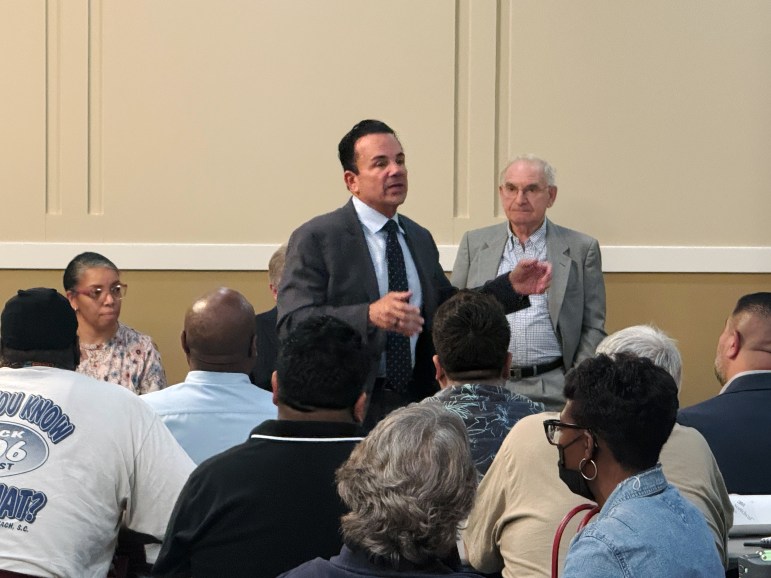
At a meeting of Bridgeport’s Democratic Town Committee in late May, the 90-member body heard a series of speeches from party nominees seeking to represent city residents in the state legislature. Then they voted to endorse incumbent state Rep. Christopher Rosario in his run for another term this November.
Political party committees like this one, in cities and towns all over Connecticut, are responsible for deciding which local candidates will carry their party’s endorsement on the ballot.
And in Bridgeport, where Democrats outnumber Republicans by a wide margin and Democratic primaries often determine who ultimately wins elected office, the DTC occupies an influential position. Its endorsements shape political races for top leadership positions in both local and state offices.
“The town committee is super powerful,” said Callie Heilmann, a committee member representing the city’s 130th District and cofounder of Bridgeport Generation Now — a grassroots social action and civic engagement network fighting to undo systemic racism, corruption, and political exclusion in the city. Heilmann believes the DTC’s influence is far greater than most residents realize.
Yet for all its influence, the DTC remains largely invisible to many residents. Few voters attend committee meetings let alone know who their district’s representatives are. Fewer still understand how party endorsements are made or why they matter.
That perceived lack of transparency has led some Democrats — including Heilmann — to question the motives of the committee’s longtime chairman, Mario Testa.
To Heilmann, the party’s endorsements appear driven more by loyalty than by established criteria against which each resident can evaluate the candidates. “The people are nowhere in the picture,” she said.
But Testa and others say the committee has helped to unify the local Democratic party, elect strong candidates and secure financial resources for Bridgeport.
“We got money from the state,” Testa said, pointing to recent education grants the city’s delegation helped negotiate in the state budget.
In response to calls for more transparency, Testa said much of the information people are asking for is readily available online. “You go on the internet, Facebook, and you’ll get all the information,” he said.
Reputation matters
Bridgeport’s DTC is made up of 90 elected members from across the city’s 10 council districts. Each district elects nine committee members who are tasked with representing Democrats in their neighborhoods and participating in the endorsement process.
“When it comes to getting the word out for various candidates, whether it’s your local city council or all the way up to president, your local DTC is the workhorse side of the party,” Rep. Rosario said.
The committee was designed to serve as the hyperlocal face of the Democratic party, connecting neighborhoods to candidates and voters to government. Whether it is fulfilling that mission is a matter of intense debate.
Some city leaders acknowledge that the committee’s reputation has suffered as its motives have been questioned.
“I think the reputation is not a good look for us,” said City Council President Jeanetter Herron. “I’ve seen it decline as the years go on.”
Herron said she believes committee members can play a role in improving the public perception — particularly by being more active in their communities, assisting local candidates, registering voters and maintaining relationships in the neighborhood.
“When you have nine people and you have six of them not doing anything, that’s what’s happened,” she said.
State Rep. Rosario pointed to what he sees as a broader issue behind city residents’ frustrations with transparency and influence within the DTC: a collapse in public trust toward government and politics.
He said he sees evidence of this in how difficult it can be to convince residents to participate in public meetings or run for office. “It’s just so hard to attract folks to get involved civically,” he said.
Rosario, who has been involved in Bridgeport politics for more than two decades, rejected the notion that insider influence is unique to his city. “Bridgeport just happens to be in the spotlight,” he said. “But if you look across Connecticut, there are power structures and political organizations everywhere.”
He said he thinks the committee is actually more open today than it was when he first became involved in politics. “When I was coming up, it was much harder to break in,” Rosario said.
Heilmann, who was elected as part of a newer generation of committee members seeking reforms, said there’s still room for improvement. The more transparent the organization, the more accessible it could become for people who have felt left out of its decision-making, the theory goes.
Heilmann said the committee needs to clarify its standards for evaluating candidates, establishing clear policy goals and expectations rather than relying on information relationships or political allegiances.
“You would think that all 10 districts in Bridgeport have a written platform or written issues or certain criteria that they’re using,” she said. “That’s not how the district plays.”
At least not yet.
Heilmann and others have suggested having candidates complete questionnaires and interviews. Her own district has already implemented some of these processes.
